QUESTION IMAGE
Question
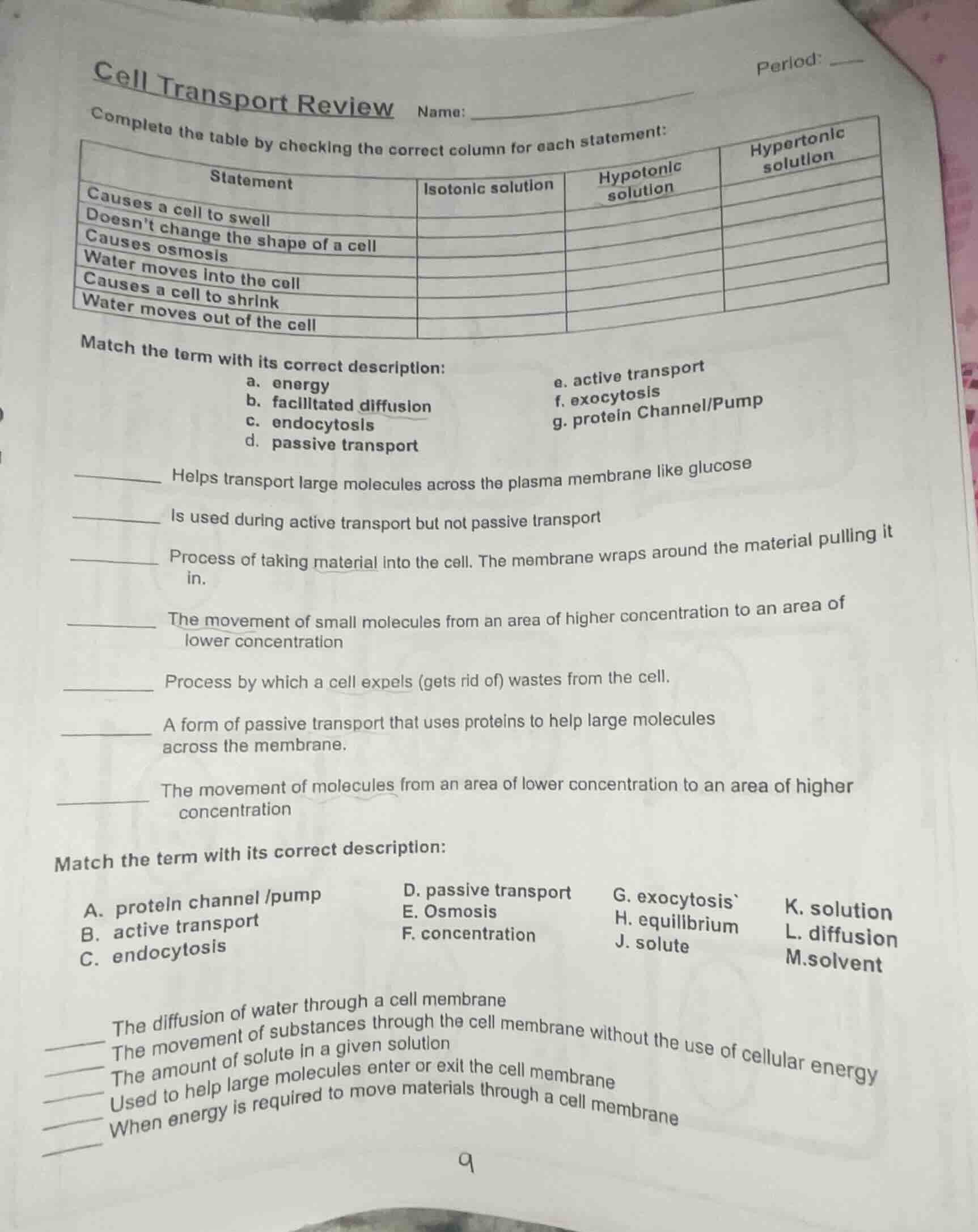
cell transport reviewname: _______________________ period: _complete the table by checking the correct column for each statement:|statement|isotonic solution|hypotonic solution|hypertonic solution|| ---- | ---- | ---- | ---- ||causes a cell to swell| | | ||doesnt change the shape of a cell| | | ||causes osmosis| | | ||water moves into the cell| | | ||causes a cell to shrink| | | ||water moves out of the cell| | | |match the term with its correct description:a. energyb. facilitated diffusionc. endocytosisd. passive transporte. active transportf. exocytosisg. protein channel/pump_____ helps transport large molecules across the plasma membrane like glucose___ is used during active transport but not passive transport___ process of taking material into the cell. the membrane wraps around the material pulling it in.___ the movement of small molecules from an area of higher concentration to an area of lower concentration___ process by which a cell expels (gets rid of) wastes from the cell.___ a form of passive transport that uses proteins to help large molecules across the membrane.___ the movement of molecules from an area of lower concentration to an area of higher concentrationmatch the term with its correct description:a. protein channel /pumpb. active transportc. endocytosisd. passive transporte. osmosisf. concentrationg. exocytosis`h. equilibriumj. solutek. solutionl. diffusionm.solvent___ the diffusion of water through a cell membrane___ the movement of substances through the cell membrane without the use of cellular energy___ the amount of solute in a given solution___ used to help large molecules enter or exit the cell membrane_____ when energy is required to move materials through a cell membrane
Table Completion:
- A hypotonic solution has a lower solute concentration than the cell, so water moves in, making the cell swell.
- An isotonic solution has equal solute concentration to the cell, so no shape change occurs.
- Osmosis (water movement across a membrane) happens in all three solution types due to concentration gradients.
- Water moves into the cell in a hypotonic solution.
- A hypertonic solution has a higher solute concentration than the cell, so water moves out, making the cell shrink.
- Water moves out of the cell in a hypertonic solution.
First Matching Section:
- Protein channels/pumps assist large molecules like glucose across the membrane.
- Energy (ATP) is only used in active transport, not passive.
- Endocytosis is the process of the cell membrane wrapping around material to bring it into the cell.
- Passive transport is the movement of small molecules down a concentration gradient (high to low) without energy.
- Exocytosis is the process of the cell expelling wastes via membrane vesicles.
- Facilitated diffusion is passive transport that uses proteins for large molecules.
- Active transport moves molecules against their concentration gradient (low to high) using energy.
Second Matching Section:
- Osmosis is the specific diffusion of water across a cell membrane.
- Passive transport is movement across the membrane without cellular energy.
- Concentration refers to the amount of solute in a given solution.
- Protein channels/pumps help large molecules cross the cell membrane.
- Active transport requires cellular energy to move materials against a gradient.

Snap & solve any problem in the app
Get step-by-step solutions on Sovi AI
Photo-based solutions with guided steps
Explore more problems and detailed explanations
Completed Table:
| Statement | Isotonic solution | Hypotonic solution | Hypertonic solution |
|---|---|---|---|
| Doesn't change the shape of a cell | ✅ | ||
| Causes osmosis | ✅ | ✅ | ✅ |
| Water moves into the cell | ✅ | ||
| Causes a cell to shrink | ✅ | ||
| Water moves out of the cell | ✅ |
First Matching (Terms a-g):
- g. protein Channel/Pump
- a. energy
- c. endocytosis
- d. passive transport
- f. exocytosis
- b. facilitated diffusion
- e. active transport
Second Matching (Terms A-M):
- E. Osmosis
- D. passive transport
- F. concentration
- A. protein channel /pump
- B. active transport