QUESTION IMAGE
Question
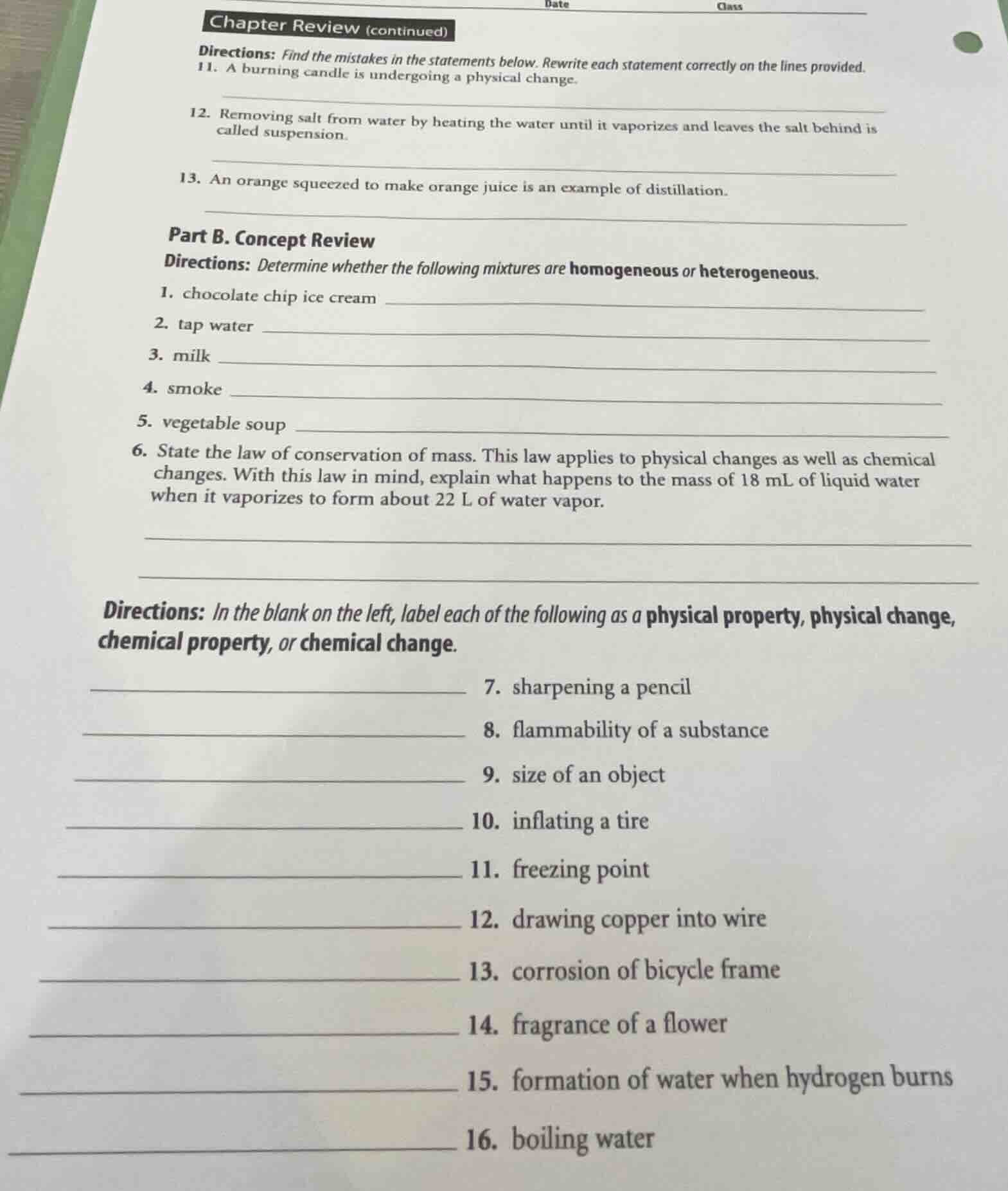
chapter review (continued)directions: find the mistakes in the statements below. rewrite each statement correctly on the lines provided.11. a burning candle is undergoing a physical change.12. removing salt from water by heating the water until it vaporizes and leaves the salt behind is called suspension.13. an orange squeezed to make orange juice is an example of distillation.part b. concept reviewdirections: determine whether the following mixtures are homogeneous or heterogeneous.1. chocolate chip ice cream2. tap water3. milk4. smoke5. vegetable soup6. state the law of conservation of mass. this law applies to physical changes as well as chemical changes. with this law in mind, explain what happens to the mass of 18 ml of liquid water when it vaporizes to form about 22 l of water vapor.directions: in the blank on the left, label each of the following as a physical property, physical change, chemical property, or chemical change.7. sharpening a pencil8. flammability of a substance9. size of an object10. inflating a tire11. freezing point12. drawing copper into wire13. corrosion of bicycle frame14. fragrance of a flower15. formation of water when hydrogen burns16. boiling water
Step1: Correct statement 11
A burning candle is undergoing a chemical change.
Step2: Correct statement 12
Removing salt from water by heating the water until it vaporizes and leaves the salt behind is called evaporation.
Step3: Correct statement 13
An orange squeezed to make orange juice is an example of physical change.
Step4: Classify mixture 1
chocolate chip ice cream: heterogeneous
Step5: Classify mixture 2
tap water: homogeneous
Step6: Classify mixture 3
milk: homogeneous
Step7: Classify mixture 4
smoke: heterogeneous
Step8: Classify mixture 5
vegetable soup: heterogeneous
Step9: Answer law of conservation question
Law of conservation of mass: Mass is neither created nor destroyed in a closed system during physical or chemical changes. When 18 mL of liquid water vaporizes, the mass of the water vapor equals the mass of the original liquid water; the change in volume is due to a change in state, not a change in the amount of matter.
Step10: Label item 7
physical change: sharpening a pencil
Step11: Label item 8
chemical property: flammability of a substance
Step12: Label item 9
physical property: size of an object
Step13: Label item 10
physical change: inflating a tire
Step14: Label item 11
physical property: freezing point
Step15: Label item 12
physical change: drawing copper into wire
Step16: Label item 13
chemical change: corrosion of bicycle frame
Step17: Label item 14
physical property: fragrance of a flower
Step18: Label item 15
chemical change: formation of water when hydrogen burns
Step19: Label item 16
physical change: boiling water

Snap & solve any problem in the app
Get step-by-step solutions on Sovi AI
Photo-based solutions with guided steps
Explore more problems and detailed explanations
- A burning candle is undergoing a chemical change.
- Removing salt from water by heating the water until it vaporizes and leaves the salt behind is called evaporation.
- An orange squeezed to make orange juice is an example of physical change.
Part B:
- heterogeneous
- homogeneous
- homogeneous
- heterogeneous
- heterogeneous
- Law of conservation of mass: Mass is neither created nor destroyed in a closed system during physical or chemical changes. When 18 mL of liquid water vaporizes, the mass of the water vapor is equal to the mass of the original liquid water; the large increase in volume is just a result of the water changing from a liquid to a gaseous state, with no addition or loss of matter.
Property/Change Labels:
- physical change
- chemical property
- physical property
- physical change
- physical property
- physical change
- chemical change
- physical property
- chemical change
- physical change