QUESTION IMAGE
Question
in a chemical process, the atoms in the reactants are arranged differently than they are in the products. for these atoms to be rearranged, the bonds between some of the atoms in the reactants must be broken. the disconnected atoms can now form new bonds with other atoms, producing substances with different arrangements of atoms. these substances are the products.
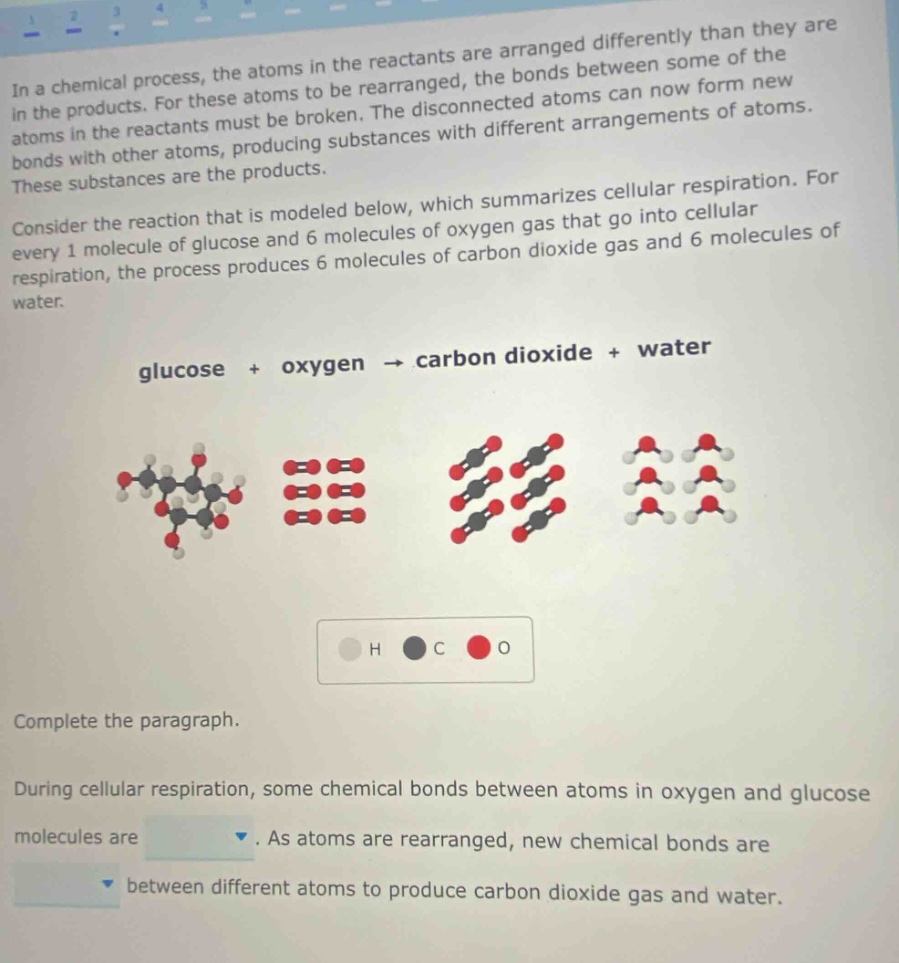
consider the reaction that is modeled below, which summarizes cellular respiration. for every 1 molecule of glucose and 6 molecules of oxygen gas that go into cellular respiration, the process produces 6 molecules of carbon dioxide gas and 6 molecules of water.
glucose + oxygen → carbon dioxide + water
images of glucose, oxygen, carbon dioxide, and water molecules with a key for h, c, o
complete the paragraph.
during cellular respiration, some chemical bonds between atoms in oxygen and glucose molecules are dropdown. as atoms are rearranged, new chemical bonds are dropdown between different atoms to produce carbon dioxide gas and water.
The text explains that in a chemical process (here, cellular respiration), bonds in reactants (oxygen and glucose) must be broken for atoms to rearrange, and then new bonds form to make products (carbon dioxide and water). So the first blank relates to breaking bonds, and the second to forming bonds. From the context: "the bonds between some of the atoms in the reactants must be broken" and "the disconnected atoms can now form new bonds". So the first word is "broken" (since bonds in reactants are broken) and the second is "formed" (new bonds are formed between rearranged atoms).

Snap & solve any problem in the app
Get step-by-step solutions on Sovi AI
Photo-based solutions with guided steps
Explore more problems and detailed explanations
First blank: broken
Second blank: formed