QUESTION IMAGE
Question
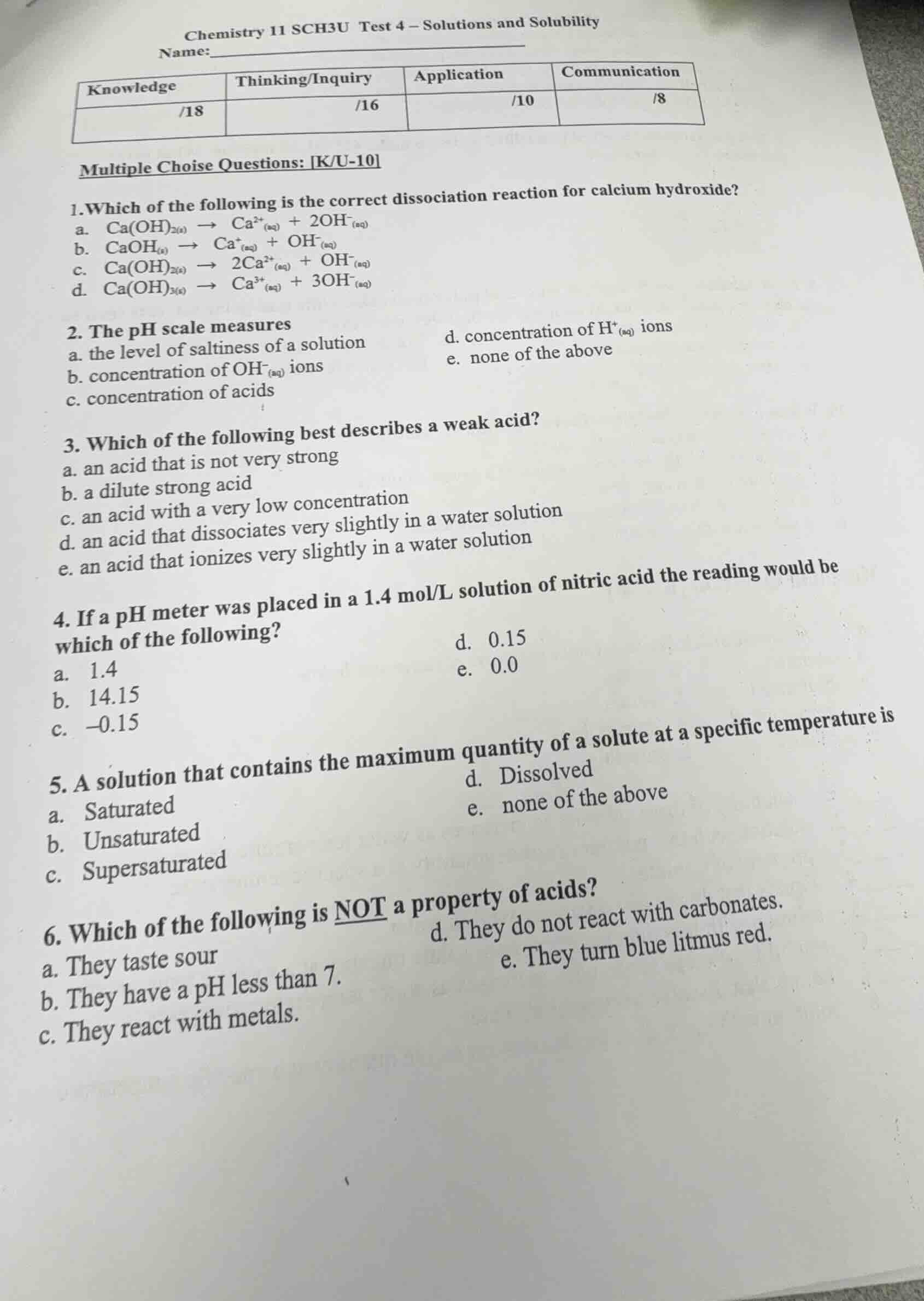
chemistry 11 sch3u test 4 – solutions and solubility
name:_____________________________
multiple choise questions: k/u-10
- which of the following is the correct dissociation reaction for calcium hydroxide?
a. $\ce{ca(oh)_{2(s)} \
ightarrow ca^{2+}_{(aq)} + 2oh^{-}_{(aq)}}$
b. $\ce{caoh_{(s)} \
ightarrow ca^{+}_{(aq)} + oh^{-}_{(aq)}}$
c. $\ce{ca(oh)_{2(s)} \
ightarrow 2ca^{2+}_{(aq)} + oh^{-}_{(aq)}}$
d. $\ce{ca(oh)_{3(s)} \
ightarrow ca^{3+}_{(aq)} + 3oh^{-}_{(aq)}}$
- the ph scale measures
a. the level of saltiness of a solution
b. concentration of $\ce{oh^{-}_{(aq)}}$ ions
c. concentration of acids
d. concentration of $\ce{h^{+}_{(aq)}}$ ions
e. none of the above
- which of the following best describes a weak acid?
a. an acid that is not very strong
b. a dilute strong acid
c. an acid with a very low concentration
d. an acid that dissociates very slightly in a water solution
e. an acid that ionizes very slightly in a water solution
- if a ph meter was placed in a 1.4 mol/l solution of nitric acid the reading would be which of the following?
a. 1.4
b. 14.15
c. $-0.15$
d. 0.15
e. 0.0
- a solution that contains the maximum quantity of a solute at a specific temperature is
a. saturated
b. unsaturated
c. supersaturated
d. dissolved
e. none of the above
- which of the following is not a property of acids?
a. they taste sour
b. they have a ph less than 7.
c. they react with metals.
d. they do not react with carbonates.
e. they turn blue litmus red.
Question 1
Calcium hydroxide has the formula \( \text{Ca(OH)}_2 \). When it dissociates, it should produce one \( \text{Ca}^{2+} \) ion and two \( \text{OH}^- \) ions. Option a shows \( \text{Ca(OH)}_{2(\text{s})}
ightarrow \text{Ca}^{2+}_{(\text{aq})} + 2\text{OH}^-_{(\text{aq})} \), which is correct. Option b has the wrong formula for calcium hydroxide (should be \( \text{Ca(OH)}_2 \), not \( \text{CaOH} \)) and wrong charge on Ca. Option c has incorrect stoichiometry (2 \( \text{Ca}^{2+} \) instead of 1). Option d has the wrong formula (should be \( \text{Ca(OH)}_2 \), not \( \text{Ca(OH)}_3 \)) and wrong charge on Ca.
The pH scale is defined as \( \text{pH} = -\log[\text{H}^+] \), so it measures the concentration of \( \text{H}^+_{(\text{aq})} \) ions. Option a is incorrect (saltiness is related to salt concentration, not pH). Option b is incorrect (pOH measures \( \text{OH}^- \) concentration). Option c is incorrect (pH measures \( \text{H}^+ \) concentration, not acid concentration directly). Option d is correct.
A weak acid is one that ionizes (dissociates) very slightly in water. Option a is too vague. Option b is incorrect (a dilute strong acid is still a strong acid, just less concentrated). Option c is incorrect (concentration and strength are different; a weak acid can be concentrated or dilute). Option d says "dissociates very slightly" and option e says "ionizes very slightly" – both are correct in meaning, but the standard definition refers to ionization (which includes dissociation for acids). However, among the options, e is a more precise definition as "ionizes" is the term used for acid behavior. Wait, no – actually, "dissociate" and "ionize" are often used interchangeably here. Wait, let's check: a weak acid ionizes (dissociates) only partially in water. So option d: "an acid that dissociates very slightly in a water solution" and option e: "an acid that ionizes very slightly in a water solution" – both are correct, but maybe the intended answer is e? Wait, no, maybe I made a mistake. Wait, the key is that weak acids have low ionization (dissociation) in water. So between d and e, "ionizes" is more accurate for acids (since acids donate protons, ionize to form \( \text{H}^+ \) and conjugate base). So option e is better? Wait, no, let's check the options again. Option d: "dissociates very slightly" – dissociation is the separation into ions, which is what happens. Option e: "ionizes very slightly" – ionization is the process of forming ions, which is the same as dissociation for acids. But maybe the answer is e? Wait, no, maybe the intended answer is d or e. Wait, actually, in chemistry, the term "ionize" is often used for acids (since they produce \( \text{H}^+ \) ions), so a weak acid ionizes slightly. So option e is correct. Wait, but let's check the options again: option d: "dissociates very slightly in a water solution" – dissociation is the breaking into ions, which is what acids do. Option e: "ionizes very slightly in a water solution" – ionization is the formation of ions, which is the same. But maybe the answer is e? Wait, no, maybe the answer is d? Wait, I think the standard definition is that a weak acid dissociates (ionizes) only partially in water. So both d and e are similar, but maybe the intended answer is e? Wait, no, let's see the options again. Option d: "dissociates very slightly" – dissociation is the process, and option e: "ionizes very slightly" – ionization is the process. But in the context of acids, ionization is the correct term (since acids are proton donors, and ionization involves the formation of \( \text{H}^+ \) ions). So option e is correct.

Snap & solve any problem in the app
Get step-by-step solutions on Sovi AI
Photo-based solutions with guided steps
Explore more problems and detailed explanations
a. \( \text{Ca(OH)}_{2(\text{s})}
ightarrow \text{Ca}^{2+}_{(\text{aq})} + 2\text{OH}^-_{(\text{aq})} \)