QUESTION IMAGE
Question
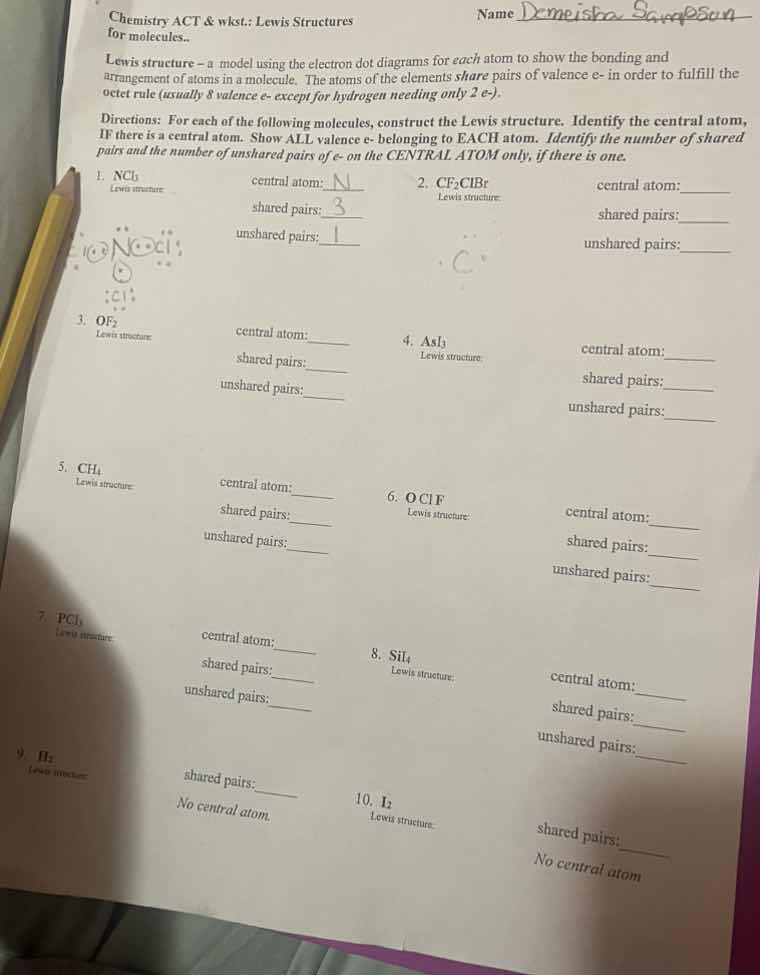
chemistry act & wkst: lewis structures for molecules.
lewis structure – a model using the electron dot diagrams for each atom to show the bonding and arrangement of atoms in a molecule. the atoms of the elements share pairs of valence e- in order to fulfill the octet rule (usually 8 valence e- except for hydrogen needing only 2 e-).
directions: for each of the following molecules, construct the lewis structure. identify the central atom, if there is a central atom. show all valence e- belonging to each atom. identify the number of shared pairs and the number of unshared pairs of e- on the central atom only, if there is one.
- ncl₃
lewis structure
central atom: n
shared pairs: 3
unshared pairs: 1
- cf₂clbr
lewis structure
central atom:
shared pairs:
unshared pairs:
- of₂
lewis structure
central atom:
shared pairs:
unshared pairs:
- asi₃
lewis structure
central atom:
shared pairs:
unshared pairs:
- ch₄
lewis structure
central atom:
shared pairs:
unshared pairs:
- oclf
lewis structure
central atom:
shared pairs:
unshared pairs:
- pcl₃
lewis structure
central atom:
shared pairs:
unshared pairs:
- sih₄
lewis structure
central atom:
shared pairs:
unshared pairs:
- h₂
lewis structure
shared pairs:
no central atom.
- i₂
lewis structure
shared pairs:
no central atom
Step1: Find central atom (least EN)
Central atom is the least electronegative element (except H).
Step2: Count total valence electrons
Sum valence e⁻ of all atoms.
Step3: Draw single bonds, assign e⁻
Form bonds, distribute remaining e⁻ to satisfy octet (H=2 e⁻).
Step4: Count shared/unshared pairs
Shared pairs = bonds; unshared = lone pairs on central atom.
---
2. $CF_2Cl_2$
Step1: Identify central atom
Least EN: C
Step2: Total valence e⁻
$4 + 2(7) + 2(7) = 32$
Step3: Draw Lewis structure
C bonded to 2 F, 2 Cl; each has 3 lone pairs.
Step4: Count pairs
Shared pairs: 4; Unshared pairs on C: 0
---
3. $OF_2$
Step1: Identify central atom
Least EN: O
Step2: Total valence e⁻
$6 + 2(7) = 20$
Step3: Draw Lewis structure
O bonded to 2 F; O has 2 lone pairs, each F has 3.
Step4: Count pairs
Shared pairs: 2; Unshared pairs on O: 2
---
4. $AsI_3$
Step1: Identify central atom
Least EN: As
Step2: Total valence e⁻
$5 + 3(7) = 26$
Step3: Draw Lewis structure
As bonded to 3 I; As has 1 lone pair, each I has 3.
Step4: Count pairs
Shared pairs: 3; Unshared pairs on As: 1
---
5. $CH_4$
Step1: Identify central atom
Least EN: C
Step2: Total valence e⁻
$4 + 4(1) = 8$
Step3: Draw Lewis structure
C bonded to 4 H; no lone pairs on C.
Step4: Count pairs
Shared pairs: 4; Unshared pairs on C: 0
---
6. $OClF$
Step1: Identify central atom
Least EN: O
Step2: Total valence e⁻
$6 + 7 + 7 = 20$
Step3: Draw Lewis structure
O bonded to Cl and F; O has 2 lone pairs, Cl/F have 3 each.
Step4: Count pairs
Shared pairs: 2; Unshared pairs on O: 2
---
7. $PCl_3$
Step1: Identify central atom
Least EN: P
Step2: Total valence e⁻
$5 + 3(7) = 26$
Step3: Draw Lewis structure
P bonded to 3 Cl; P has 1 lone pair, each Cl has 3.
Step4: Count pairs
Shared pairs: 3; Unshared pairs on P: 1
---
8. $SiI_4$
Step1: Identify central atom
Least EN: Si
Step2: Total valence e⁻
$4 + 4(7) = 32$
Step3: Draw Lewis structure
Si bonded to 4 I; no lone pairs on Si, each I has 3.
Step4: Count pairs
Shared pairs: 4; Unshared pairs on Si: 0
---
9. $H_2$
Step1: No central atom
Two H atoms bonded.
Step2: Total valence e⁻
$2(1) = 2$
Step3: Draw Lewis structure
Single bond between H atoms.
Step4: Count pairs
Shared pairs: 1
---
10. $I_2$
Step1: No central atom
Two I atoms bonded.
Step2: Total valence e⁻
$2(7) = 14$
Step3: Draw Lewis structure
Single bond, each I has 3 lone pairs.
Step4: Count pairs
Shared pairs: 1

Snap & solve any problem in the app
Get step-by-step solutions on Sovi AI
Photo-based solutions with guided steps
Explore more problems and detailed explanations
- $NCl_3$ (completed):
central atom: N; shared pairs: 3; unshared pairs: 1
- $CF_2Cl_2$:
central atom: C; shared pairs: 4; unshared pairs: 0
Lewis structure: $\ce{Cl-C(Cl)(F)-F}$ (each halogen has 3 lone pairs)
- $OF_2$:
central atom: O; shared pairs: 2; unshared pairs: 2
Lewis structure: $\ce{F-O-F}$ (O has 2 lone pairs, each F has 3)
- $AsI_3$:
central atom: As; shared pairs: 3; unshared pairs: 1
Lewis structure: $\ce{I-As(I)-I}$ (As has 1 lone pair, each I has 3)
- $CH_4$:
central atom: C; shared pairs: 4; unshared pairs: 0
Lewis structure: $\ce{H-C(H)(H)-H}$ (no lone pairs on C)
- $OClF$:
central atom: O; shared pairs: 2; unshared pairs: 2
Lewis structure: $\ce{Cl-O-F}$ (O has 2 lone pairs, Cl/F have 3 each)
- $PCl_3$:
central atom: P; shared pairs: 3; unshared pairs: 1
Lewis structure: $\ce{Cl-P(Cl)-Cl}$ (P has 1 lone pair, each Cl has 3)
- $SiI_4$:
central atom: Si; shared pairs: 4; unshared pairs: 0
Lewis structure: $\ce{I-Si(I)(I)-I}$ (no lone pairs on Si, each I has 3)
- $H_2$:
shared pairs: 1
- $I_2$:
shared pairs: 1
Lewis structure: $\ce{I-I}$ (each I has 3 lone pairs)