QUESTION IMAGE
Question
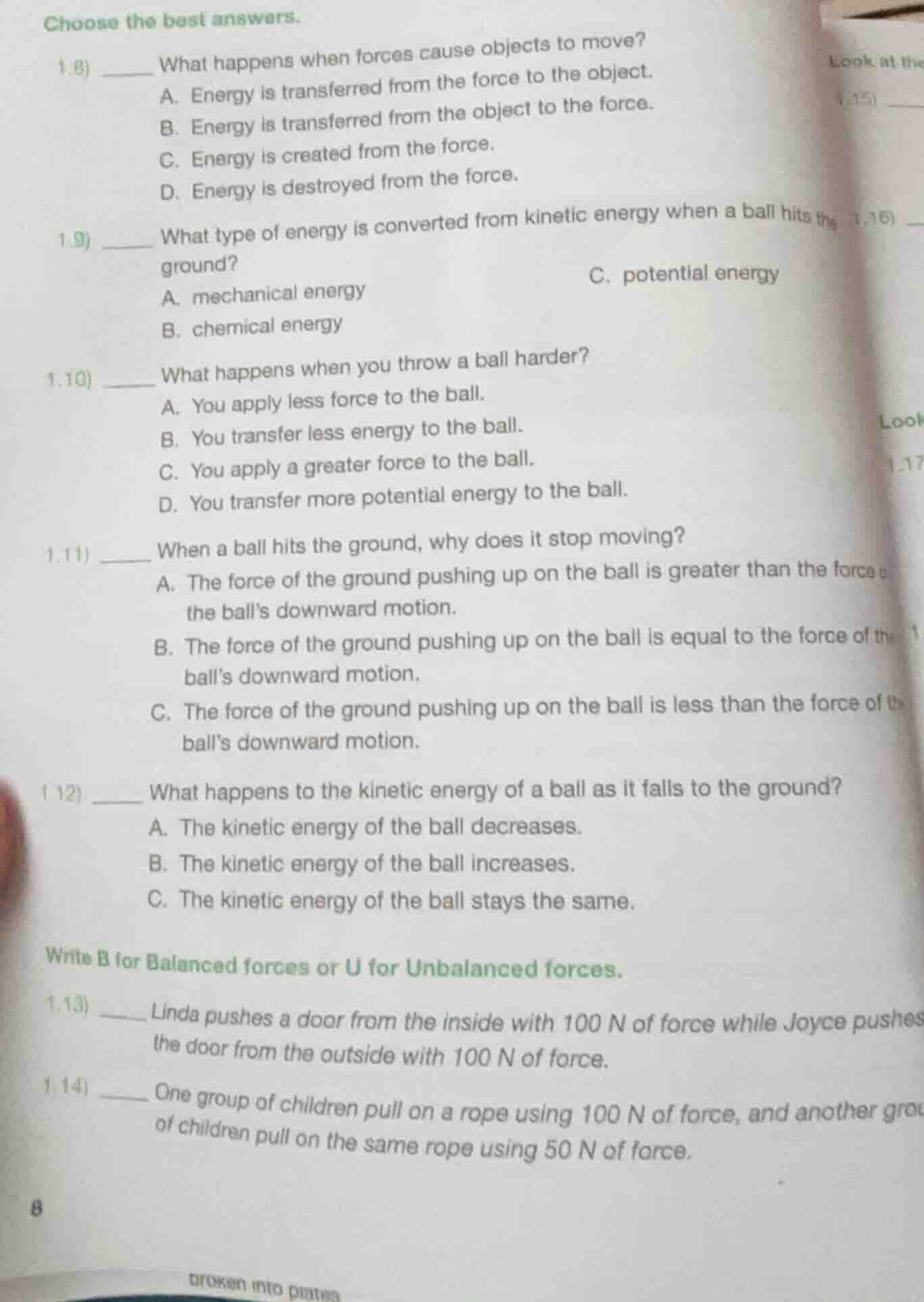
choose the best answers.
1.8) ______ what happens when forces cause objects to move?
a. energy is transferred from the force to the object.
b. energy is transferred from the object to the force.
c. energy is created from the force.
d. energy is destroyed from the force.
1.9) ______ what type of energy is converted from kinetic energy when a ball hits the ground?
a. mechanical energy
b. chemical energy
c. potential energy
1.10) ______ what happens when you throw a ball harder?
a. you apply less force to the ball.
b. you transfer less energy to the ball.
c. you apply a greater force to the ball.
d. you transfer more potential energy to the ball.
1.11) ______ when a ball hits the ground, why does it stop moving?
a. the force of the ground pushing up on the ball is greater than the force of the ball’s downward motion.
b. the force of the ground pushing up on the ball is equal to the force of the ball’s downward motion.
c. the force of the ground pushing up on the ball is less than the force of the ball’s downward motion.
1.12) ______ what happens to the kinetic energy of a ball as it falls to the ground?
a. the kinetic energy of the ball decreases.
b. the kinetic energy of the ball increases.
c. the kinetic energy of the ball stays the same.
write b for balanced forces or u for unbalanced forces.
1.13) ______ linda pushes a door from the inside with 100 n of force while joyce pushes the door from the outside with 100 n of force.
1.14) ______ one group of children pull on a rope using 100 n of force, and another group of children pull on the same rope using 50 n of force.
1.8)
When a force causes an object to move, work is done, and energy is transferred from the source of the force (or the agent applying the force) to the object. Energy cannot be created or destroyed (law of conservation of energy), so options C and D are wrong. Option B is the reverse of what happens. So the correct answer is A.
When a ball hits the ground, its kinetic energy (energy of motion) is converted. Mechanical energy is the sum of kinetic and potential, so A is not specific. Chemical energy is related to chemical reactions, not this scenario. Potential energy is stored energy, but when the ball hits the ground, kinetic energy is often converted to other forms like sound, heat, or elastic potential, but among the options, the most relevant conversion from kinetic (motion) to a form that's a type of stored energy (though in this case, maybe elastic potential, but the option given as potential energy is the closest among the choices. Wait, actually, when a ball hits the ground, kinetic energy is converted to elastic potential energy (if it deforms) and then back, but the options here: A is mechanical (too broad), B is chemical (no), C is potential. So the best answer is C as kinetic (motion) can convert to potential (stored) in the interaction with the ground (like compression of the ball).
Throwing a ball harder means applying a greater force (since force and acceleration are related by F = ma, and a harder throw means more acceleration, hence more force). Option A is wrong (less force is opposite). Option B: transferring less energy is wrong, as a harder throw gives more kinetic energy (energy transfer is more). Option D: potential energy is not transferred here; throwing involves transferring kinetic energy (or work done to give kinetic energy), not potential. So the correct answer is C.

Snap & solve any problem in the app
Get step-by-step solutions on Sovi AI
Photo-based solutions with guided steps
Explore more problems and detailed explanations
A. Energy is transferred from the force to the object.