QUESTION IMAGE
Question
class goal: a b or better on every assessment
name
h. chemistry b
date
period
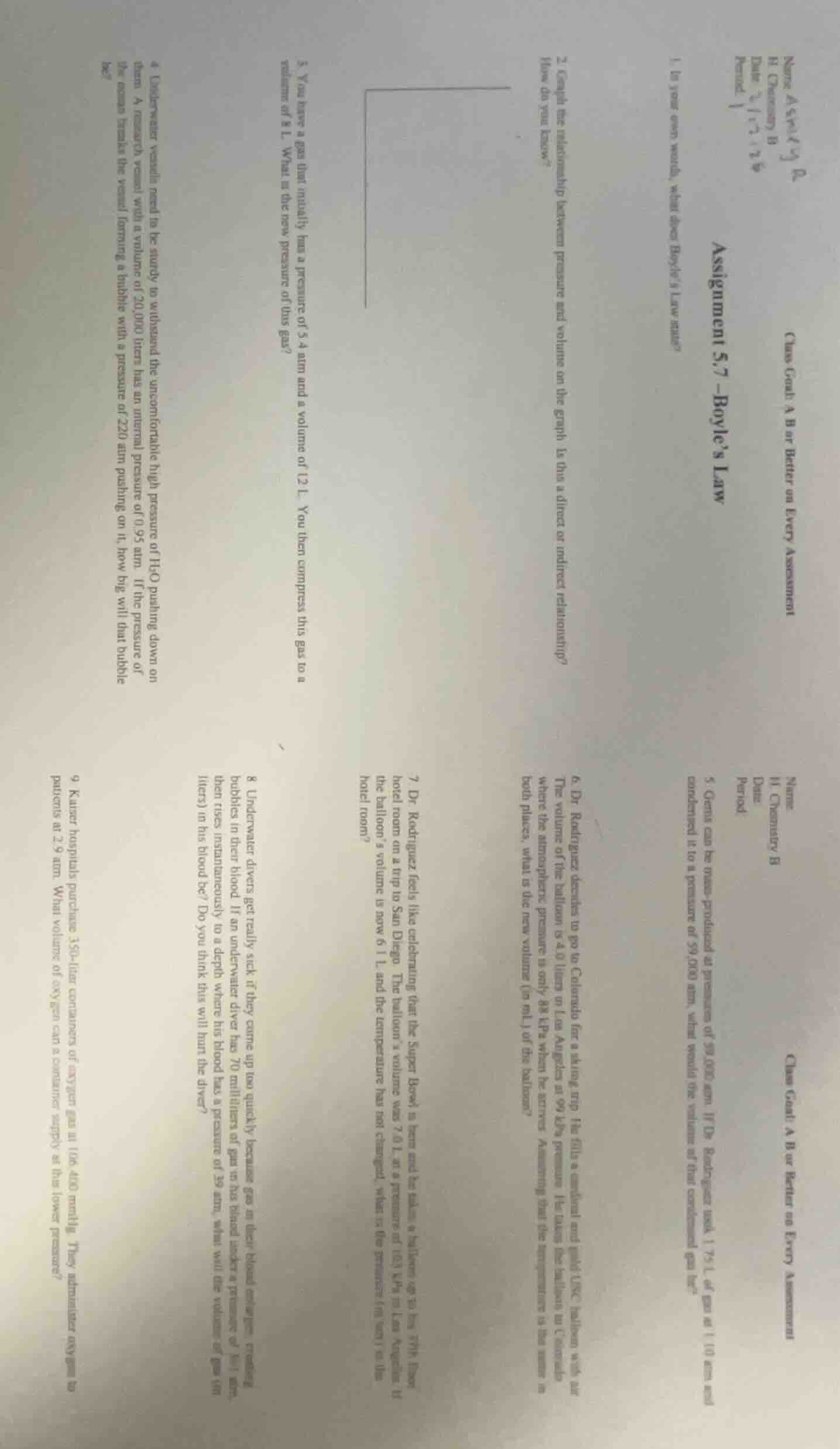
assignment 5.7 -boyles law
- in your own words, what does boyles law state?
- graph the relationship between pressure and volume on the graph. is this a direct or indirect relationship?
how do you know?
- you have a gas that initially has a pressure of 5.4 atm and a volume of 12 l. you then compress this gas to a
volume of 8 l. what is the new pressure of this gas?
- underwater vessels need to be sturdy to withstand the uncomfortable high pressure of h₂o pushing down on
them. a research vessel with a volume of 20,000 liters has an internal pressure of 0.95 atm. if the pressure of
the ocean breaks the vessel forming a bubble with a pressure of 220 atm pushing on it, how big will that bubble
be?
name
h. chemistry b
date
period
class goal: a b or better on every assessment
- gems can be mass-produced at pressures of 59,000 atm. if dr. rodriguez took 1.75 l of gas at 1.0 atm and
condensed it to a pressure of 59,000 atm, what would the volume of that condensed gas be?
- dr. rodriguez decides to go to colorado for a skiing trip. he fills a cardinal and gold usc balloon with air
the volume of the balloon is 4.0 liters in los angeles at 99 kpa pressure. he takes the balloon to colorado
where the atmospheric pressure is only 88 kpa when he arrives. assuming that the temperature is the same in
both places, what is the new volume (in ml) of the balloon?
- dr. rodriguez feels like celebrating that the super bowl is here and he takes a balloon up to his 7th floor
hotel room on a trip to san diego. the balloons volume was 7.0 l at a pressure of 103 kpa in los angeles. if
the balloons volume is now 6.1 l and the temperature has not changed, what is the pressure (in kpa) in the
hotel room?
- underwater divers get really sick if they come up too quickly because gas in their blood enlarges creating
bubbles in their blood. if an underwater diver has 70 milliliters of gas in his blood under a pressure of 1 atm,
then rises instantaneously to a depth where his blood has a pressure of 39 atm, what will the volume of gas (in
liters) in his blood be? do you think this will hurt the diver?
- kaiser hospitals purchase 350-liter containers of oxygen gas at 106,400 mmhg. they administer oxygen to
patients at 2.9 atm. what volume of oxygen can a container supply at this lower pressure?
Step1: State Boyle's Law definition
Boyle's Law states that for a fixed amount of gas at constant temperature, the pressure of the gas is inversely proportional to its volume. In simple terms: As pressure increases, volume decreases, and vice versa, as long as temperature and the amount of gas stay the same.
---
Step2: Graph relationship explanation
The relationship between pressure (P) and volume (V) of a gas (at constant T, n) is an indirect (inverse) relationship. When graphed with P on the y-axis and V on the x-axis, the curve is a hyperbola. This is an inverse relationship because $P \propto \frac{1}{V}$.
---
Step3: Solve problem 3 (gas compression)
Boyle's Law formula: $P_1V_1 = P_2V_2$
Given: $P_1=5.4\ \text{atm}$, $V_1=12\ \text{L}$, $V_2=8\ \text{L}$
Rearrange for $P_2$: $P_2 = \frac{P_1V_1}{V_2}$
Substitute values: $P_2 = \frac{5.4\ \text{atm} \times 12\ \text{L}}{8\ \text{L}} = 8.1\ \text{atm}$
---
Step4: Solve problem 4 (underwater bubble)
Boyle's Law formula: $P_1V_1 = P_2V_2$
Given: $P_1=0.95\ \text{atm}$, $V_1=20000\ \text{L}$, $P_2=220\ \text{atm}$
Rearrange for $V_2$: $V_2 = \frac{P_1V_1}{P_2}$
Substitute values: $V_2 = \frac{0.95\ \text{atm} \times 20000\ \text{L}}{220\ \text{atm}} \approx 86.36\ \text{L}$
---
Step5: Solve problem 5 (gas condensation)
Boyle's Law formula: $P_1V_1 = P_2V_2$
Given: $P_1=1.0\ \text{atm}$, $V_1=175\ \text{L}$, $P_2=59000\ \text{atm}$
Rearrange for $V_2$: $V_2 = \frac{P_1V_1}{P_2}$
Substitute values: $V_2 = \frac{1.0\ \text{atm} \times 175\ \text{L}}{59000\ \text{atm}} \approx 0.00297\ \text{L} = 2.97\ \text{mL}$
---
Step6: Solve problem 6 (balloon in Colorado)
Boyle's Law formula: $P_1V_1 = P_2V_2$
Given: $P_1=99\ \text{kPa}$, $V_1=4.0\ \text{L}$, $P_2=88\ \text{kPa}$
Rearrange for $V_2$: $V_2 = \frac{P_1V_1}{P_2}$
Substitute values: $V_2 = \frac{99\ \text{kPa} \times 4.0\ \text{L}}{88\ \text{kPa}} = 4.5\ \text{L} = 4500\ \text{mL}$
---
Step7: Solve problem 7 (balloon in San Diego)
Boyle's Law formula: $P_1V_1 = P_2V_2$
Given: $P_1=103\ \text{kPa}$, $V_1=7.0\ \text{L}$, $V_2=6.1\ \text{L}$
Rearrange for $P_2$: $P_2 = \frac{P_1V_1}{V_2}$
Substitute values: $P_2 = \frac{103\ \text{kPa} \times 7.0\ \text{L}}{6.1\ \text{L}} \approx 118.52\ \text{kPa}$
---
Step8: Solve problem 8 (diver's blood bubbles)
Boyle's Law formula: $P_1V_1 = P_2V_2$
Given: $P_1=1\ \text{atm}$, $V_1=70\ \text{mL}$, $P_2=39\ \text{atm}$
Rearrange for $V_2$: $V_2 = \frac{P_1V_1}{P_2}$
Substitute values: $V_2 = \frac{1\ \text{atm} \times 70\ \text{mL}}{39\ \text{atm}} \approx 1.79\ \text{mL}$
When the diver rises, the pressure decreases, so the bubble volume increases drastically. This will hurt the diver, as expanding bubbles damage blood vessels and tissue.
---
Step9: Solve problem 9 (oxygen containers)
First convert units: $106400\ \text{mmHg} = \frac{106400}{760}\ \text{atm} = 140\ \text{atm}$
Boyle's Law formula: $P_1V_1 = P_2V_2$
Given: $P_1=140\ \text{atm}$, $V_1=350\ \text{L}$, $P_2=2.9\ \text{atm}$
Rearrange for $V_2$: $V_2 = \frac{P_1V_1}{P_2}$
Substitute values: $V_2 = \frac{140\ \text{atm} \times 350\ \text{L}}{2.9\ \text{atm}} \approx 16896.55\ \text{L}$

Snap & solve any problem in the app
Get step-by-step solutions on Sovi AI
Photo-based solutions with guided steps
Explore more problems and detailed explanations
- Boyle's Law states that for a fixed amount of gas at constant temperature, the pressure of the gas is inversely proportional to its volume (as pressure goes up, volume goes down, and vice versa).
- The relationship between pressure and volume (for a fixed gas at constant temperature) is an indirect (inverse) relationship, shown as a hyperbola on a P-V graph.
- $8.1\ \text{atm}$
- $\approx 86.4\ \text{L}$
- $\approx 3.0\ \text{mL}$
- $4500\ \text{mL}$
- $\approx 119\ \text{kPa}$
- The bubble volume will be $\approx 1.8\ \text{mL}$ at depth. When rising, the bubble expands sharply, which will hurt the diver.
- $\approx 16900\ \text{L}$