QUESTION IMAGE
Question
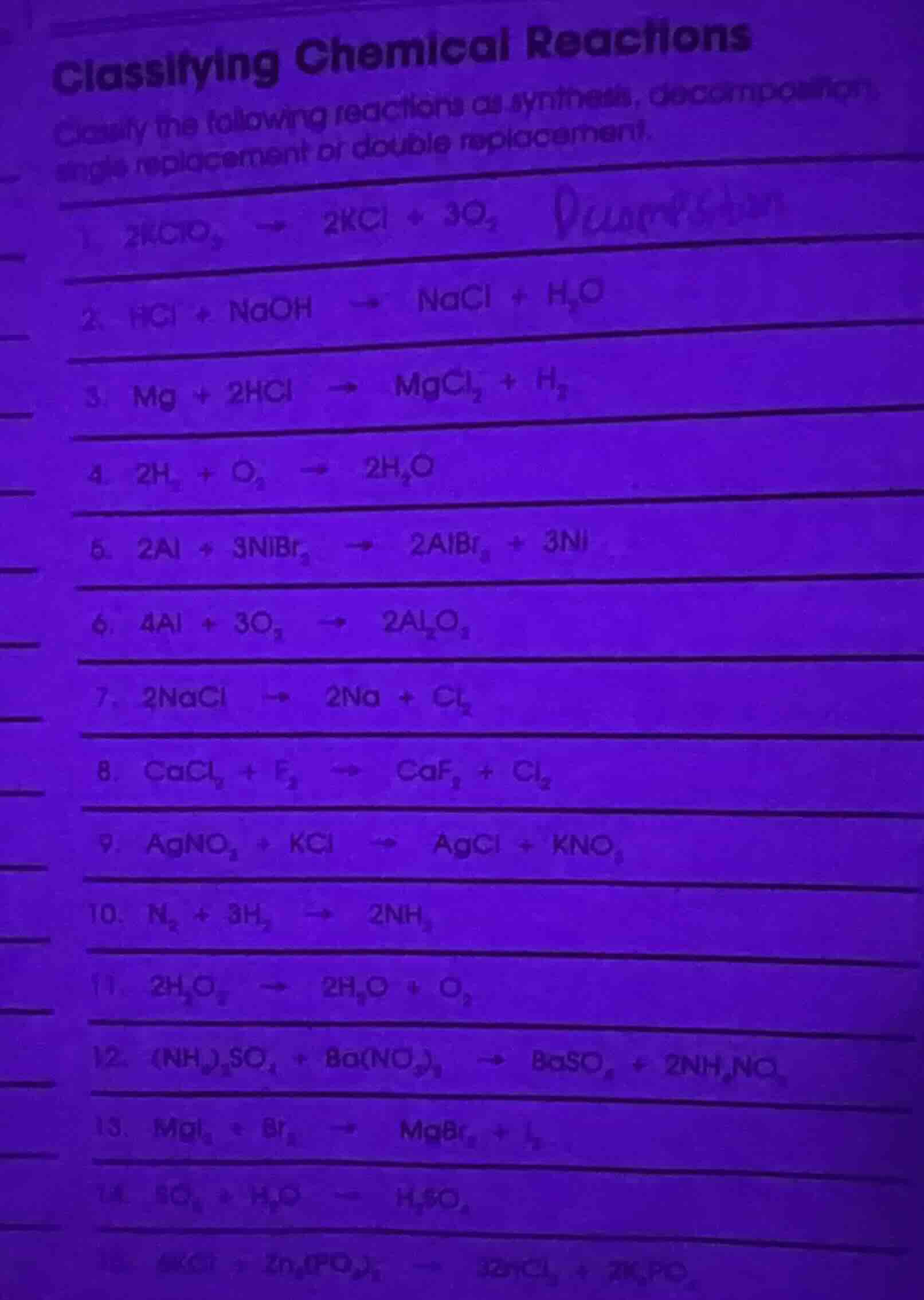
classifying chemical reactions
classify the following reactions as synthesis, decomposition, single replacement or double replacement.
- $2kclo_3 \
ightarrow 2kcl + 3o_2$
- $hcl + naoh \
ightarrow nacl + h_2o$
- $mg + 2hcl \
ightarrow mgcl_2 + h_2$
- $2h_2 + o_2 \
ightarrow 2h_2o$
- $2al + 3nibr_2 \
ightarrow 2albr_3 + 3ni$
- $4al + 3o_2 \
ightarrow 2al_2o_3$
- $2nacl \
ightarrow 2na + cl_2$
- $cacl_2 + f_2 \
ightarrow caf_2 + cl_2$
- $agno_3 + kcl \
ightarrow agcl + kno_3$
- $n_2 + 3h_2 \
ightarrow 2nh_3$
- $2h_2o_2 \
ightarrow 2h_2o + o_2$
- $(nh_4)_2so_4 + ba(no_3)_2 \
ightarrow baso_4 + 2nh_4no_3$
- $mgi_2 + br_2 \
ightarrow mgbr_2 + i_2$
- $so_3 + h_2o \
ightarrow h_2so_4$
- $6kcl + zn_3(po_4)_2 \
ightarrow 3zncl_2 + 2k_3po_4$
Step1: Define reaction types
- Synthesis: $A + B
ightarrow AB$ (combine into 1 compound)
- Decomposition: $AB
ightarrow A + B$ (break into simpler substances)
- Single Replacement: $A + BC
ightarrow AC + B$ (1 element replaces another)
- Double Replacement: $AB + CD
ightarrow AD + CB$ (ions swap between compounds)
Step2: Classify each reaction
- Match $2\text{KClO}_3
ightarrow 2\text{KCl} + 3\text{O}_2$ to decomposition.
- Match $\text{HCl} + \text{NaOH}
ightarrow \text{NaCl} + \text{H}_2\text{O}$ to double replacement.
- Match $\text{Mg} + 2\text{HCl}
ightarrow \text{MgCl}_2 + \text{H}_2$ to single replacement.
- Match $2\text{H}_2 + \text{O}_2
ightarrow 2\text{H}_2\text{O}$ to synthesis.
- Match $2\text{Al} + 3\text{NiBr}_2
ightarrow 2\text{AlBr}_3 + 3\text{Ni}$ to single replacement.
- Match $4\text{Al} + 3\text{O}_2
ightarrow 2\text{Al}_2\text{O}_3$ to synthesis.
- Match $2\text{NaCl}
ightarrow 2\text{Na} + \text{Cl}_2$ to decomposition.
- Match $\text{CaCl}_2 + \text{F}_2
ightarrow \text{CaF}_2 + \text{Cl}_2$ to single replacement.
- Match $\text{AgNO}_3 + \text{KCl}
ightarrow \text{AgCl} + \text{KNO}_3$ to double replacement.
- Match $\text{N}_2 + 3\text{H}_2
ightarrow 2\text{NH}_3$ to synthesis.
- Match $2\text{H}_2\text{O}_2
ightarrow 2\text{H}_2\text{O} + \text{O}_2$ to decomposition.
- Match $(\text{NH}_4)_2\text{SO}_4 + \text{Ba(NO}_3\text{)}_2
ightarrow \text{BaSO}_4 + 2\text{NH}_4\text{NO}_3$ to double replacement.
- Match $\text{MgI}_2 + \text{Br}_2
ightarrow \text{MgBr}_2 + \text{I}_2$ to single replacement.
- Match $\text{SO}_3 + \text{H}_2\text{O}
ightarrow \text{H}_2\text{SO}_4$ to synthesis.
- Match $6\text{KCl} + \text{Zn}_3(\text{PO}_4)_2
ightarrow 3\text{ZnCl}_2 + 2\text{K}_3\text{PO}_4$ to double replacement.

Snap & solve any problem in the app
Get step-by-step solutions on Sovi AI
Photo-based solutions with guided steps
Explore more problems and detailed explanations
- Decomposition
- Double Replacement
- Single Replacement
- Synthesis
- Single Replacement
- Synthesis
- Decomposition
- Single Replacement
- Double Replacement
- Synthesis
- Decomposition
- Double Replacement
- Single Replacement
- Synthesis
- Double Replacement