QUESTION IMAGE
Question
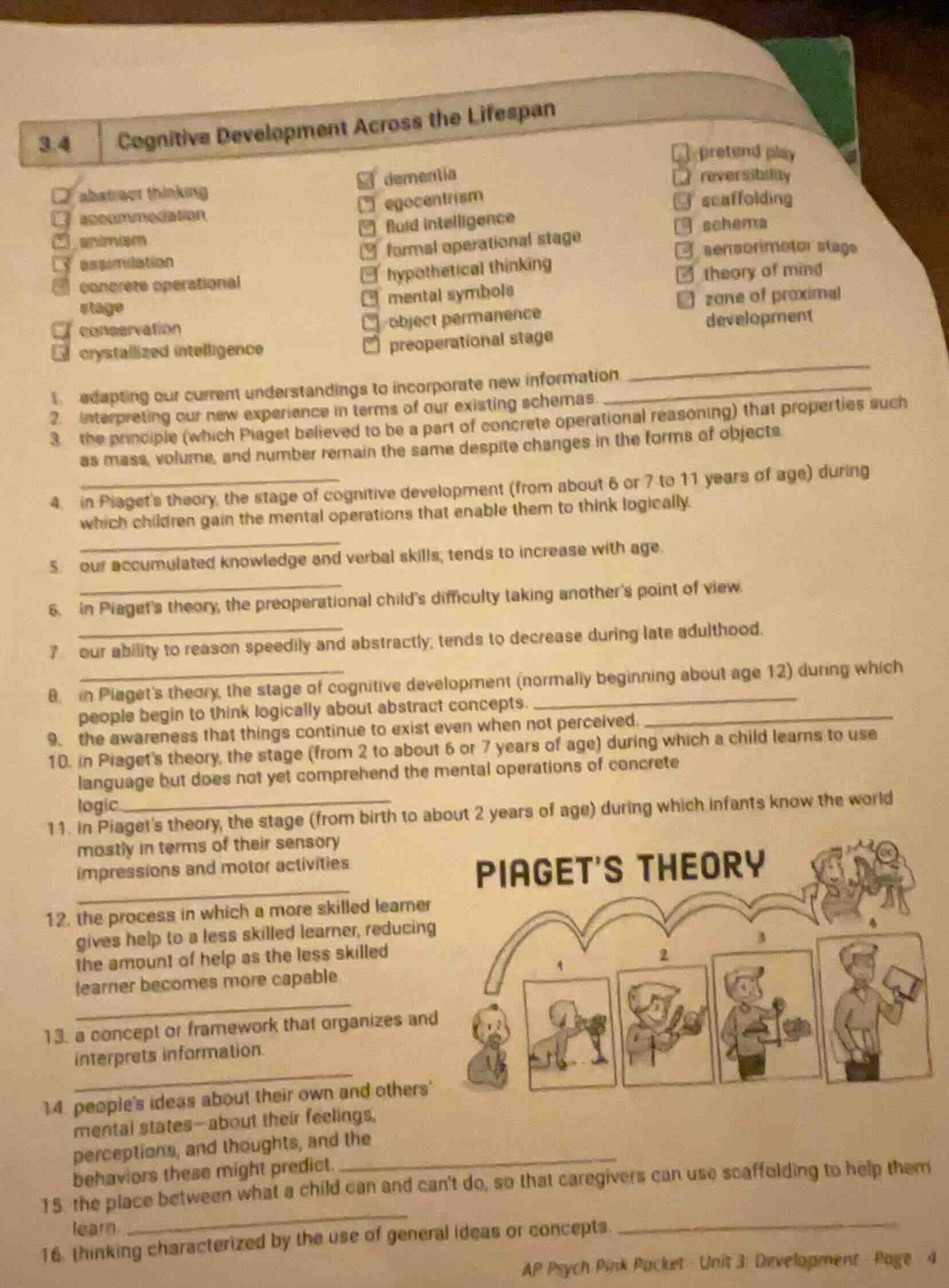
3.4 cognitive development across the lifespan
abstract thinking
accommodation
anirism
assimilation
concrete operational stage
conservation
crystallized intelligence
dementia
egocentrism
fluid intelligence
formal operational stage
hypothetical thinking
mental symbols
object permanence
preoperational stage
pretend play
reversibility
scaffolding
schema
sensorimotor stage
theory of mind
zone of proximal development
- adapting our current understandings to incorporate new information
- interpreting our new experience in terms of our existing schemas
- the principle (which piaget believed to be a part of concrete operational reasoning) that properties such as mass, volume, and number remain the same despite changes in the forms of objects
- in piaget’s theory, the stage of cognitive development (from about 6 or 7 to 11 years of age) during which children gain the mental operations that enable them to think logically.
- our accumulated knowledge and verbal skills; tends to increase with age.
- in piaget’s theory, the preoperational child’s difficulty taking another’s point of view.
- our ability to reason speedily and abstractly; tends to decrease during late adulthood.
- in piaget’s theory, the stage of cognitive development (normally beginning about age 12) during which people begin to think logically about abstract concepts.
- the awareness that things continue to exist even when not perceived.
- in piaget’s theory, the stage (from 2 to about 6 or 7 years of age) during which a child learns to use language but does not yet comprehend the mental operations of concrete logic.
- in piaget’s theory, the stage (from birth to about 2 years of age) during which infants know the world mostly in terms of their sensory impressions and motor activities
- the process in which a more skilled learner gives help to a less skilled learner, reducing the amount of help as the less skilled learner becomes more capable
- a concept or framework that organizes and interprets information.
- people’s ideas about their own and others’ mental states—about their feelings, perceptions, and thoughts, and the behaviors these might predict.
- the place between what a child can and can’t do, so that caregivers can use scaffolding to help them learn.
- (thinking characterized by the use of general ideas or concepts.
piagets theory
ap psych pink packet unit 3 development page 4
Each term is matched to its definition based on key cognitive development concepts, primarily from Piaget's theory and related developmental psychology frameworks.

Snap & solve any problem in the app
Get step-by-step solutions on Sovi AI
Photo-based solutions with guided steps
Explore more problems and detailed explanations
- accommodation
- assimilation
- conservation
- concrete operational stage
- crystallized intelligence
- egocentrism
- fluid intelligence
- formal operational stage
- object permanence
- preoperational stage
- sensorimotor stage
- scaffolding
- schema
- theory of mind
- zone of proximal development
- abstract thinking