QUESTION IMAGE
Question
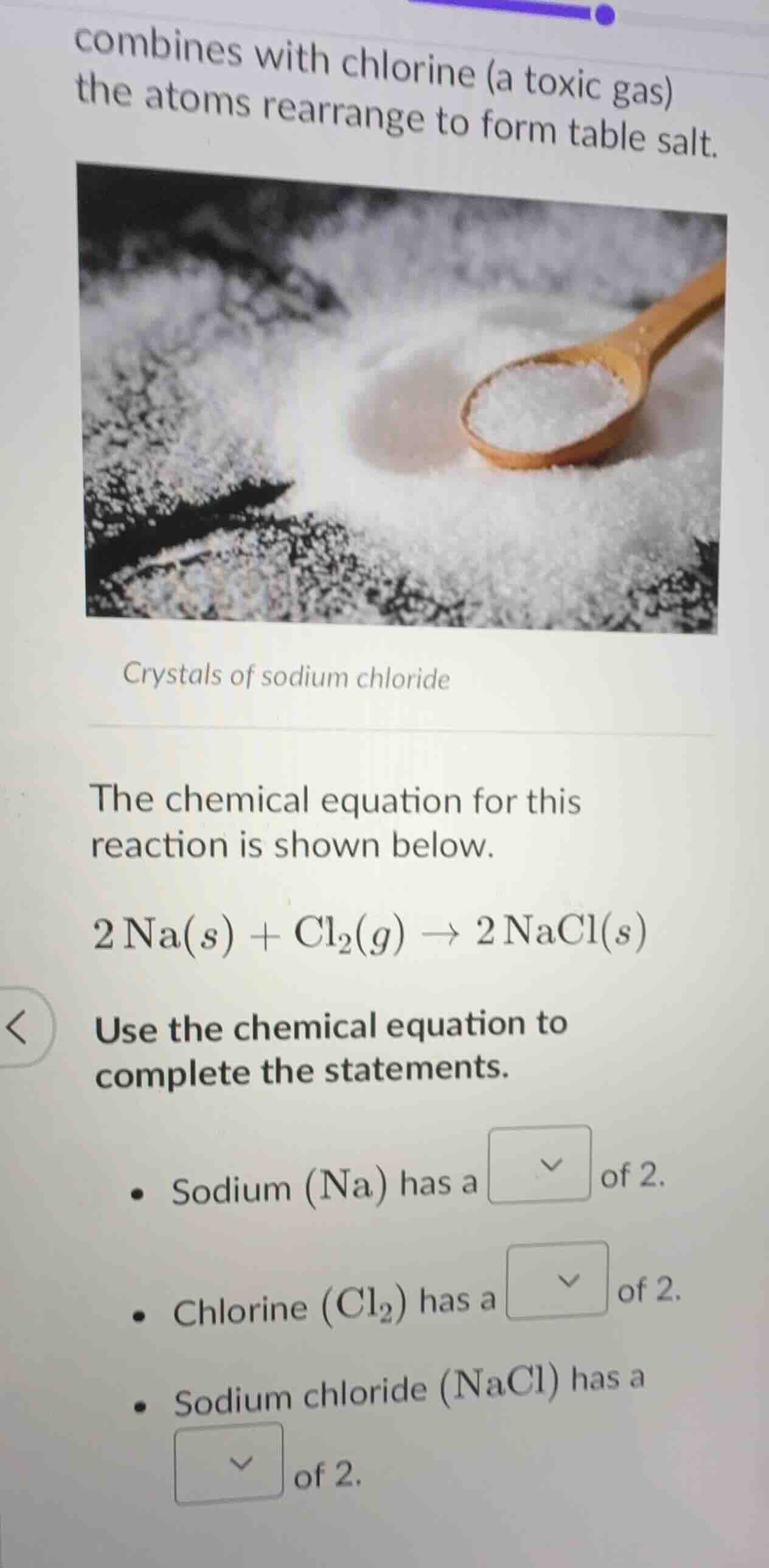
combines with chlorine (a toxic gas) the atoms rearrange to form table salt.
crystals of sodium chloride
the chemical equation for this reaction is shown below.
\\(\ce{2na(s) + cl_{2}(g) \
ightarrow 2nacl(s)}\\)
use the chemical equation to complete the statements.
- sodium (\\(\ce{na}\\)) has a \\(\boldsymbol{\downarrow}\\) of 2.
- chlorine (\\(\ce{cl_{2}}\\)) has a \\(\boldsymbol{\downarrow}\\) of 2.
- sodium chloride (\\(\ce{nacl}\\)) has a \\(\boldsymbol{\downarrow}\\) of 2.
Step1: Analyze Sodium (Na)
In the chemical equation \( 2\text{Na}(s) + \text{Cl}_2(g)
ightarrow 2\text{NaCl}(s) \), the number in front of Na is 2. This number is called the coefficient, which represents the number of moles (or molecules/atoms in terms of stoichiometry) of the substance. So Sodium (Na) has a coefficient of 2.
Step2: Analyze Chlorine (\( \text{Cl}_2 \))
For \( \text{Cl}_2 \), the subscript of Cl is 2, but wait, no—wait, the coefficient in front of \( \text{Cl}_2 \) is 1 (since there's no number, it's 1), but the question is about the "of 2" part. Wait, no, looking at the equation: \( 2\text{Na} \) (coefficient 2), \( \text{Cl}_2 \) has a subscript? No, \( \text{Cl}_2 \) is a diatomic molecule, so the subscript 2 means there are 2 Cl atoms per molecule. But in terms of the coefficient for the substance \( \text{Cl}_2 \), it's 1. Wait, no, the question is about the "of 2"—wait, maybe the first blank for Na: coefficient. Then for \( \text{Cl}_2 \), maybe the subscript? No, wait, the equation: \( 2\text{Na} \) (coefficient 2), \( \text{Cl}_2 \) (molecule with 2 atoms, so subscript 2? No, subscript is for atoms in a molecule. Wait, maybe the question is about the coefficient (for the substance) or the number of atoms/molecules. Wait, let's re-express:
- For \( 2\text{Na} \): the coefficient is 2, meaning 2 moles (or atoms) of Na.
- For \( \text{Cl}_2 \): the subscript 2 means 2 atoms of Cl per molecule of \( \text{Cl}_2 \), but the coefficient of \( \text{Cl}_2 \) is 1. Wait, no, maybe the question is using "of 2" to refer to:
Wait, the three blanks:
- Sodium (Na) has a coefficient of 2 (since the number in front is 2).
- Chlorine (\( \text{Cl}_2 \)) has a subscript? No, \( \text{Cl}_2 \) has a subscript of 2 (atoms per molecule), but the coefficient of \( \text{Cl}_2 \) is 1. Wait, maybe the question is about the number of atoms/molecules:
Wait, no, let's check the equation again:
\( 2\text{Na}(s) \): 2 atoms (or moles) of Na.
\( \text{Cl}_2(g) \): 1 molecule of \( \text{Cl}_2 \), which contains 2 atoms of Cl.
\( 2\text{NaCl}(s) \): 2 formula units of NaCl, each containing 1 Na and 1 Cl.
So the first blank (Na): coefficient (2).
Second blank (Cl₂): maybe the number of atoms per molecule (subscript 2), but the coefficient of Cl₂ is 1. Wait, maybe the question is using "of 2" as:
- Sodium (Na): coefficient (2)
- Chlorine (Cl₂): number of atoms (2 per molecule)
- Sodium chloride (NaCl): coefficient (2)
Yes, that makes sense. So:
- Sodium (Na) has a coefficient of 2 (since 2 Na atoms/moles).
- Chlorine (Cl₂) has a subscript of 2 (2 Cl atoms per Cl₂ molecule), but wait, the coefficient of Cl₂ is 1. Wait, maybe the question is simplified:
In the equation, the number in front (coefficient) for Na is 2, for Cl₂ is 1, but the Cl₂ molecule has 2 Cl atoms (subscript 2), and for NaCl, the coefficient is 2.
So:
- Sodium (Na) has a coefficient of 2.
- Chlorine (Cl₂) has a subscript of 2 (number of Cl atoms per Cl₂ molecule).
- Sodium chloride (NaCl) has a coefficient of 2.
But maybe the question is using "of 2" to refer to:
- Coefficient (for the substance) or the number of atoms in the molecule/formula.
So to fill the blanks:
- Sodium (Na): coefficient (2)
- Chlorine (Cl₂): subscript (2, atoms per molecule)
- Sodium chloride (NaCl): coefficient (2)
But let's confirm:
- Coefficient: number in front of the chemical formula (for the substance).
- Subscript: number within the chemical formula (for atoms in a molecule or ions in a formula unit).
So:
- \( 2\text{Na} \): coeffici…

Snap & solve any problem in the app
Get step-by-step solutions on Sovi AI
Photo-based solutions with guided steps
Explore more problems and detailed explanations
- Sodium (Na) has a \(\boldsymbol{\text{coefficient}}\) of 2.
- Chlorine (\(\text{Cl}_2\)) has a \(\boldsymbol{\text{subscript}}\) of 2 (or "number of atoms" depending on context, but subscript is the formula term).
- Sodium chloride (NaCl) has a \(\boldsymbol{\text{coefficient}}\) of 2.
(Note: If the dropdown options are "coefficient", "subscript", "number of atoms", etc., the first and third are "coefficient", the second is "subscript" or "number of atoms" for \(\text{Cl}_2\) having 2 atoms per molecule.)