QUESTION IMAGE
Question
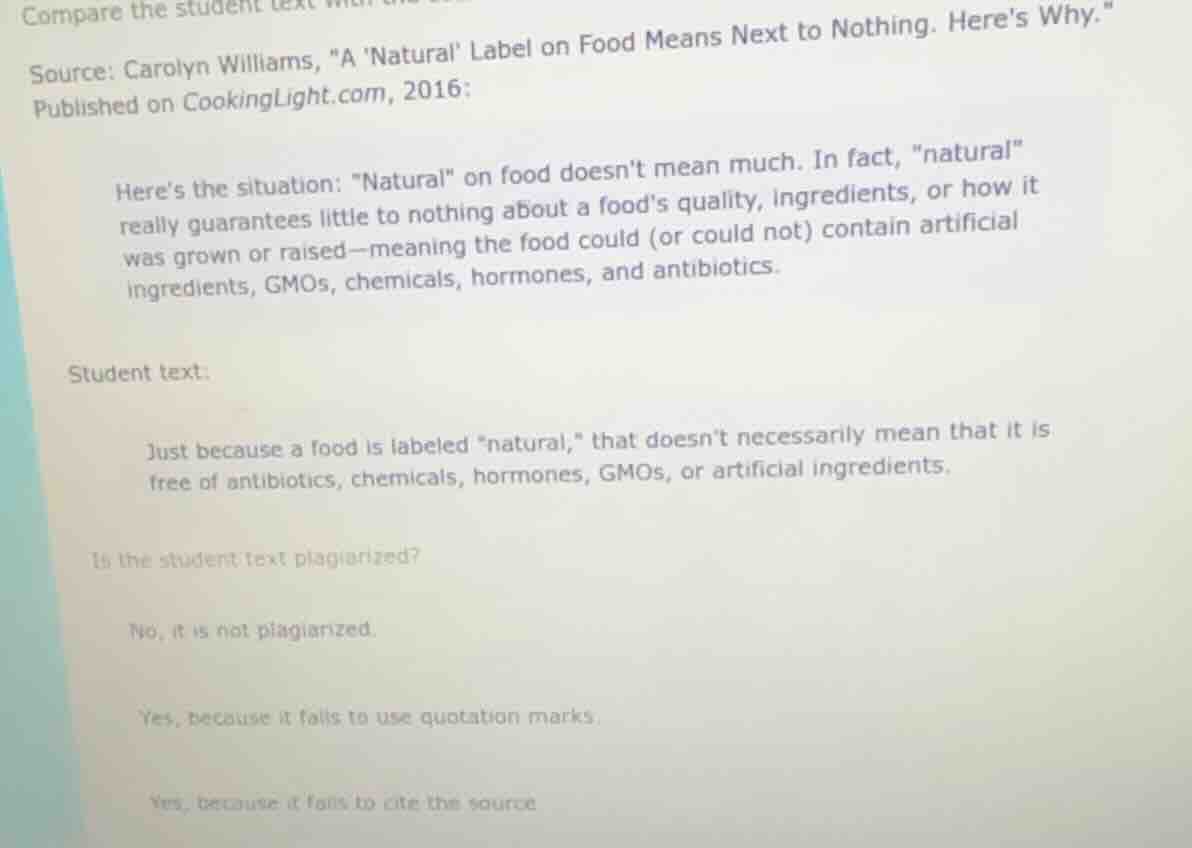
compare the student text
source: carolyn williams, \a natural label on food means next to nothing. heres why.\ published on cookinglight.com, 2016:
heres the situation:
atural\ on food doesnt mean much. in fact,
atural\ really guarantees little to nothing about a foods quality, ingredients, or how it was grown or raised—meaning the food could (or could not) contain artificial ingredients, gmos, chemicals, hormones, and antibiotics.
student text.
just because a food is labeled
atural,\ that doesnt necessarily mean that it is free of antibiotics, chemicals, hormones, gmos, or artificial ingredients.
is the student text plagiarized?
no, it is not plagiarized.
yes, because it fails to use quotation marks.
yes, because it fails to cite the source
Plagiarism involves using someone else's work (ideas, text) without proper citation or by copying too closely without attribution. The student text rephrases the source's idea about "natural" food labels not guaranteeing the absence of certain ingredients. However, to determine plagiarism, we check if there's proper citation. The student text here is a paraphrase, but if we assume the context is that they didn't cite the source (the question's options include "Yes, because it fails to cite the source"), but wait, actually, the student's text is a rephrasing. Wait, no—let's re - evaluate. The source says "natural" guarantees little about quality, ingredients, growth/raising, meaning food could (or not) have artificial ingredients, GMOs, etc. The student says "just because labeled 'natural' doesn't mean free of those things". But the key for plagiarism here: if the student is using the source's idea without citing, then "Yes, because it fails to cite the source" is correct? Wait, no—wait, the options: the first option is "No, it is not plagiarized"—but actually, plagiarism requires either copying text (without quotes and citation) or using ideas without citation. The student's text is a paraphrase of the source's idea. So if they didn't cite the source, then it's plagiarism. But let's check the options. The options are:
- No, it is not plagiarized.
- Yes, because it fails to use quotation marks.
- Yes, because it fails to cite the source.
Wait, the student's text is a paraphrase, not a direct quote, so quotation marks aren't needed. But they need to cite the source. So the correct answer is "Yes, because it fails to cite the source"? Wait, no—wait, maybe the original problem's context: maybe the student is supposed to cite the source, and since they didn't, it's plagiarism. But let's think again. The student's text is a rephrasing. Let's analyze each option:
- "No, it is not plagiarized": If the student is paraphrasing and we assume that in the context (maybe it's a short answer where citation is required, but the student didn't cite). Wait, no—plagiarism is using someone else's work without attribution. If the student is using the source's idea without citing, then it's plagiarism. But the first option says "No". Wait, maybe I made a mistake. Let's re - read the source and student text. The source's main idea: "natural" on food doesn't mean much, food could have those ingredients. The student's idea: "natural" label doesn't mean free of those ingredients. It's the same idea. If the student is presenting this as their own idea without citing the source, then it's plagiarism. But the options: the third option is "Yes, because it fails to cite the source". But wait, maybe the answer is "Yes, because it fails to cite the source"? Wait, no—wait, maybe the correct answer is "Yes, because it fails to cite the source"—but let's check the options again. Wait, the user's question is about which option is correct. Let's go back.
Wait, the source is from Carolyn Williams, 2016. The student text is a paraphrase. For academic work, even paraphrases need to cite the source. So if the student didn't cite the source, then it's plagiarism. So the option "Yes, because it fails to cite the source" is correct. But wait, the first option is "No, it is not plagiarized"—maybe I'm wrong. Wait, maybe the student's text is a common - sense rephrasing, but no, the idea comes from the source. Let's check the options again.
Wait, the first option: "No, it is not plagiarized"—if the student is paraphrasing and we consider that maybe in the context (like a…

Snap & solve any problem in the app
Get step-by-step solutions on Sovi AI
Photo-based solutions with guided steps
Explore more problems and detailed explanations
Yes, because it fails to cite the source.