QUESTION IMAGE
Question
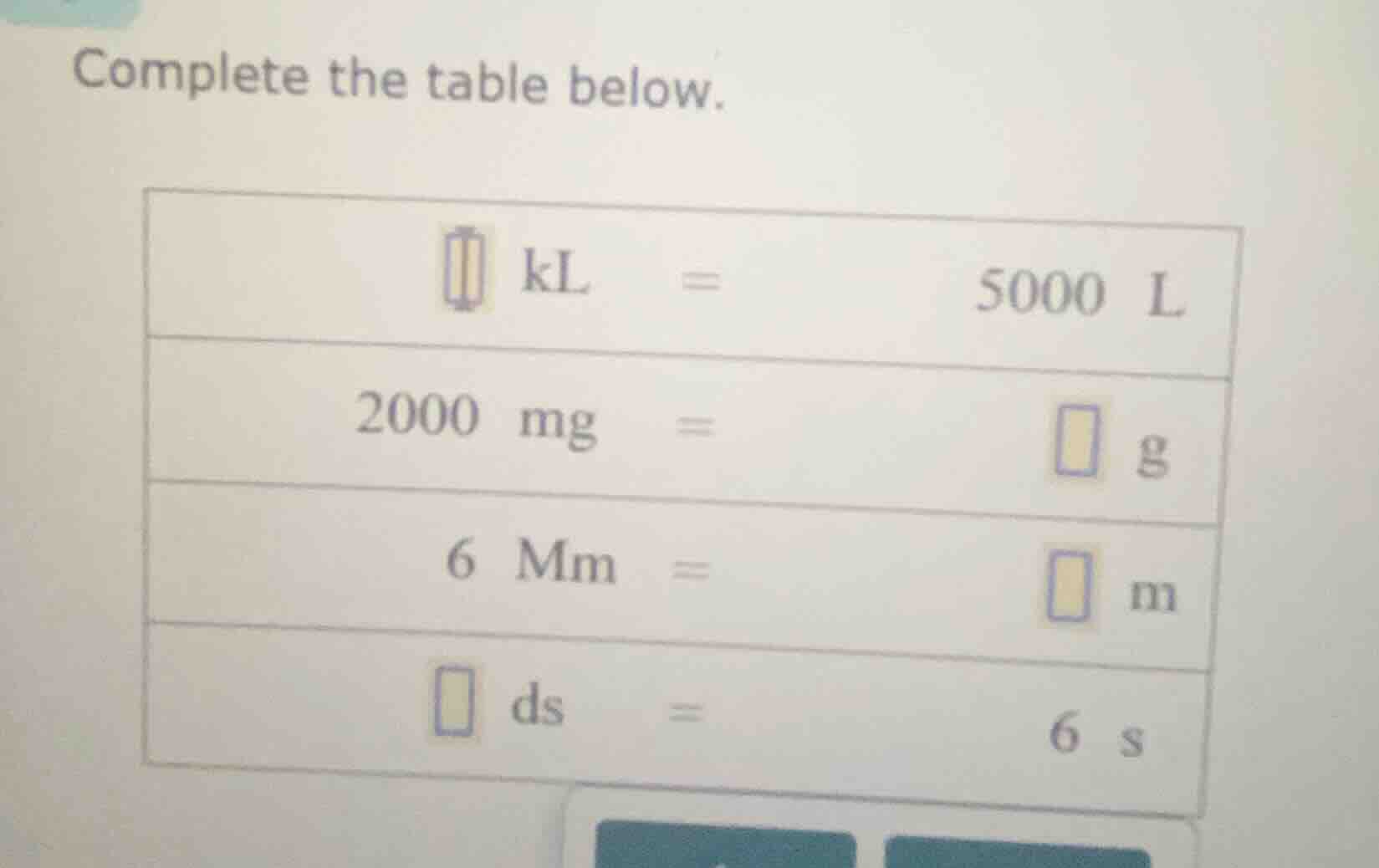
complete the table below.
| $square$ kl $=$ 5000 l
| 2000 mg $=$ $square$ g
| 6 mm $=$ $square$ m
| $square$ ds $=$ 6 s
Step1: Convert kL to L (1 kL = 1000 L)
Let the unknown be \( x \) kL. So \( x \times 1000 = 5000 \), then \( x=\frac{5000}{1000}=5 \).
Step2: Convert mg to g (1 g = 1000 mg)
For \( 2000 \) mg, \( 2000\div1000 = 2 \) g.
Step3: Convert Mm to m (1 Mm = \( 10^6 \) m)
For \( 6 \) Mm, \( 6\times10^6 = 6000000 \) m.
Step4: Convert s to ds (1 ds = 10 s)
Let the unknown be \( y \) ds. So \( y\times10 = 6 \), then \( y = \frac{6}{10}=0.6 \)? Wait, no, wait: Wait, 1 ds is 10 s? Wait, no, decisecond: 1 ds = 10 s? Wait, no, 1 second = 10 deciseconds? Wait, no, the metric prefix: deci- is \( 10^{-1} \), so 1 ds = 0.1 s? Wait, I made a mistake. Let's correct:
Wait, metric units:
- For volume: 1 kL (kiloliter) = 1000 L (liter)
- For mass: 1 g (gram) = 1000 mg (milligram)
- For length: 1 Mm (megameter) = \( 10^6 \) m (meter)
- For time: 1 ds (decisecond) = 0.1 s (second), so 1 s = 10 ds? Wait, no: deci- is \( 10^{-1} \), so 1 ds = \( 10^{-1} \) s = 0.1 s. So to convert s to ds: 1 s = 10 ds? Wait, no: if 1 ds = 0.1 s, then 1 s = 10 ds. So if we have 6 s, then number of ds is \( 6\times10 = 60 \)? Wait, I messed up earlier. Let's re - do step 4:
We know that 1 ds = 0.1 s, so to find how many ds are in 6 s, we use \( \text{ds}=\frac{\text{s}}{0.1} \). So \( \frac{6}{0.1}=60 \) ds. Wait, my earlier mistake was in the conversion factor. Let's re - check all steps:
Step 1: kL to L: 1 kL = 1000 L. So \( x \) kL = 5000 L. So \( x=\frac{5000}{1000}=5 \). Correct.
Step 2: mg to g: 1 g = 1000 mg. So 2000 mg \(=\frac{2000}{1000}=2 \) g. Correct.
Step 3: Mm to m: 1 Mm = \( 10^6 \) m. So 6 Mm \( = 6\times10^6=6000000 \) m. Correct.
Step 4: s to ds: 1 ds = 0.1 s (since deci - is \( 10^{-1} \)). So to get ds from s: \( \text{ds}=\frac{\text{s}}{0.1} \). So for 6 s, \( \frac{6}{0.1}=60 \) ds. So my initial mistake was the conversion factor direction.

Snap & solve any problem in the app
Get step-by-step solutions on Sovi AI
Photo-based solutions with guided steps
Explore more problems and detailed explanations
- \( 5 \) kL \( = 5000 \) L
- \( 2000 \) mg \( = 2 \) g
- \( 6 \) Mm \( = 6000000 \) m
- \( 60 \) ds \( = 6 \) s
(If we fill the table cells in order: first cell: 5; second cell: 2; third cell: 6000000; fourth cell: 60)