QUESTION IMAGE
Question
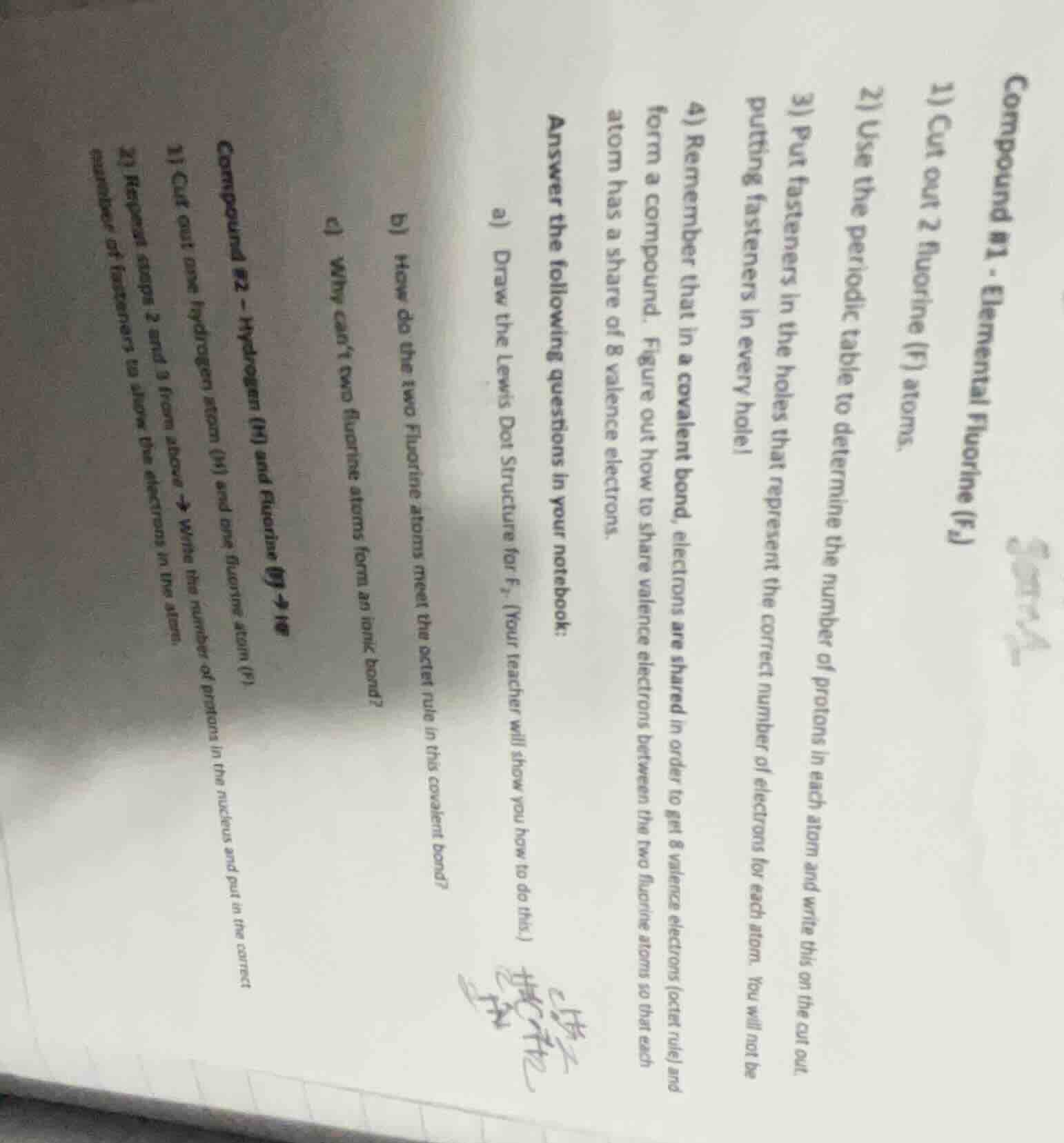
compound #1 - elemental fluorine (f₂)
- cut out 2 fluorine (f) atoms.
- use the periodic table to determine the number of protons in each atom and write this on the cut out.
- put fasteners in the holes that represent the correct number of electrons for each atom. you will not be putting fasteners in every hole!
- remember that in a covalent bond, electrons are shared in order to get 8 valence electrons (octet rule) and form a compound. figure out how to share valence electrons between the two fluorine atoms so that each atom has a share of 8 valence electrons.
answer the following questions in your notebook:
a) draw the lewis dot structure for f₂ (your teacher will show you how to do this!)
b) how do the two fluorine atoms meet the octet rule in this covalent bond?
c) why can’t two fluorine atoms form an ionic bond?
compound #2 - hydrogen (h) and fluorine (f) #
- cut out one hydrogen atom (h) and one fluorine atom (f)
- repeat steps 2 and 3 from above → write the number of protons in the nucleus and put in the correct number of fasteners to show the electrons in the atom.
For Compound #1 (F₂):
- Fluorine (F) has an atomic number of 9, so each atom has 9 protons. It has 7 valence electrons.
- To satisfy the octet rule, each F atom shares 1 valence electron, forming a single covalent bond. This gives each atom a full 8 valence electrons (6 unshared + 2 shared).
- a) The Lewis Dot Structure shows two F atoms, each with 6 unpaired dots (non-bonding electrons) and a single line between them (the shared electron pair).
b) Each F atom contributes 1 electron to the shared pair, so each now has 6 unshared electrons + 2 shared electrons = 8 valence electrons, meeting the octet rule.
c) Ionic bonds form between atoms with large differences in electronegativity (metal and nonmetal) where one atom transfers electrons to another. Fluorine atoms have identical electronegativity, so they share electrons (covalent bond) instead of transferring them.
For Compound #2 (HF):
- Hydrogen (H) has 1 proton and 1 valence electron; Fluorine (F) has 9 protons and 7 valence electrons.
- H shares its 1 electron with F, and F shares 1 electron with H. H gets a full 2-electron valence shell, and F gets a full 8-electron valence shell, forming a single covalent bond.

Snap & solve any problem in the app
Get step-by-step solutions on Sovi AI
Photo-based solutions with guided steps
Explore more problems and detailed explanations
Compound #1 (F₂)
a) Lewis Dot Structure: $\ce{:F-F:}$ (each F has 3 additional pairs of dots, so full structure is $\ce{: \underset{\cdot \cdot}{F} - \underset{\cdot \cdot}{F} :}$)
b) Each fluorine atom contributes one electron to a shared pair. This gives each atom 6 unshared valence electrons plus 2 shared valence electrons, totaling 8 valence electrons, satisfying the octet rule.
c) Two fluorine atoms have identical electronegativity, so neither can pull an electron away from the other to form ions. Ionic bonds require electron transfer between atoms with very different electronegativity, which does not occur here.
Compound #2 (HF)
- (Hands-on step: physically cut out 1 H and 1 F atom)
- Hydrogen has 1 proton, fluorine has 9 protons. Hydrogen has 1 valence electron, fluorine has 7 valence electrons. The shared electron pair gives H 2 valence electrons and F 8 valence electrons, forming $\ce{H-F:}$ (with 3 additional pairs of dots on F: $\ce{H-\underset{\cdot \cdot}{F} :}$)