QUESTION IMAGE
Question
concept: calculating density
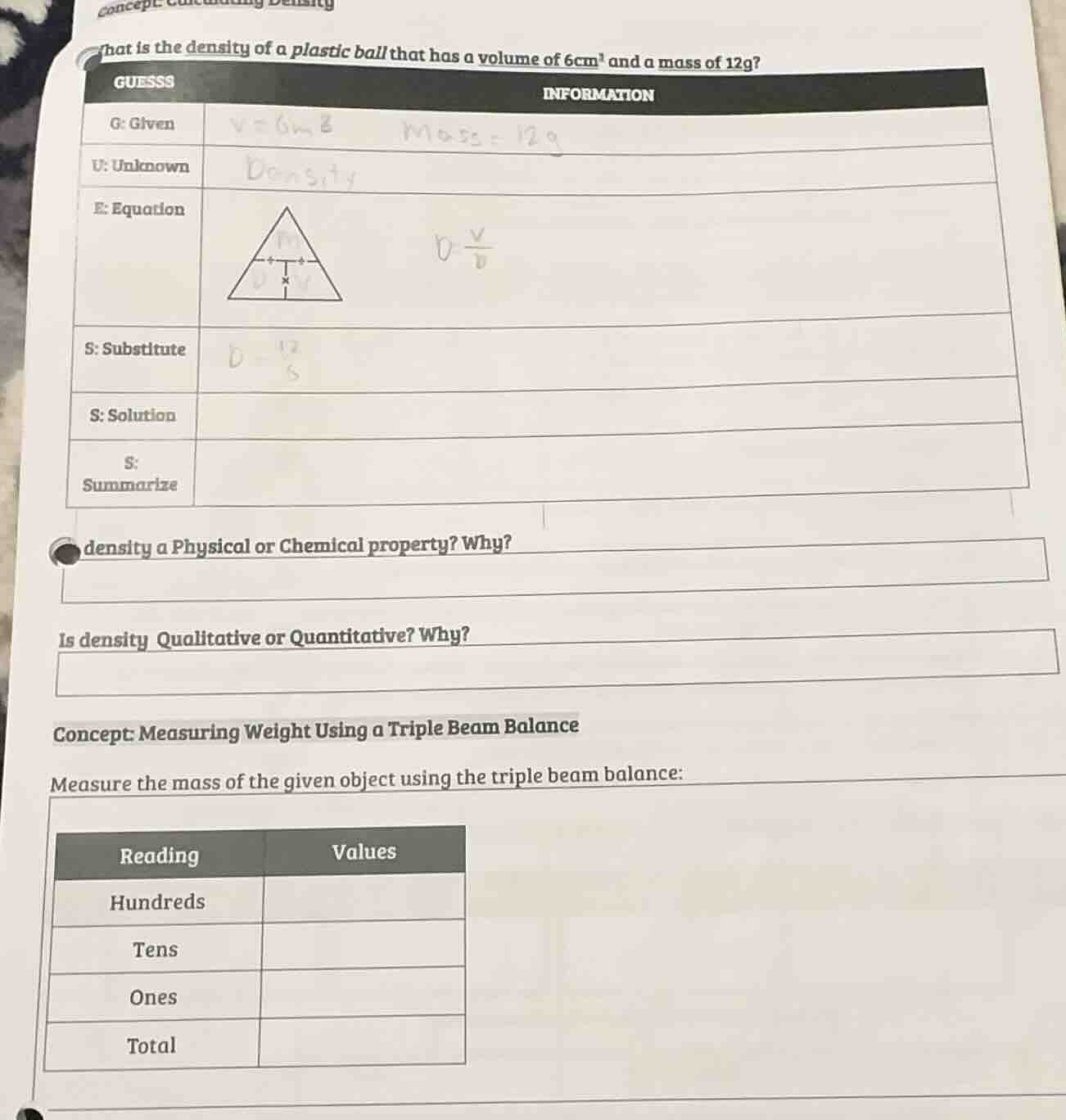
what is the density of a plastic ball that has a volume of 6 cm³ and a mass of 12 g?
guess information
g: given
u: unknown
e: equation
s: substitute
s: solution
s: summarize
density a physical or chemical property? why?
is density qualitative or quantitative? why?
concept: measuring weight using a triple beam balance
measure the mass of the given object using the triple beam balance:
reading values
hundreds
tens
ones
total
Part 1: Calculating Density
Step1: Recall the density formula
The formula for density (\(D\)) is \(D=\frac{m}{V}\), where \(m\) is mass and \(V\) is volume.
Step2: Substitute the given values
Given \(m = 12\,\text{g}\) and \(V=6\,\text{cm}^3\), substitute into the formula: \(D=\frac{12}{6}\)
Step3: Solve for density
\(\frac{12}{6}=2\)
Step4: Summarize
The density is calculated by dividing mass by volume, resulting in \(2\,\text{g/cm}^3\).
Density is a physical property because it can be measured without changing the substance's chemical identity (e.g., a plastic ball's density is determined by mass/volume, no chemical reaction occurs).
Density is quantitative because it is expressed as a numerical value (e.g., \(2\,\text{g/cm}^3\)) with a unit, representing a measurable quantity.

Snap & solve any problem in the app
Get step-by-step solutions on Sovi AI
Photo-based solutions with guided steps
Explore more problems and detailed explanations
The density of the plastic ball is \(2\,\text{g/cm}^3\).