QUESTION IMAGE
Question
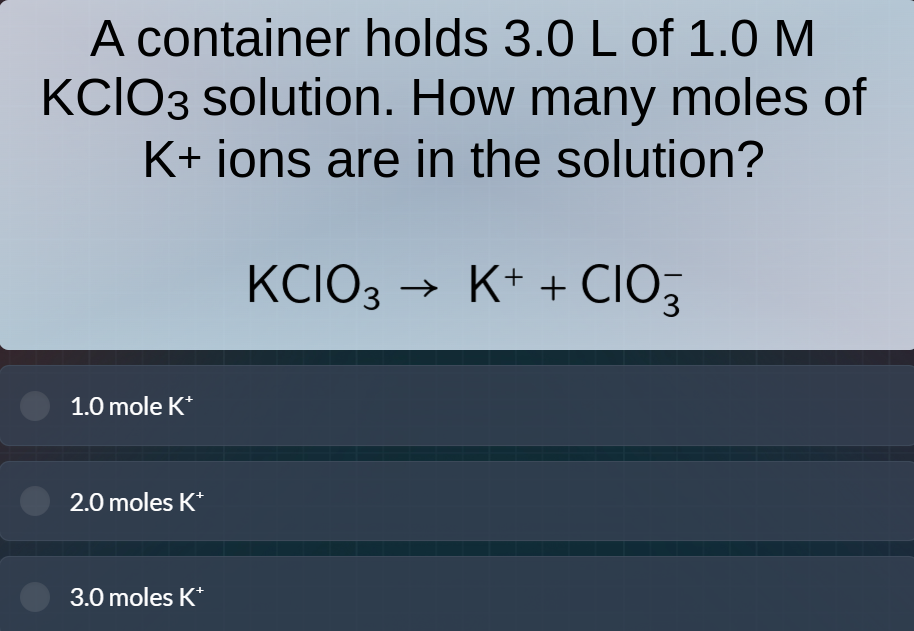
a container holds 3.0 l of 1.0 m kclo₃ solution. how many moles of k⁺ ions are in the solution? kclo₃ → k⁺ + clo₃⁻ 1.0 mole k⁺ 2.0 moles k⁺ 3.0 moles k⁺
Step1: Recall the formula for moles from molarity
The formula relating moles (\(n\)), molarity (\(M\)) and volume (\(V\)) in liters is \(n = M\times V\). Here, the molarity of \(\ce{KClO3}\) is \(1.0\ M\) and the volume is \(3.0\ L\).
So, moles of \(\ce{KClO3}\) \(n = 1.0\ M\times3.0\ L = 3.0\) moles.
Step2: Analyze the dissociation of \(\ce{KClO3}\)
From the dissociation equation \(\ce{KClO3
ightarrow K+ + ClO3-}\), we can see that 1 mole of \(\ce{KClO3}\) dissociates to give 1 mole of \(\ce{K+}\) ions.
So, the moles of \(\ce{K+}\) ions will be equal to the moles of \(\ce{KClO3}\) present. Since we have 3.0 moles of \(\ce{KClO3}\), we will have 3.0 moles of \(\ce{K+}\) ions.

Snap & solve any problem in the app
Get step-by-step solutions on Sovi AI
Photo-based solutions with guided steps
Explore more problems and detailed explanations
3.0 moles \( \ce{K+} \)