QUESTION IMAGE
Question
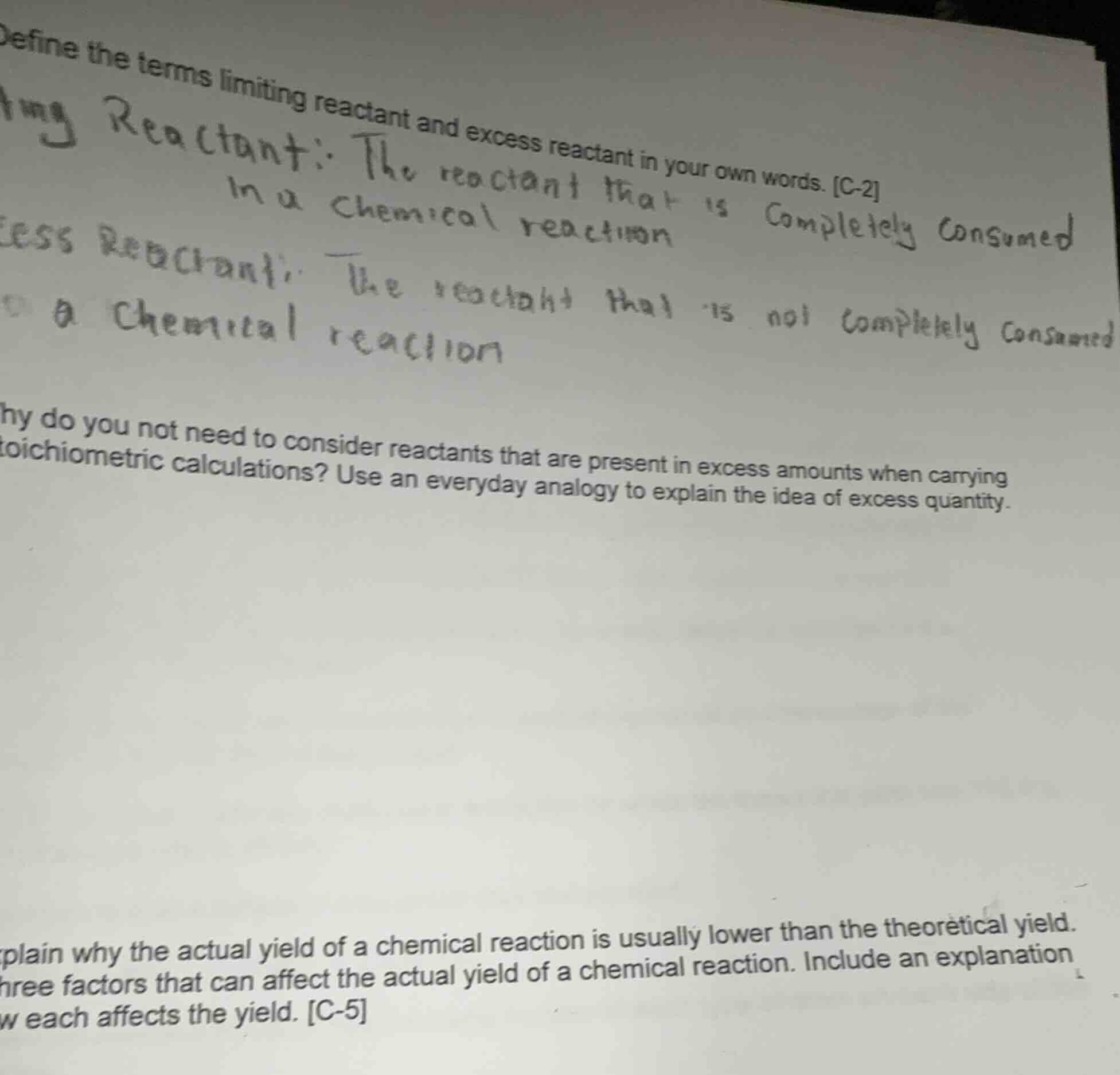
define the terms limiting reactant and excess reactant in your own words. c-2
why do you not need to consider reactants that are present in excess amounts when carrying out stoichiometric calculations? use an everyday analogy to explain the idea of excess quantity.
explain why the actual yield of a chemical reaction is usually lower than the theoretical yield. name three factors that can affect the actual yield of a chemical reaction. include an explanation of how each affects the yield. c-5
Part 1: Define Limiting and Excess Reactant
Limiting Reactant
In a chemical reaction, the limiting reactant is the substance that gets completely used up. Once it’s all consumed, the reaction stops because there’s no more of this reactant to keep the reaction going. It “limits” how much product can be made.
Excess Reactant
The excess reactant is a reactant that isn’t fully used up in the reaction. After the limiting reactant is gone, some of this reactant still remains because there was more of it than needed to react with the limiting reactant.
Part 2: Excess Reactants in Stoichiometry & Analogy
Why Excess Reactants Are Ignored in Stoichiometry
Stoichiometric calculations (like finding how much product forms) depend on the limiting reactant because it’s the one that runs out first. The excess reactant has more than enough to react with the limiting reactant, so only the amount of the limiting reactant determines how much product is made. The extra excess reactant doesn’t contribute to more product (since the limiting reactant is already gone).
Everyday Analogy (e.g., Making Sandwiches)
Imagine you’re making peanut butter and jelly sandwiches. To make 1 sandwich, you need:
- 2 slices of bread (let’s call this “Reactant B”)
- 1 tablespoon of peanut butter (Reactant P)
- 1 tablespoon of jelly (Reactant J)
Suppose you have:
- 4 slices of bread (so 2 sandwiches’ worth of bread)
- 1 tablespoon of peanut butter
- 3 tablespoons of jelly
Here:
- Limiting Reactant: Peanut butter (only 1 tbsp—enough for 1 sandwich).
- Excess Reactants: Bread (4 slices – 2 used = 2 left) and jelly (3 tbsp – 1 used = 2 left).
Even though you have extra bread and jelly, you can only make 1 sandwich because the peanut butter (limiting reactant) runs out. The extra bread and jelly are “excess” and don’t let you make more sandwiches—just like excess reactants in chemistry don’t let you make more product than the limiting reactant allows.
Part 3: Actual Yield vs. Theoretical Yield
The theoretical yield is the maximum amount of product calculated from stoichiometry (using the limiting reactant). The actual yield is how much product you actually get in a real experiment. Actual yield is usually lower than theoretical yield because of:
1. Incomplete Reactions
Reactions often don’t go to completion (100% of reactants become products). Some reactants might stay unreacted, or the reaction might stop early (e.g., reversible reactions that reach equilibrium before all reactants are used).
2. Side Reactions
Instead of only forming the desired product, reactants might react in other ways (side reactions) to make unwanted byproducts. This means less of the desired product is formed. For example, burning methane (CH₄) might also produce carbon monoxide (CO) instead of just carbon dioxide (CO₂) if there’s not enough oxygen.
3. Loss During Separation/Purification
After the reaction, you have to separate the product from the mixture (e.g., filtering, distilling, or drying). Some product might be lost during these steps (e.g., sticking to filter paper, evaporating, or being left behind in equipment).
Final Answers (Summarized)
- Limiting Reactant: Reactant completely consumed, limits product.
Excess Reactant: Reactant not fully consumed, remains after reaction.
- Excess Reactants in Stoichiometry: Only the limiting reactant determines product amount (excess has more than needed). Analogy: Peanut butter limits sandwich production, even with extra bread/jelly.
- **Actual Yield < Theor…

Snap & solve any problem in the app
Get step-by-step solutions on Sovi AI
Photo-based solutions with guided steps
Explore more problems and detailed explanations
Part 1: Define Limiting and Excess Reactant
Limiting Reactant
In a chemical reaction, the limiting reactant is the substance that gets completely used up. Once it’s all consumed, the reaction stops because there’s no more of this reactant to keep the reaction going. It “limits” how much product can be made.
Excess Reactant
The excess reactant is a reactant that isn’t fully used up in the reaction. After the limiting reactant is gone, some of this reactant still remains because there was more of it than needed to react with the limiting reactant.
Part 2: Excess Reactants in Stoichiometry & Analogy
Why Excess Reactants Are Ignored in Stoichiometry
Stoichiometric calculations (like finding how much product forms) depend on the limiting reactant because it’s the one that runs out first. The excess reactant has more than enough to react with the limiting reactant, so only the amount of the limiting reactant determines how much product is made. The extra excess reactant doesn’t contribute to more product (since the limiting reactant is already gone).
Everyday Analogy (e.g., Making Sandwiches)
Imagine you’re making peanut butter and jelly sandwiches. To make 1 sandwich, you need:
- 2 slices of bread (let’s call this “Reactant B”)
- 1 tablespoon of peanut butter (Reactant P)
- 1 tablespoon of jelly (Reactant J)
Suppose you have:
- 4 slices of bread (so 2 sandwiches’ worth of bread)
- 1 tablespoon of peanut butter
- 3 tablespoons of jelly
Here:
- Limiting Reactant: Peanut butter (only 1 tbsp—enough for 1 sandwich).
- Excess Reactants: Bread (4 slices – 2 used = 2 left) and jelly (3 tbsp – 1 used = 2 left).
Even though you have extra bread and jelly, you can only make 1 sandwich because the peanut butter (limiting reactant) runs out. The extra bread and jelly are “excess” and don’t let you make more sandwiches—just like excess reactants in chemistry don’t let you make more product than the limiting reactant allows.
Part 3: Actual Yield vs. Theoretical Yield
The theoretical yield is the maximum amount of product calculated from stoichiometry (using the limiting reactant). The actual yield is how much product you actually get in a real experiment. Actual yield is usually lower than theoretical yield because of:
1. Incomplete Reactions
Reactions often don’t go to completion (100% of reactants become products). Some reactants might stay unreacted, or the reaction might stop early (e.g., reversible reactions that reach equilibrium before all reactants are used).
2. Side Reactions
Instead of only forming the desired product, reactants might react in other ways (side reactions) to make unwanted byproducts. This means less of the desired product is formed. For example, burning methane (CH₄) might also produce carbon monoxide (CO) instead of just carbon dioxide (CO₂) if there’s not enough oxygen.
3. Loss During Separation/Purification
After the reaction, you have to separate the product from the mixture (e.g., filtering, distilling, or drying). Some product might be lost during these steps (e.g., sticking to filter paper, evaporating, or being left behind in equipment).
Final Answers (Summarized)
- Limiting Reactant: Reactant completely consumed, limits product.
Excess Reactant: Reactant not fully consumed, remains after reaction.
- Excess Reactants in Stoichiometry: Only the limiting reactant determines product amount (excess has more than needed). Analogy: Peanut butter limits sandwich production, even with extra bread/jelly.
- Actual Yield < Theoretical Yield due to incomplete reactions, side reactions, and loss during purification.