QUESTION IMAGE
Question
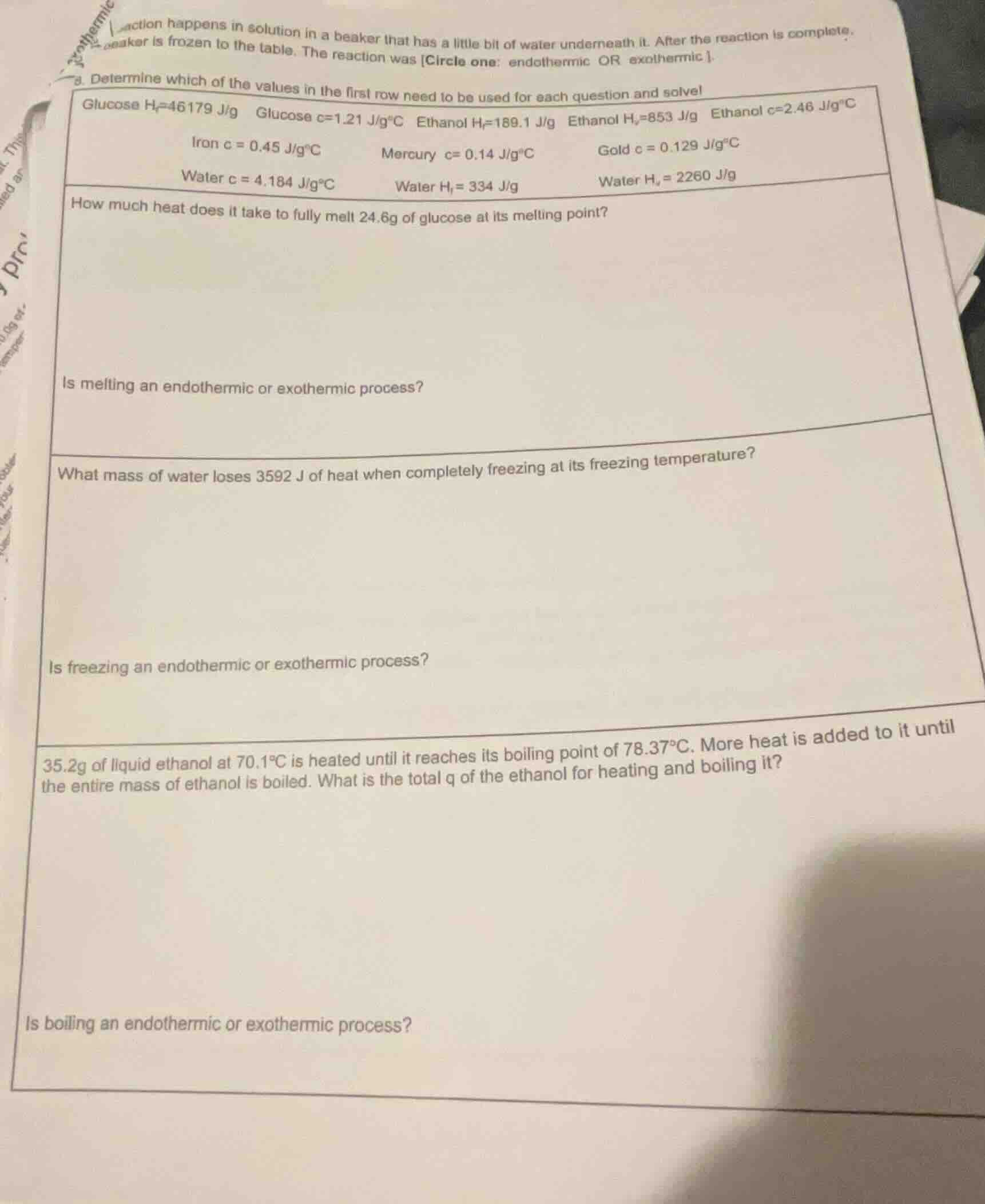
- determine which of the values in the first row need to be used for each question and solve
glucose ( h_f = 46179 , \text{j/g} ) glucose ( c = 1.21 , \text{j/g}^circ\text{c} ) ethanol ( h_f = 189.1 , \text{j/g} ) ethanol ( h_v = 853 , \text{j/g} ) ethanol ( c = 2.46 , \text{j/g}^circ\text{c} )
iron ( c = 0.45 , \text{j/g}^circ\text{c} ) mercury ( c = 0.14 , \text{j/g}^circ\text{c} ) gold ( c = 0.129 , \text{j/g}^circ\text{c} )
water ( c = 4.184 , \text{j/g}^circ\text{c} ) water ( h_f = 334 , \text{j/g} ) water ( h_v = 2260 , \text{j/g} )
how much heat does it take to fully melt 24.6g of glucose at its melting point?
is melting an endothermic or exothermic process?
what mass of water loses 3592 j of heat when completely freezing at its freezing temperature?
is freezing an endothermic or exothermic process?
35.2g of liquid ethanol at ( 70.1^circ\text{c} ) is heated until it reaches its boiling point of ( 78.37^circ\text{c} ). more heat is added to it until the entire mass of ethanol is boiled. what is the total ( q ) of the ethanol for heating and boiling it?
is boiling an endothermic or exothermic process?
1. How much heat does it take to fully melt 24.6g of glucose at its melting point?
Step1: Identify the formula for heat of fusion
The heat required to melt a substance at its melting point is given by \( q = m \times H_f \), where \( m \) is the mass and \( H_f \) is the heat of fusion.
Step2: Substitute the values
Given \( m = 24.6 \, \text{g} \) and \( H_f \) for glucose is \( 46179 \, \text{J/g} \). So, \( q = 24.6 \, \text{g} \times 46179 \, \text{J/g} \).
Step3: Calculate the heat
\( q = 24.6 \times 46179 = 1136003.4 \, \text{J} \) (approx).
Melting requires heat to be absorbed by the substance to change from solid to liquid. Endothermic processes absorb heat.
Step1: Identify the formula for heat of fusion (freezing is reverse of melting)
The heat released during freezing is \( q = m \times H_f \) (here \( q \) is the heat lost, so we can use \( m=\frac{q}{H_f} \)).
Step2: Substitute the values
Given \( q = 3592 \, \text{J} \) and \( H_f \) for water is \( 334 \, \text{J/g} \). So, \( m=\frac{3592}{334} \).
Step3: Calculate the mass
\( m = \frac{3592}{334}=10.7545 \, \text{g} \) (approx 10.8 g).

Snap & solve any problem in the app
Get step-by-step solutions on Sovi AI
Photo-based solutions with guided steps
Explore more problems and detailed explanations
\( 1136003.4 \, \text{J} \) (or more precisely, \( 24.6\times46179 = 1136003.4 \, \text{J} \))