QUESTION IMAGE
Question
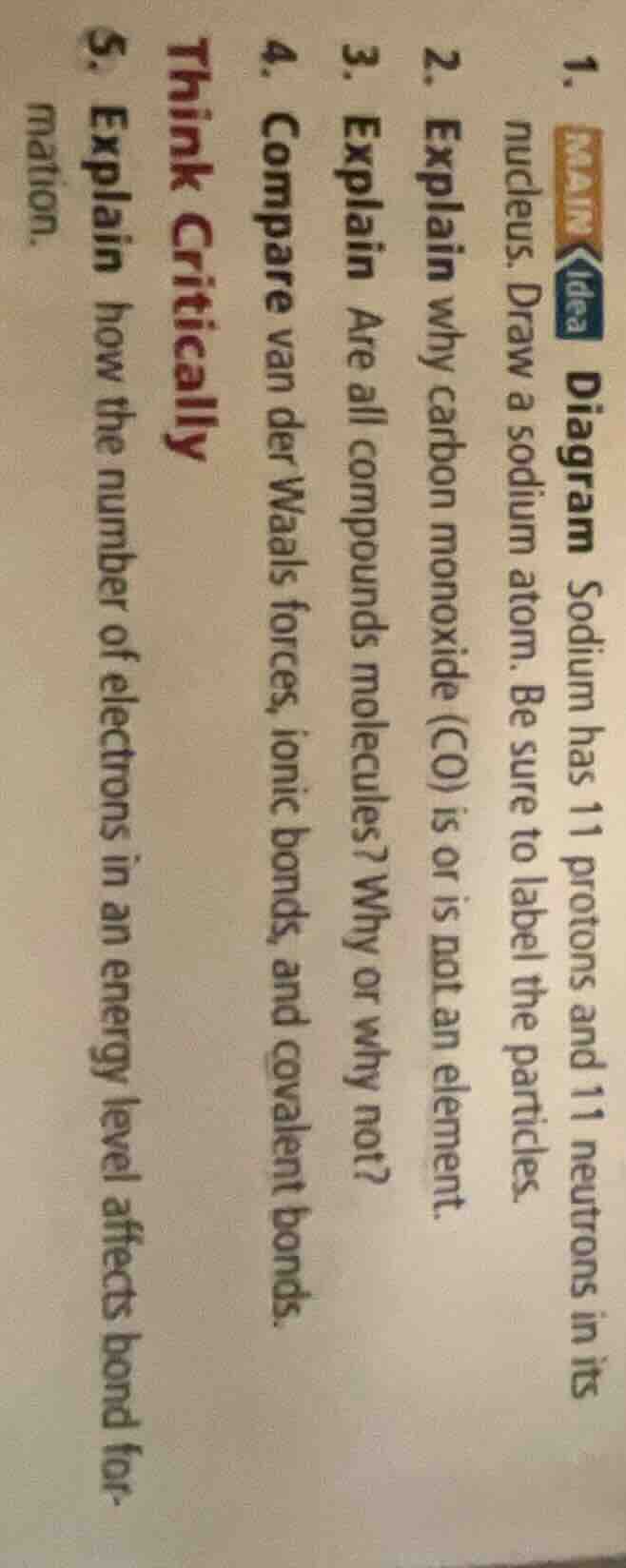
- diagram sodium has 11 protons and 11 neutrons in its nucleus. draw a sodium atom. be sure to label the particles. 2. explain why carbon monoxide (co) is or is not an element. 3. explain are all compounds molecules? why or why not? 4. compare van der waals forces, ionic bonds, and covalent bonds. think critically 5. explain how the number of electrons in an energy level affects bond for - mation.
Since there are multiple sub - questions, we'll address them one by one using the appropriate format (Answer - Explanation Format for these conceptual chemistry questions which fall under Natural Science - Chemistry subfield).
Sub - question 1: Diagram Sodium Atom
A sodium atom has 11 protons and 11 neutrons in the nucleus. The electrons are arranged in energy levels: 2 in the first (n = 1), 8 in the second (n = 2), and 1 in the third (n = 3). To draw it, sketch a central nucleus labeled with "11 protons, 11 neutrons". Then draw three concentric circles (energy levels) around it. Put 2 electrons on the innermost circle, 8 on the middle, and 1 on the outermost. Label each energy level and the electrons.
An element is a pure substance made of only one type of atom. Carbon monoxide (CO) is made of two different types of atoms: carbon (C) and oxygen (O). So it is a compound, not an element, as it contains atoms of multiple elements chemically combined.
Not all compounds are molecules. Ionic compounds (e.g., NaCl) are compounds. In ionic compounds, ions are held together by ionic bonds in a crystal lattice, not as discrete molecules. Molecular compounds (e.g., H₂O) are made of molecules. So while molecular compounds are molecules, ionic compounds are not, so not all compounds are molecules.

Snap & solve any problem in the app
Get step-by-step solutions on Sovi AI
Photo-based solutions with guided steps
Explore more problems and detailed explanations
Draw a central nucleus (label: 11 protons, 11 neutrons). Draw three energy levels (circles) around it. First level: 2 electrons, second: 8 electrons, third: 1 electron. Label each part (nucleus, energy levels, electrons).