QUESTION IMAGE
Question
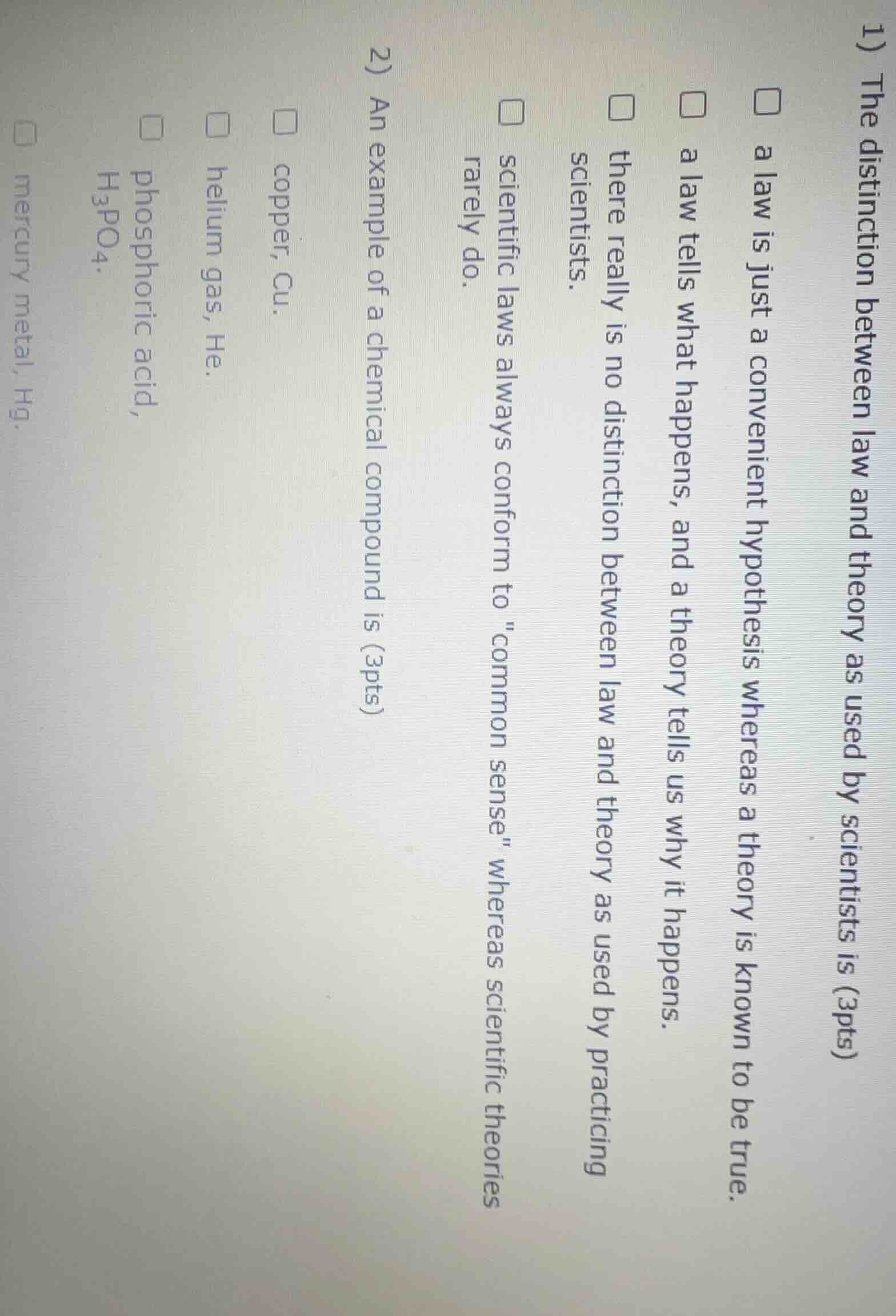
- the distinction between law and theory as used by scientists is (3pts)
□ a law is just a convenient hypothesis whereas a theory is known to be true.
□ a law tells what happens, and a theory tells us why it happens.
□ there really is no distinction between law and theory as used by practicing scientists.
□ scientific laws always conform to \common sense\ whereas scientific theories rarely do.
- an example of a chemical compound is (3pts)
□ copper, cu.
□ helium gas, he.
□ phosphoric acid, h₃po₄.
□ mercury metal, hg.
Brief Explanations
- For the first question: Scientific laws describe observed phenomena (what happens), while theories explain the underlying reasons (why it happens). The other options are incorrect: laws are well-supported (not just convenient hypotheses), there is a clear distinction between laws and theories, and laws do not always align with common sense.
- For the second question: A chemical compound is a substance made of two or more different elements bonded together. Copper (Cu), helium (He), and mercury (Hg) are pure elements, while phosphoric acid ($H_3PO_4$) contains hydrogen, phosphorus, and oxygen, making it a compound.

Snap & solve any problem in the app
Get step-by-step solutions on Sovi AI
Photo-based solutions with guided steps
Explore more problems and detailed explanations
- a law tells what happens, and a theory tells us why it happens.
- phosphoric acid, $H_3PO_4$.