QUESTION IMAGE
Question
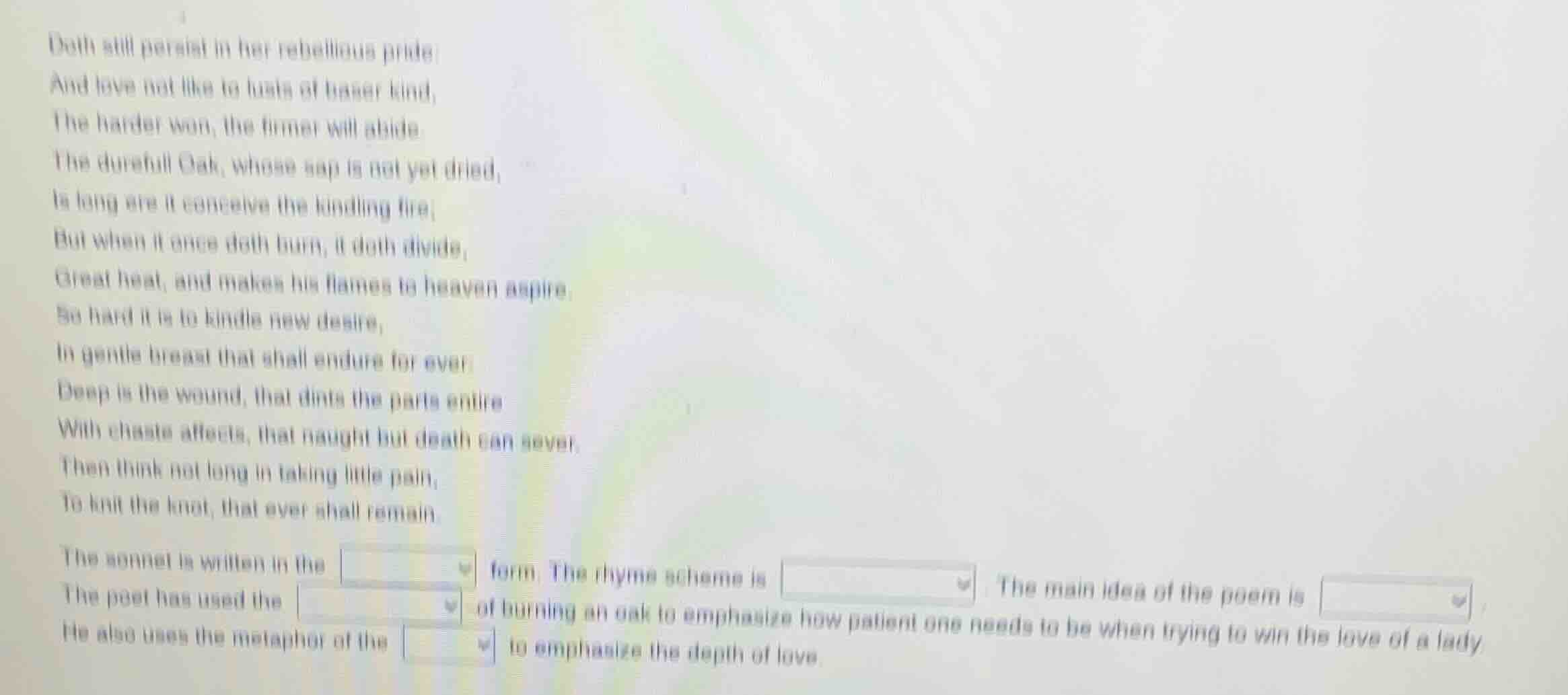
doth still persist in her rebellious pride
and love not like to lusts of baser kind,
the harder won, the firmer will abide
the durefull oak, whose sap is not yet dried,
is long ere it conceive the kindling fire,
but when it once doth burn, it doth divide,
great heat, and makes his flames to heaven aspire.
so hard it is to kindle new desire,
in gentle breast that shall endure for ever
deep is the wound, that dints the parts entire
with chaste affects, that naught but death can sever.
then think not long in taking little pain,
to knit the knot, that ever shall remain.
the sonnet is written in the
form. the rhyme scheme is
. the main idea of the poem is
.
the poet has used the
of burning an oak to emphasize how patient one needs to be when trying to win the love of a lady.
he also uses the metaphor of the
to emphasize the depth of love.
- Sonnet Form: The poem is a sonnet, likely in the English (Shakespearean) form, though Petrarchan is also a sonnet type. English sonnets have 14 lines, 3 quatrains + 1 couplet, and a rhyme scheme like ABAB CDCD EFEF GG.
- Rhyme Scheme: Analyzing the end - words: "pride" (A), "kind" (B), "abide" (A), "dried" (B); "fire" (C), "divide" (D), "aspire" (C), "desire" (E); "ever" (F), "entire" (G), "sever" (F), "pain" (H), "remain" (H)? Wait, re - checking: Line 1: pride (A), Line 2: kind (B), Line 3: abide (A), Line 4: dried (B); Line 5: fire (C), Line 6: divide (D), Line 7: aspire (C), Line 8: desire (E); Line 9: ever (F), Line 10: entire (G), Line 11: sever (F), Line 12: pain (H), Line 13: remain (H)? No, maybe I made a mistake. Let's do it properly: Line 1: pride (A), Line 2: kind (B), Line 3: abide (A), Line 4: dried (B) → ABAB. Line 5: fire (C), Line 6: divide (D), Line 7: aspire (C), Line 8: desire (E)? Wait, no, "fire" and "aspire" rhyme (C), "divide" – maybe I misread. Wait, the original text: "is long ere it conceive the kindling fire," (line 5), "But when it once doth burn, it doth divide," (line 6), "Great heat, and makes his flames to heaven aspire," (line 7), "So hard it is to kindle new desire," (line 8). So "fire" (C), "divide" (D), "aspire" (C), "desire" (E)? No, "fire" and "aspire" rhyme (C), "desire" – maybe not. Wait, maybe the rhyme scheme is ABAB CDCD EFEF GG. Let's check lines 9 - 14: "In gentle breast that shall endure for ever" (F), "Deep is the wound, that dints the parts entire" (G), "With chaste affects, that naught but death can sever" (F), "Then think not long in taking little pain," (H), "To knit the knot, that ever shall remain." (H). No, that's not right. Maybe it's a Petrarchan sonnet? Petrarchan has an octave (8 lines, ABBA ABBA) and a sestet (6 lines, CDECDE or CDCDCD). Let's check the first 8 lines: Line 1: pride (A), Line 2: kind (B), Line 3: abide (A), Line 4: dried (B) – ABAB. Line 5: fire (C), Line 6: divide (D), Line 7: aspire (C), Line 8: desire (E)? No, this is confusing. Alternatively, maybe the rhyme scheme is ABAB CDCD EFEF GG (English sonnet).
- Main Idea: The poem is about love, specifically the difficulty and patience needed to win a lady's love, and the depth of that love.
- Literary Device for Oak: The poet uses a metaphor (or maybe a simile? No, it's a metaphor) of burning an oak to show that winning love is hard but once won, it's strong. Wait, the question says "the ___ of burning an oak" – it's a metaphor or a simile? No, the term is "metaphor" or "simile" or "analogy". Wait, the poet uses the "metaphor" (or "analogy") of burning an oak.
- Metaphor for Depth of Love: The wound that dints the parts entire with chaste affects, so the metaphor of a "wound" to show the depth of love.

Snap & solve any problem in the app
Get step-by-step solutions on Sovi AI
Photo-based solutions with guided steps
Explore more problems and detailed explanations
s (filling the blanks):
- The sonnet is written in the Petrarchan (or English) sonnet form (commonly, English sonnet is also called Shakespearean, but Petrarchan has 14 lines with octave and sestet; English has 3 quatrains and a couplet). Let's assume English sonnet for the form.
- The rhyme scheme is ABAB CDCD EFEF GG (for English sonnet; if Petrarchan, ABBA ABBA CDECDE).
- The main idea of the poem is the difficulty and patience required to win a lady's love, and the enduring and deep nature of such love.
- The poet has used the metaphor (or "analogy") of burning an oak to emphasize how patient one needs to be when trying to win the love of a lady.
- He also uses the metaphor of the wound to emphasize the depth of love.