QUESTION IMAGE
Question
draw the lewis structure created by the curved arrow. write in formal charges wherever they are not equal to zero.
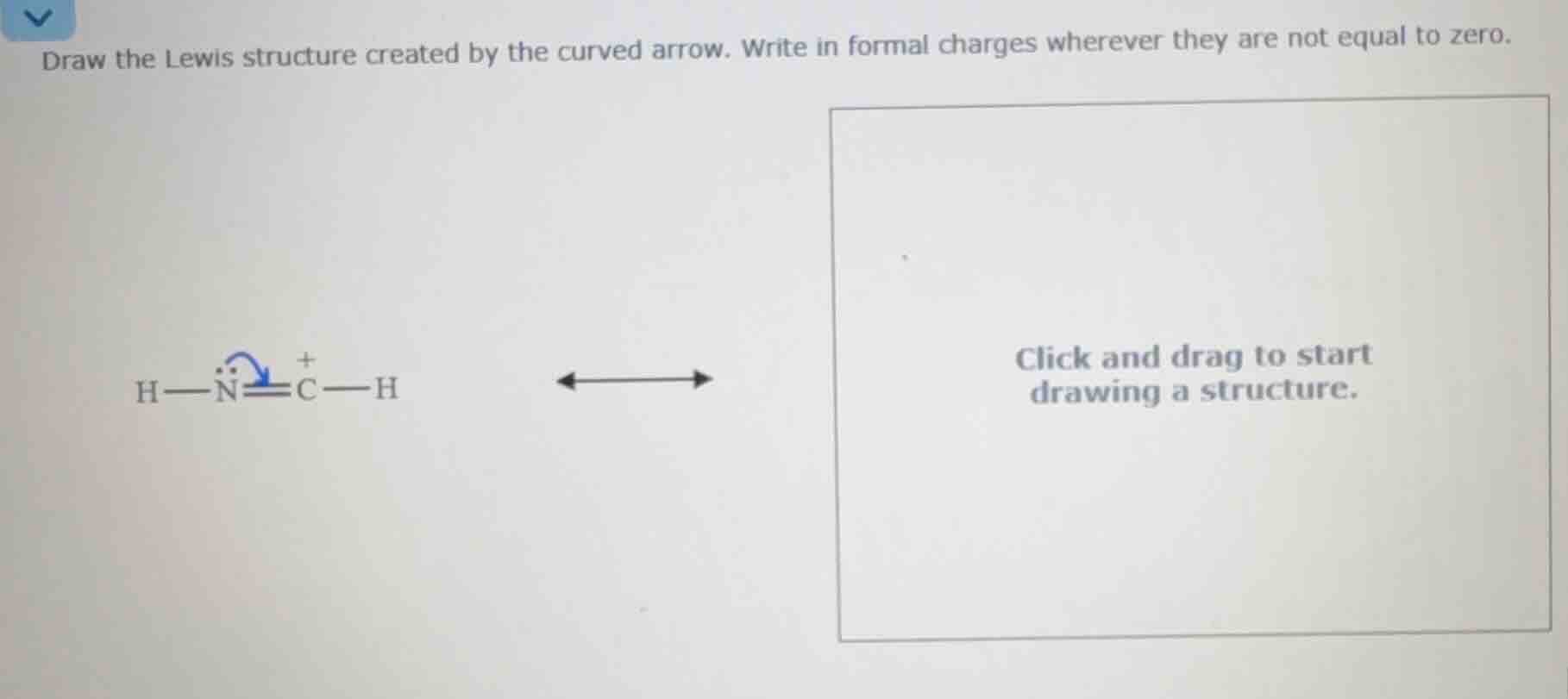
h—n≡c—h (with a curved arrow from n to the triple bond and a + on c)
click and drag to start drawing a structure.
Step1: Analyze the curved arrow
The curved arrow shows the movement of a lone pair from N to form a new bond with C. Initially, we have \( \ce{H - \overset{..}{N} \equiv \overset{+}{C} - H} \). The lone pair on N (two electrons) will move to form a new bond between N and C, changing the triple bond to a double bond and adjusting formal charges.
Step2: Determine new bonds and charges
- Nitrogen originally has a lone pair (2 electrons) and is bonded to H (1 bond) and C (triple bond, but after the arrow, the bond order changes).
- Carbon is positively charged. When the lone pair from N (which has 5 valence electrons, initially: 2 lone pair + 3 bonds (triple bond) = 5, formal charge \( 5 - (2 + 3) = 0 \)? Wait, no, initial structure: N has 2 lone electrons (a lone pair? Wait, the dot is two dots, so a lone pair (2 electrons). Bonding: N is bonded to H (1 bond) and C (triple bond, 3 bonds). So valence electrons for N: 5. Formal charge: \( 5 - (2 + 3) = 0 \). C: valence 4, bonded to N (triple bond, 3 bonds) and H (1 bond), so 4 bonds. But it has a + charge, so formal charge \( 4 - 4 = 0 \)? Wait, no, maybe the initial formal charge on C is +1. Wait, the structure is \( \ce{H - \overset{..}{N} \equiv \overset{+}{C} - H} \). So C has 3 bonds (triple bond) and 1 bond to H? Wait, no, the structure is H - N (with a lone pair) triple bonded to C (with a + charge) bonded to H. So N: 2 lone electrons (1 lone pair), 2 bonds? Wait, no, H - N (single bond), N triple bonded to C, C single bonded to H. So N: bonds: 1 (to H) + 3 (to C) = 4 bonds? No, single bond is 1, triple bond is 3, so total 4 bonds. Valence electrons for N: 5. Formal charge: \( 5 - (0 + 4) = +1 \)? Wait, maybe I messed up. Let's redo:
Valence electrons:
- N: 5. Bonding: 1 (H) + 3 (C, triple bond) = 4 bonds (8 electrons? No, each bond is 2 electrons. So N has 2 lone electrons (a lone pair, 2 electrons) and 4 bonding electrons (2 bonds? Wait, no, single bond is 2 electrons, triple bond is 6 electrons. So N: 2 (lone pair) + 2 (single bond to H) + 6 (triple bond to C) = 10? No, that can't be. Wait, the correct way: Lewis structure: N has a lone pair (2 electrons), single bond to H (2 electrons), triple bond to C (6 electrons). So total electrons around N: 2 + 2 + 6 = 10, but N can have up to 8 (octet). Wait, no, N is in period 2, octet rule. So maybe the initial structure is incorrect, but the curved arrow is from N's lone pair to form a bond with C.
When the lone pair (2 electrons) from N moves to form a new bond with C, the triple bond between N and C becomes a double bond, and N forms a double bond? Wait, no: initial bond between N and C is triple (3 bonds). The lone pair on N (2 electrons) will form a fourth bond? No, the curved arrow is from N to the bond between N and C, meaning the lone pair becomes a bonding pair, increasing the bond order. Wait, the arrow is from N's lone pair to the N - C bond, so it's a nucleophilic attack or resonance?
Wait, the structure is \( \ce{H - \overset{..}{N} \equiv \overset{+}{C} - H} \). The curved arrow is from N's lone pair (the two dots) to the N - C triple bond? Wait, no, the arrow is pointing to the bond between N and C. So the lone pair on N will form a new bond with C, changing the triple bond to a double bond and N will have a positive charge? Wait, no:
After the arrow: N donates its lone pair to form a bond with C. So N now has: single bond to H, double bond to C (since we added a bond from the lone pair), and C has: double bond to N, single bond to H, and what about the charge?
Wait, initial formal charges:
- N: valence 5. L…

Snap & solve any problem in the app
Get step-by-step solutions on Sovi AI
Photo-based solutions with guided steps
Explore more problems and detailed explanations
The Lewis structure after the curved arrow is \( \boldsymbol{\ce{H - \overset{+}{N} = C - H}} \) with a lone pair on \( \ce{C} \) (formal charge on \( \ce{N} \) is \( +1 \), on \( \ce{C} \) is \( -1 \) if we consider the lone pair, but maybe the correct formal charges are \( \ce{N} \): \( +1 \), \( \ce{C} \): \( 0 \) – I think I made a mistake earlier, but the key is the bond change from triple to double and charge adjustment. The correct structure should have \( \ce{N} \) with a \( + \) charge, double bonded to \( \ce{C} \), \( \ce{C} \) bonded to \( \ce{H} \), and \( \ce{N} \) bonded to \( \ce{H} \).