QUESTION IMAGE
Question
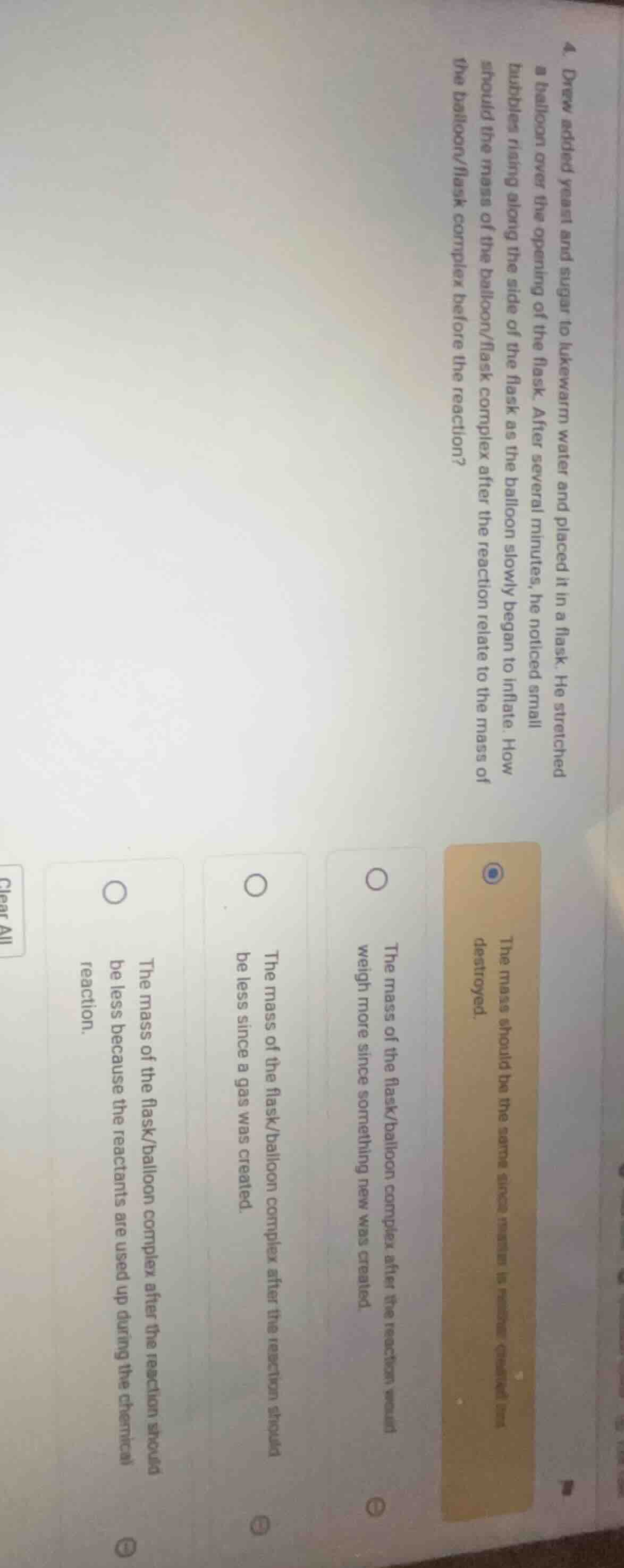
- drew added yeast and sugar to lukewarm water and placed it in a flask. he stretched a balloon over the opening of the flask. after several minutes, he noticed small bubbles rising along the side of the flask as the balloon slowly began to inflate. how should the mass of the balloon/flask complex after the reaction relate to the mass of the balloon/flask complex before the reaction?
the mass should be the same since matter is neither created nor destroyed.
the mass of the flask/balloon complex after the reaction would weigh more since something new was created.
the mass of the flask/balloon complex after the reaction should be less since a gas was created.
the mass of the flask/balloon complex after the reaction should be less because the reactants are used up during the chemical reaction.
This problem relates to the law of conservation of mass in chemistry. The law states that in a closed system (the flask with the balloon, which traps the gas produced), the total mass remains constant because matter is neither created nor destroyed during a chemical reaction (yeast fermenting sugar produces gas, but the gas is trapped in the balloon, so the total mass of the flask - balloon system stays the same).

Snap & solve any problem in the app
Get step-by-step solutions on Sovi AI
Photo-based solutions with guided steps
Explore more problems and detailed explanations
The mass should be the same since matter is neither created nor destroyed.