QUESTION IMAGE
Question
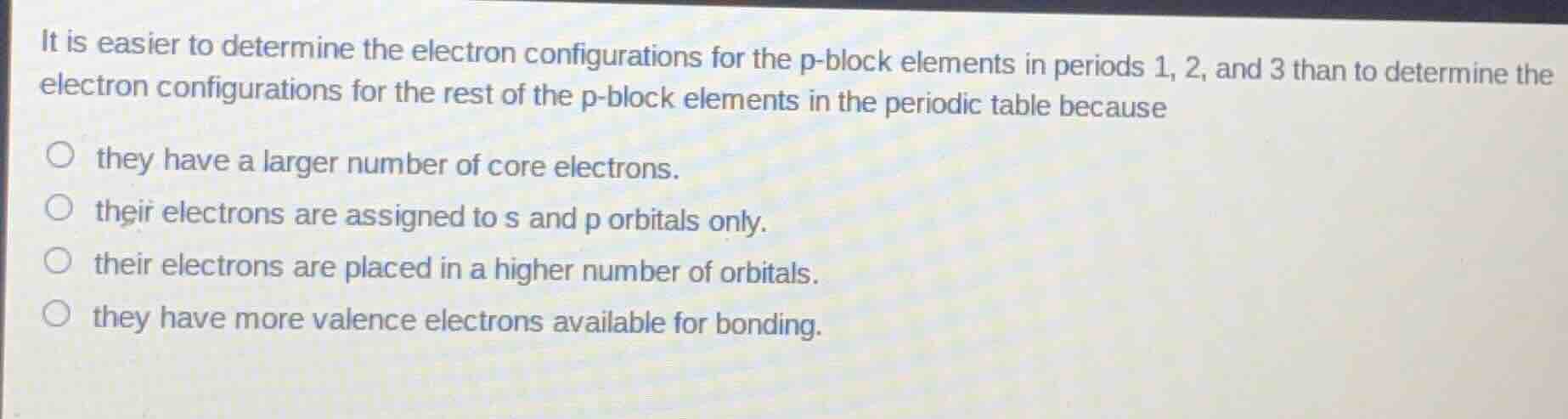
it is easier to determine the electron configurations for the p-block elements in periods 1, 2, and 3 than to determine the electron configurations for the rest of the p-block elements in the periodic table because
○ they have a larger number of core electrons.
○ their electrons are assigned to s and p orbitals only.
○ their electrons are placed in a higher number of orbitals.
○ they have more valence electrons available for bonding.
Brief Explanations
- Analyze Option 1: Elements in periods 1 - 3 p - block have fewer core electrons (since they have fewer inner shells) compared to heavier p - block elements. So this option is incorrect.
- Analyze Option 2: For p - block elements in periods 1, 2, and 3, the electron configuration only involves filling s and p orbitals. Heavier p - block elements (periods 4 and above) may have electrons in d (and f for period 6 and 7) orbitals as well (due to the Aufbau principle and the availability of these orbitals). So the simplicity in determining their electron configurations comes from the fact that electrons are assigned to s and p orbitals only.
- Analyze Option 3: Heavier p - block elements have electrons in more orbitals (including d and f orbitals), while periods 1 - 3 p - block elements have electrons in fewer orbitals (s and p). So this option is incorrect.
- Analyze Option 4: The number of valence electrons for p - block elements follows a pattern (group number - 10 for main - group p - block, or group number for groups 13 - 18), but the ease of electron configuration determination is not related to the number of valence electrons for bonding in this context.

Snap & solve any problem in the app
Get step-by-step solutions on Sovi AI
Photo-based solutions with guided steps
Explore more problems and detailed explanations
B. their electrons are assigned to s and p orbitals only.