QUESTION IMAGE
Question
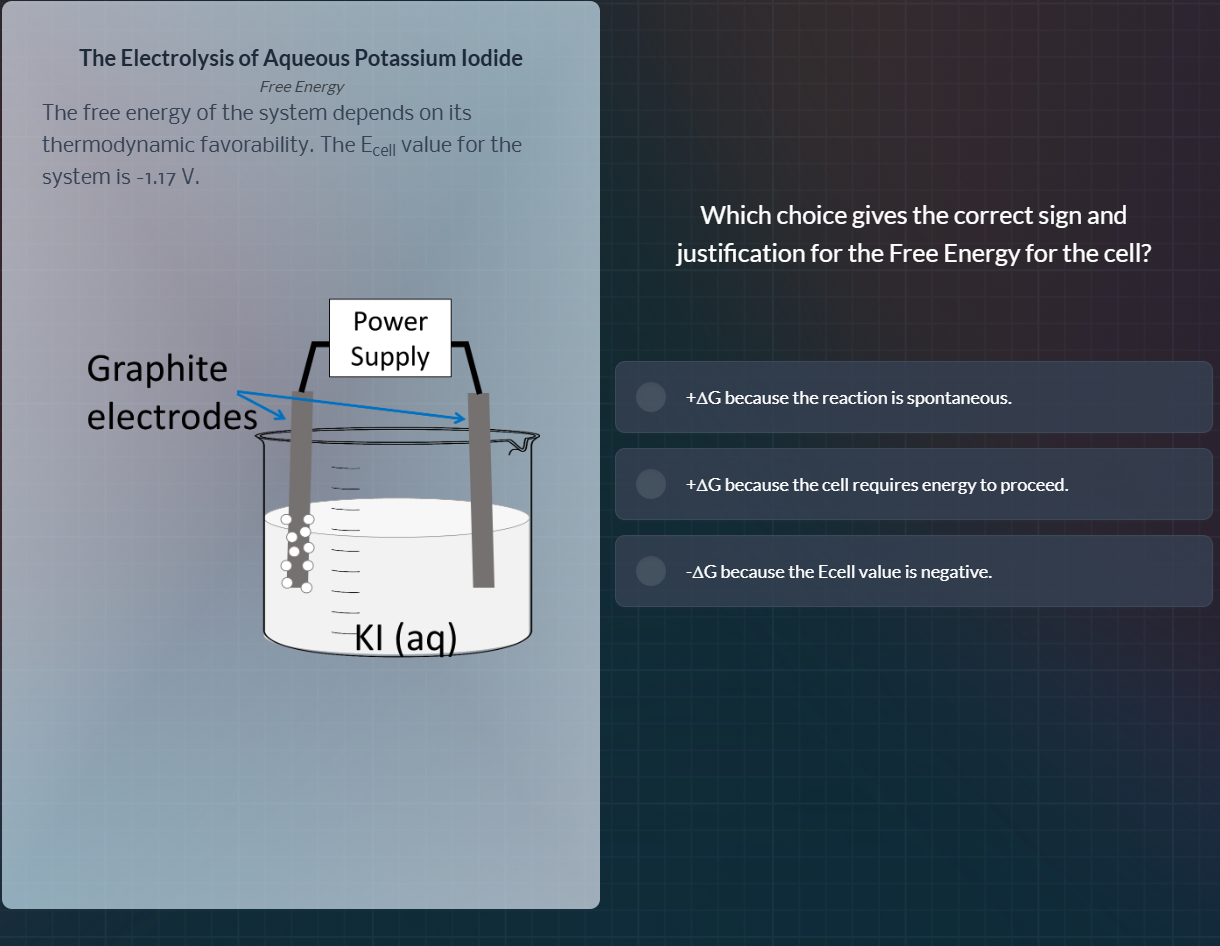
the electrolysis of aqueous potassium iodide
free energy
the free energy of the system depends on its
thermodynamic favorability. the ( e_{\text{cell}} ) value for the
system is -1.17 v.
graphite
electrodes
power
supply
ki (aq)
which choice gives the correct sign and
justification for the free energy for the cell?
+δg because the reaction is spontaneous.
+δg because the cell requires energy to proceed.
-δg because the ( e_{\text{cell}} ) value is negative.
To determine the sign of free energy ($\Delta G$) for an electrochemical cell, we use the relationship $\Delta G = -nFE_{\text{cell}}$, where $n$ is the moles of electrons, $F$ is Faraday's constant, and $E_{\text{cell}}$ is the cell potential.
- If $E_{\text{cell}} < 0$, the reaction is non - spontaneous (electrolytic cell, requires external energy).
- From $\Delta G=-nFE_{\text{cell}}$, when $E_{\text{cell}}=- 1.17\space V$ (negative), $\Delta G$ will be positive (since $n$ and $F$ are positive, a negative times a negative gives a positive). A positive $\Delta G$ means the cell reaction is non - spontaneous and requires energy (from the power supply) to proceed.
Let's analyze the options:
- Option 1: A spontaneous reaction has $\Delta G < 0$ and $E_{\text{cell}}>0$. So this is incorrect.
- Option 2: Since $E_{\text{cell}}$ is negative, using $\Delta G=-nFE_{\text{cell}}$, $\Delta G$ is positive. A positive $\Delta G$ indicates the reaction is non - spontaneous and needs external energy (from the power supply) to occur. This is correct.
- Option 3: From $\Delta G=-nFE_{\text{cell}}$, a negative $E_{\text{cell}}$ leads to a positive $\Delta G$, not negative. So this is incorrect.

Snap & solve any problem in the app
Get step-by-step solutions on Sovi AI
Photo-based solutions with guided steps
Explore more problems and detailed explanations
+$\Delta G$ because the cell requires energy to proceed.