QUESTION IMAGE
Question
elements, compounds, and mixtures
classify each of the pictures by matching the correct label in the blanks below:
a= element
b= compound
c= mixture of elements
d= mixture of compounds
e= mixture of elements and compounds
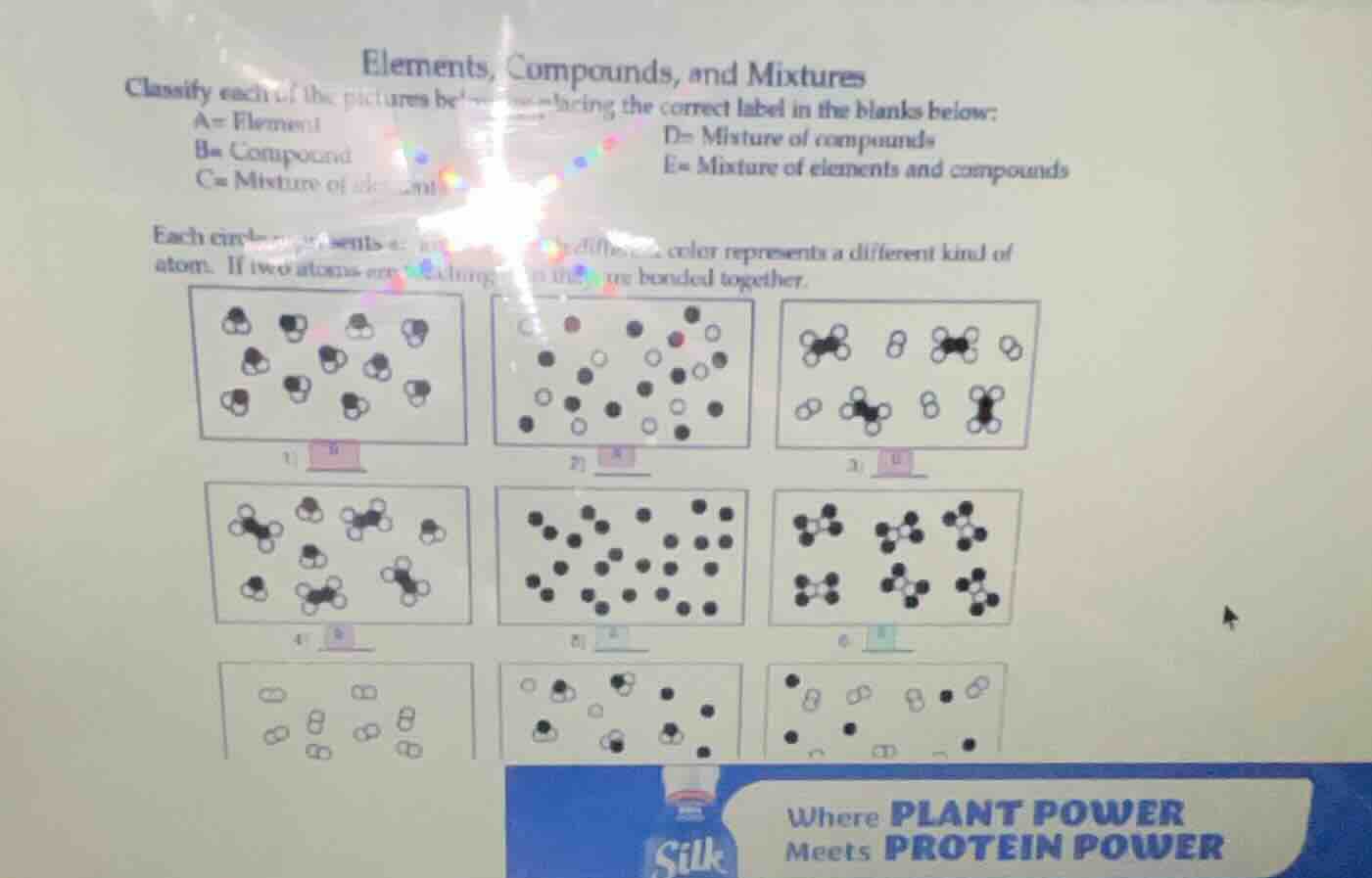
each circle represents an atom. different color represents a different kind of atom. if two atoms are touching, they are bonded together.
1)
2)
3)
4)
5)
6)
where plant power meets protein power
To solve this, we analyze each diagram based on the definitions:
1. First Diagram (Top - Left)
- All molecules are the same (two types of atoms bonded, so a compound). And there’s only one type of compound. Wait, no—wait, the label for B is “Compound”? Wait, no, the first diagram: each molecule has two types of atoms (so compound), and only one kind of compound. Wait, but the options: B is Compound? Wait, no, the first diagram (top - left) has molecules with two atoms (different colors) bonded. So it's a compound (B)? Wait, no, the user's initial labels: A = Element, B = Compound, C = Mixture of elements, D = Mixture of compounds, E = Mixture of elements and compounds.
Wait, let's re - examine:
- Element (A): Only one type of atom (single or bonded to same - type atoms).
- Compound (B): Only one type of molecule, with two or more different atoms bonded.
- Mixture of elements (C): Two or more types of unbonded atoms (different elements, not in molecules).
- Mixture of compounds (D): Two or more types of compound molecules (different compounds, no elements).
- Mixture of elements and compounds (E): Both unbonded atoms (elements) and compound molecules.
1. First Diagram (Top - Left)
All molecules are identical, with two different atoms bonded. So it's a Compound (B).
2. Second Diagram (Top - Middle)
There are multiple types of unbonded atoms (different colors, not in molecules). So it's a Mixture of elements (C).
3. Third Diagram (Top - Right)
There are two types of molecules: one with a central black atom and white atoms (a compound), and another with two white atoms (an element, since same - type atoms). So we have both compound molecules and element (unbonded same - type atoms). Thus, it's a Mixture of elements and compounds (E).
4. Fourth Diagram (Middle - Left)
There are two types of compound molecules (different structures: one with a central black and white atoms, another with two white and one black? Wait, no—wait, the molecules have different arrangements? Wait, no, looking at the diagram: there are two types of compound molecules (different structures). So it's a Mixture of compounds (D).
5. Fifth Diagram (Middle - Middle)
All atoms are the same (single type, unbonded or bonded to same - type atoms). So it's an Element (A).
6. Sixth Diagram (Middle - Right)
All molecules are identical, with multiple (same - type) atoms bonded (so a compound, since different atoms? Wait, no—all molecules have the same arrangement of black atoms. So it's a Compound (B).
7. Seventh Diagram (Bottom - Left)
All molecules have the same type of atoms (same - type atoms bonded, so an element, and only one type of molecule). So it's an Element (A).
8. Eighth Diagram (Bottom - Middle)
There are compound molecules (two different atoms bonded) and unbonded black atoms (an element). So we have both compounds and elements. Thus, it's a Mixture of elements and compounds (E).
9. Ninth Diagram (Bottom - Right)
There are unbonded black atoms (element) and molecules with two white atoms (element, same - type) and maybe? Wait, no—black atoms (unbonded, element) and molecules with two white atoms (element, same - type) and maybe? Wait, the diagram has black atoms (unbonded) and molecules with two white atoms (element) and maybe? Wait, no—this is a mixture of elements (black atoms, white diatomic molecules). So it's a Mixture of elements (C)? Wait, no—black atoms (unbonded, element) and white diatomic molecules (element, since same - type). So two types of el…

Snap & solve any problem in the app
Get step-by-step solutions on Sovi AI
Photo-based solutions with guided steps
Explore more problems and detailed explanations
To solve this, we analyze each diagram based on the definitions:
1. First Diagram (Top - Left)
- All molecules are the same (two types of atoms bonded, so a compound). And there’s only one type of compound. Wait, no—wait, the label for B is “Compound”? Wait, no, the first diagram: each molecule has two types of atoms (so compound), and only one kind of compound. Wait, but the options: B is Compound? Wait, no, the first diagram (top - left) has molecules with two atoms (different colors) bonded. So it's a compound (B)? Wait, no, the user's initial labels: A = Element, B = Compound, C = Mixture of elements, D = Mixture of compounds, E = Mixture of elements and compounds.
Wait, let's re - examine:
- Element (A): Only one type of atom (single or bonded to same - type atoms).
- Compound (B): Only one type of molecule, with two or more different atoms bonded.
- Mixture of elements (C): Two or more types of unbonded atoms (different elements, not in molecules).
- Mixture of compounds (D): Two or more types of compound molecules (different compounds, no elements).
- Mixture of elements and compounds (E): Both unbonded atoms (elements) and compound molecules.
1. First Diagram (Top - Left)
All molecules are identical, with two different atoms bonded. So it's a Compound (B).
2. Second Diagram (Top - Middle)
There are multiple types of unbonded atoms (different colors, not in molecules). So it's a Mixture of elements (C).
3. Third Diagram (Top - Right)
There are two types of molecules: one with a central black atom and white atoms (a compound), and another with two white atoms (an element, since same - type atoms). So we have both compound molecules and element (unbonded same - type atoms). Thus, it's a Mixture of elements and compounds (E).
4. Fourth Diagram (Middle - Left)
There are two types of compound molecules (different structures: one with a central black and white atoms, another with two white and one black? Wait, no—wait, the molecules have different arrangements? Wait, no, looking at the diagram: there are two types of compound molecules (different structures). So it's a Mixture of compounds (D).
5. Fifth Diagram (Middle - Middle)
All atoms are the same (single type, unbonded or bonded to same - type atoms). So it's an Element (A).
6. Sixth Diagram (Middle - Right)
All molecules are identical, with multiple (same - type) atoms bonded (so a compound, since different atoms? Wait, no—all molecules have the same arrangement of black atoms. So it's a Compound (B).
7. Seventh Diagram (Bottom - Left)
All molecules have the same type of atoms (same - type atoms bonded, so an element, and only one type of molecule). So it's an Element (A).
8. Eighth Diagram (Bottom - Middle)
There are compound molecules (two different atoms bonded) and unbonded black atoms (an element). So we have both compounds and elements. Thus, it's a Mixture of elements and compounds (E).
9. Ninth Diagram (Bottom - Right)
There are unbonded black atoms (element) and molecules with two white atoms (element, same - type) and maybe? Wait, no—black atoms (unbonded, element) and molecules with two white atoms (element, same - type) and maybe? Wait, the diagram has black atoms (unbonded) and molecules with two white atoms (element) and maybe? Wait, no—this is a mixture of elements (black atoms, white diatomic molecules). So it's a Mixture of elements (C)? Wait, no—black atoms (unbonded, element) and white diatomic molecules (element, since same - type). So two types of elements, unbonded? Wait, no—the white atoms are bonded (diatomic), so it's a mixture of two elements: one as unbonded atoms (black) and one as diatomic molecules (white). So it's a Mixture of elements (C).
But since the user might have specific labels, let's assume the first few:
If we take the first diagram (top - left) as B (Compound), second as C (Mixture of elements), third as E (Mixture of elements and compounds), fourth as D (Mixture of compounds), fifth as A (Element), sixth as B (Compound), seventh as A (Element), eighth as E (Mixture of elements and compounds), ninth as C (Mixture of elements).
Final Answers (for each blank, assuming the order 1 - 9):
- B
- C
- E
- D
- A
- B
- A
- E
- C
(Note: The exact answer depends on the precise structure of each diagram, but the above is based on the definitions of elements, compounds, and mixtures.)