QUESTION IMAGE
Question
enrichment: geology of the appalachians
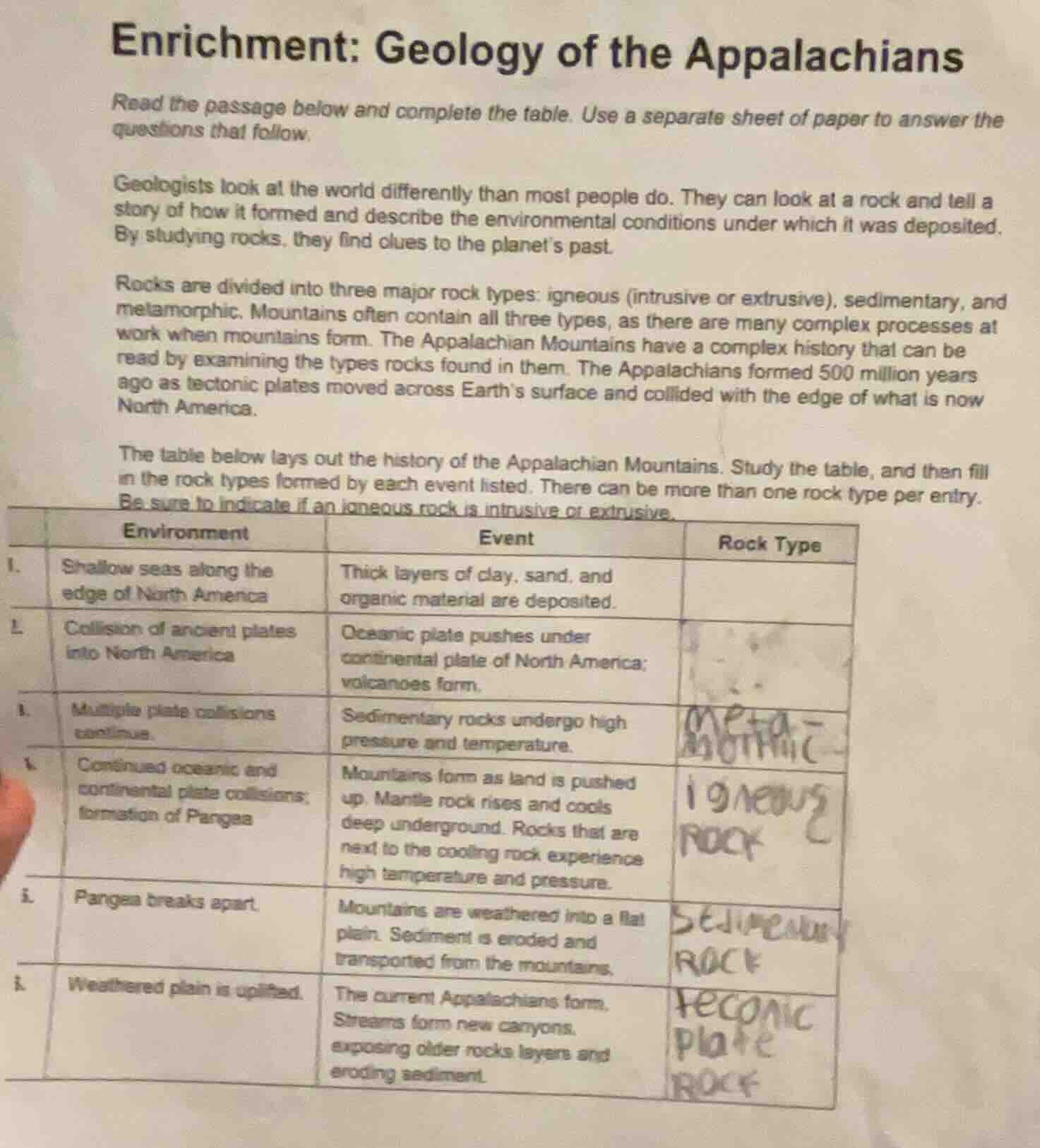
read the passage below and complete the table. use a separate sheet of paper to answer the questions that follow.
geologists look at the world differently than most people do. they can look at a rock and tell a story of how it formed and describe the environmental conditions under which it was deposited. by studying rocks, they find clues to the planet’s past.
rocks are divided into three major rock types: igneous (intrusive or extrusive), sedimentary, and metamorphic. mountains often contain all three types, as there are many complex processes at work when mountains form. the appalachian mountains have a complex history that can be read by examining the types rocks found in them. the appalachians formed 500 million years ago as tectonic plates moved across earth’s surface and collided with the edge of what is now north america.
the table below lays out the history of the appalachian mountains. study the table, and then fill in the rock types formed by each event listed. there can be more than one rock type per entry. be sure to indicate if an igneous rock is intrusive or extrusive.
| environment | event | rock type | |
|---|---|---|---|
| 2. | collision of ancient plates into north america | oceanic plate pushes under continental plate of north america; volcanoes form. | |
| 3. | multiple plate collisions continue. | sedimentary rocks undergo high pressure and temperature. | |
| 4. | continued oceanic and continental plate collisions; formation of pangea | mountains form as land is pushed up. mantle rock rises and cools deep underground. rocks that are next to the cooling rock experience high temperature and pressure. | |
| 5. | pangea breaks apart. | mountains are weathered into a flat plain. sediment is eroded and transported from the mountains. | |
| 6. | weathered plain is uplifted. | the current appalachians form. streams form new canyons, exposing older rocks layers and eroding sediment. |
Step1: Identify rock from sediment deposition
Sedimentary rocks form from deposited particles.
Step2: Identify rocks from subduction/volcanoes
Volcanoes make extrusive igneous; subduction melts rock into intrusive igneous.
Step3: Confirm rock from heat/pressure
High heat/pressure creates metamorphic rocks.
Step4: Identify dual rock types
Cooling deep rock = intrusive igneous; nearby heated rocks = metamorphic.
Step5: Confirm sediment from erosion
Eroded sediment forms new sedimentary rocks.
Step6: Identify uplifted existing rocks
Uplift exposes pre-existing rock types.

Snap & solve any problem in the app
Get step-by-step solutions on Sovi AI
Photo-based solutions with guided steps
Explore more problems and detailed explanations
| Environment | Event | Rock Type |
|---|---|---|
| Collision of ancient plates into North America | Oceanic plate pushes under continental plate of North America; volcanoes form. | Igneous (extrusive), Igneous (intrusive) |
| Multiple plate collisions continue. | Sedimentary rocks undergo high pressure and temperature. | Metamorphic |
| Continued oceanic and continental plate collisions; formation of Pangea | Mountains form as land is pushed up. Mantle rock rises and cools deep underground. Rocks that are next to the cooling rock experience high temperature and pressure. | Igneous (intrusive), Metamorphic |
| Pangaea breaks apart. | Mountains are weathered into a flat plain. Sediment is eroded and transported from the mountains. | Sedimentary |
| Weathered plain is uplifted. | The current Appalachians form. Streams form new canyons, exposing older rocks layers and eroding sediment. | Sedimentary, Igneous, Metamorphic |