QUESTION IMAGE
Question
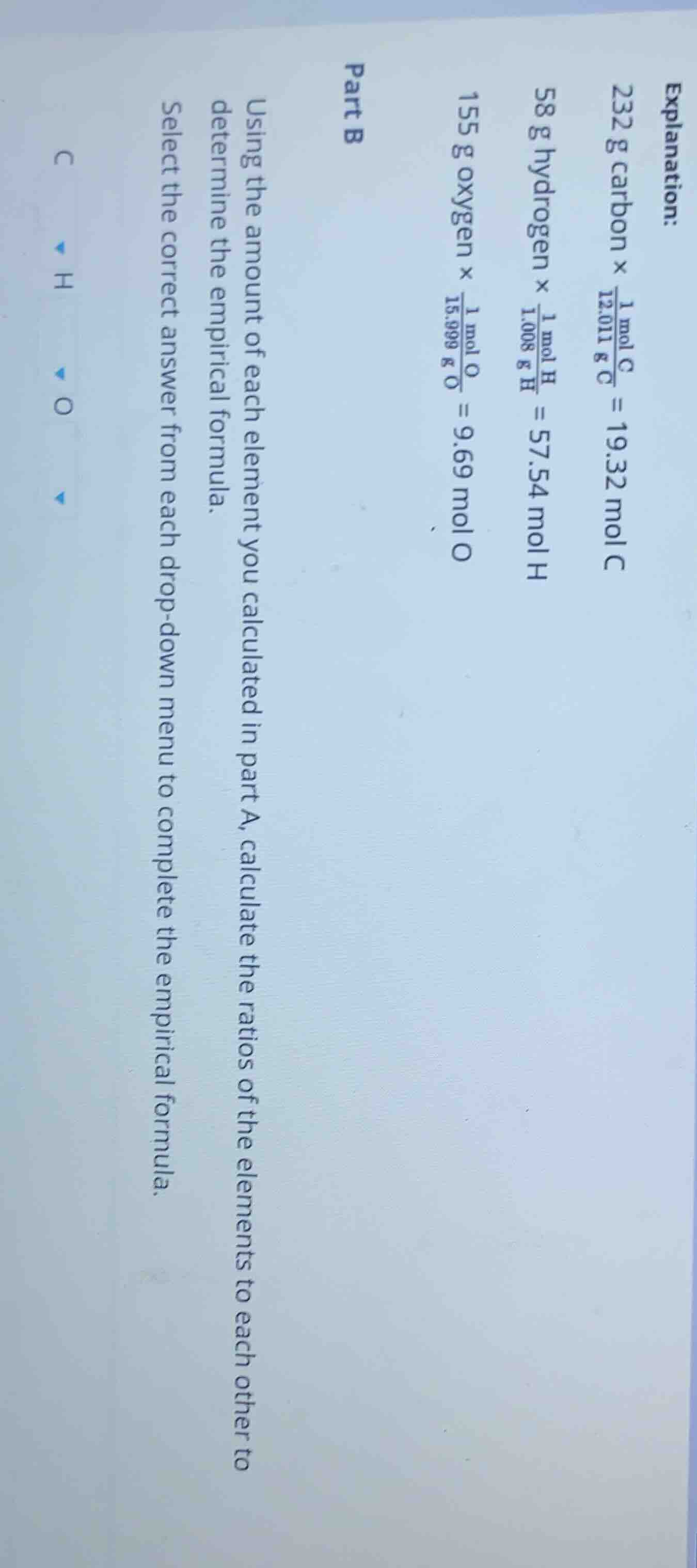
explanation: 232 g carbon × \\(\frac{1\text{ mol c}}{12.011\text{ g c}}\\) = 19.32 mol c 58 g hydrogen × \\(\frac{1\text{ mol h}}{1.008\text{ g h}}\\) = 57.54 mol h 155 g oxygen × \\(\frac{1\text{ mol o}}{15.999\text{ g o}}\\) = 9.69 mol o part b using the amount of each element you calculated in part a, calculate the ratios of the elements to each other to determine the empirical formula. select the correct answer from each drop - down menu to complete the empirical formula. c ▾ h ▾ o ▾
Step1: Find the smallest mole value
First, identify the smallest number of moles among C, H, and O. The moles are: C = 19.32 mol, H = 57.54 mol, O = 9.69 mol. The smallest is 9.69 mol (O).
Step2: Calculate the ratio for C
Divide the moles of C by the moles of O: $\frac{19.32\ \text{mol C}}{9.69\ \text{mol O}} \approx 2$
Step3: Calculate the ratio for H
Divide the moles of H by the moles of O: $\frac{57.54\ \text{mol H}}{9.69\ \text{mol O}} \approx 6$
Step4: Calculate the ratio for O
Divide the moles of O by the moles of O: $\frac{9.69\ \text{mol O}}{9.69\ \text{mol O}} = 1$

Snap & solve any problem in the app
Get step-by-step solutions on Sovi AI
Photo-based solutions with guided steps
Explore more problems and detailed explanations
The empirical formula is $\boldsymbol{C_2H_6O}$ (or $C_2H_6O$ can also be written as $C_2H_5OH$ but the empirical formula is the simplest whole - number ratio, so $C_2H_6O$).