QUESTION IMAGE
Question
6.2 extra practice determine number of solutions
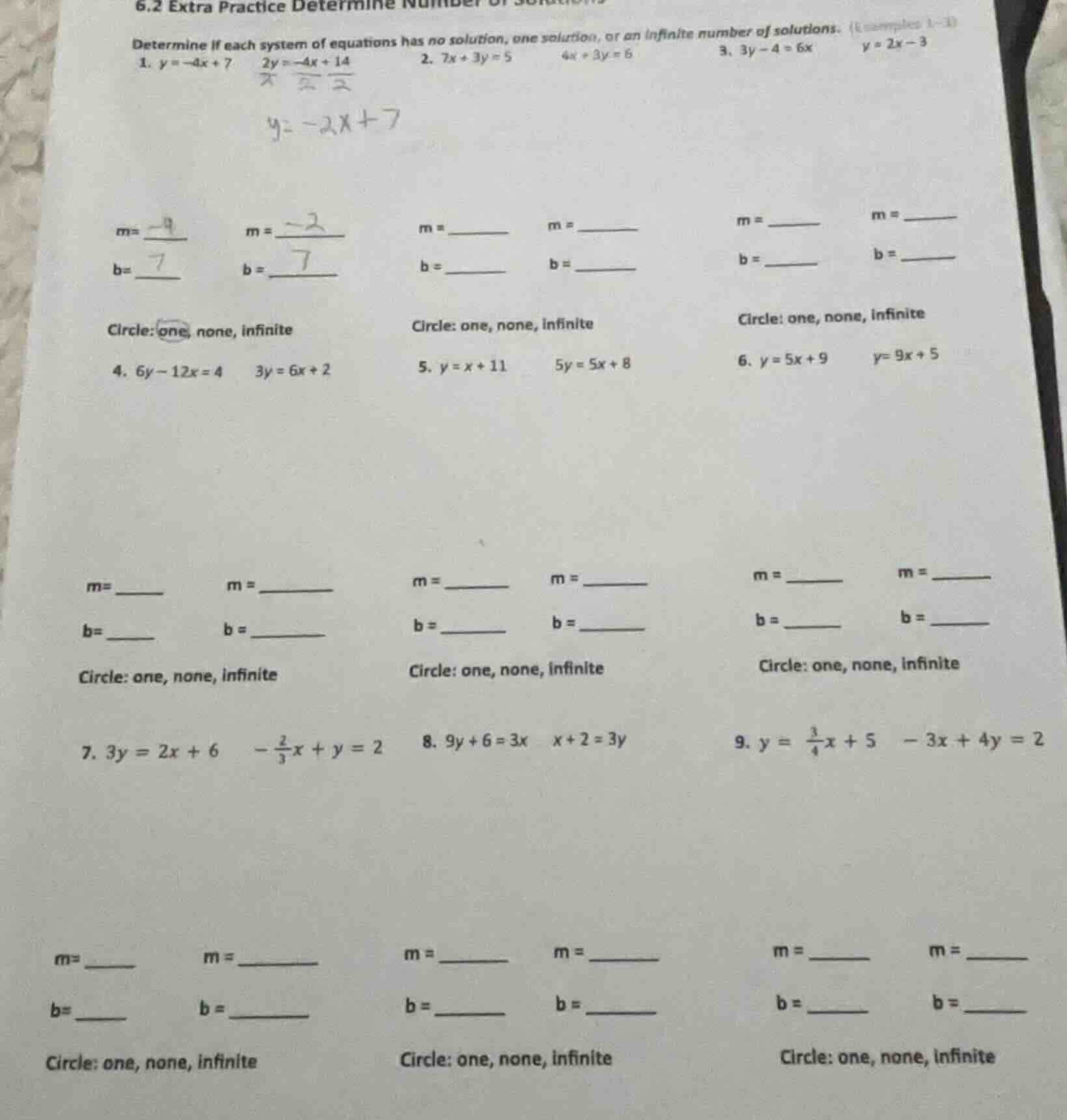
determine if each system of equations has no solution, one solution, or an infinite number of solutions. (examples 1 - 3)
- $y = -4x + 7$ $2y = -4x + 14$
- $7x + 3y = 5$ $4x + 3y = 6$
- $3y - 4 = 6x$ $y = 2x - 3$
for each system, find the slope ($m$) and y - intercept ($b$) of each equation, then circle if the number of solutions is one, none, or infinite.
1.
$m = \underline{\quad}$ $m = \underline{\quad}$
$b = \underline{\quad}$ $b = \underline{\quad}$
circle: one, none, infinite
2.
$m = \underline{\quad}$ $m = \underline{\quad}$
$b = \underline{\quad}$ $b = \underline{\quad}$
circle: one, none, infinite
3.
$m = \underline{\quad}$ $m = \underline{\quad}$
$b = \underline{\quad}$ $b = \underline{\quad}$
circle: one, none, infinite
- $6y - 12x = 4$ $3y = 6x + 2$
$m = \underline{\quad}$ $m = \underline{\quad}$
$b = \underline{\quad}$ $b = \underline{\quad}$
circle: one, none, infinite
- $y = x + 11$ $5y = 5x + 8$
$m = \underline{\quad}$ $m = \underline{\quad}$
$b = \underline{\quad}$ $b = \underline{\quad}$
circle: one, none, infinite
- $y = 5x + 9$ $y = 9x + 5$
$m = \underline{\quad}$ $m = \underline{\quad}$
$b = \underline{\quad}$ $b = \underline{\quad}$
circle: one, none, infinite
- $3y = 2x + 6$ $-\frac{2}{3}x + y = 2$
$m = \underline{\quad}$ $m = \underline{\quad}$
$b = \underline{\quad}$ $b = \underline{\quad}$
circle: one, none, infinite
- $9y + 6 = 3x$ $x + 2 = 3y$
$m = \underline{\quad}$ $m = \underline{\quad}$
$b = \underline{\quad}$ $b = \underline{\quad}$
circle: one, none, infinite
- $y = \frac{3}{4}x + 5$ $-3x + 4y = 2$
$m = \underline{\quad}$ $m = \underline{\quad}$
$b = \underline{\quad}$ $b = \underline{\quad}$
circle: one, none, infinite
Problem 1:
Step1: Rewrite equations in slope - intercept form ($y = mx + b$)
First equation: $y=-4x + 7$, so $m_1=-4$, $b_1 = 7$.
Second equation: $2y=-4x + 14$, divide both sides by 2: $y=-2x + 7$, so $m_2=-2$, $b_2 = 7$.
Step2: Analyze slopes and y - intercepts
Since $m_1
eq m_2$ (the slopes are different), the two lines intersect at one point.
Step1: Rewrite equations in slope - intercept form
First equation: $7x + 3y=5$, solve for $y$: $3y=-7x + 5$, $y=-\frac{7}{3}x+\frac{5}{3}$, so $m_1=-\frac{7}{3}$, $b_1=\frac{5}{3}$.
Second equation: $4x + 3y=6$, solve for $y$: $3y=-4x + 6$, $y=-\frac{4}{3}x + 2$, so $m_2=-\frac{4}{3}$, $b_2 = 2$.
Step2: Analyze slopes and y - intercepts
Since $m_1
eq m_2$ (the slopes are different), the two lines intersect at one point.
Step1: Rewrite equations in slope - intercept form
First equation: $3y-4 = 6x$, solve for $y$: $3y=6x + 4$, $y = 2x+\frac{4}{3}$, so $m_1=2$, $b_1=\frac{4}{3}$.
Second equation: $y=2x-3$, so $m_2=2$, $b_2=-3$.
Step2: Analyze slopes and y - intercepts
Since $m_1 = m_2$ (slopes are equal) but $b_1
eq b_2$ (y - intercepts are different), the lines are parallel and do not intersect.

Snap & solve any problem in the app
Get step-by-step solutions on Sovi AI
Photo-based solutions with guided steps
Explore more problems and detailed explanations
$m_1=-4$, $b_1 = 7$; $m_2=-2$, $b_2 = 7$; Circle: one