QUESTION IMAGE
Question
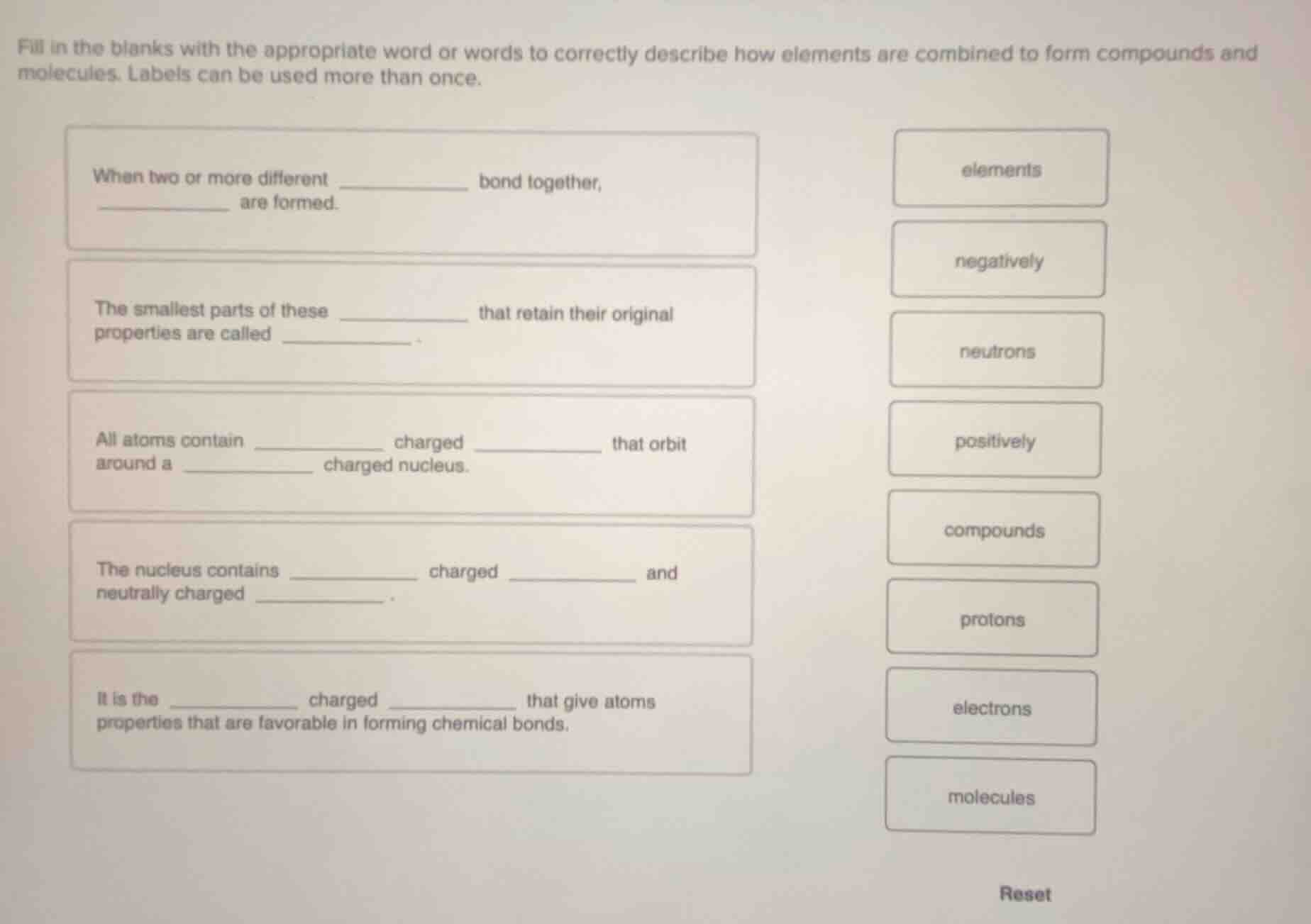
fill in the blanks with the appropriate word or words to correctly describe how elements are combined to form compounds and molecules. labels can be used more than once.
when two or more different ______ bond together, ______ are formed.
the smallest parts of these ______ that retain their original properties are called ______.
all atoms contain ______ charged ____ that orbit around a ______ charged nucleus.
the nucleus contains ______ charged ____ and neutrally charged ______.
it is the ______ charged ______ that give atoms properties that are favorable in forming chemical bonds.
(options: elements, negatively, neutrons, positively, compounds, protons, electrons, molecules)
First Blank Set:
- Explanation for first blank: To form compounds, different elements bond. So first blank: elements.
- Explanation for second blank: Bonding of different elements forms compounds. So second blank: compounds.
Second Blank Set:
- Explanation for first blank: The compounds' smallest parts retaining properties are molecules? Wait, no—wait, the first part: "these" refers to compounds? Wait, no, the first sentence was about compounds. Wait, no, the second box: "The smallest parts of these ____ that retain their original properties are called ____." Wait, actually, when elements bond to form compounds, the smallest part of a compound (or molecule) that retains properties is a molecule? Wait, no, maybe: first blank: compounds (since we formed compounds earlier), then the smallest parts of compounds that retain properties are molecules? Wait, no, maybe I messed up. Wait, let's re-express:
Wait, the first sentence: "When two or more different elements bond together, compounds are formed."
Then the second: "The smallest parts of these compounds that retain their original properties are called molecules." Wait, but the options have "molecules" as an option. Let's check the options: elements, negatively, neutrons, positively, compounds, protons, electrons, molecules.
Yes, so second box: first blank: compounds; second blank: molecules.
Third Blank Set:
- Explanation for first blank: Electrons are negatively charged. So first blank: negatively.
- Explanation for second blank: Electrons orbit the nucleus. So second blank: electrons.
- Explanation for third blank: Nucleus is positively charged (has protons). So third blank: positively.
Fourth Blank Set:
- Explanation for first blank: Protons are positively charged. So first blank: positively.
- Explanation for second blank: Protons are in the nucleus. So second blank: protons.
- Explanation for third blank: Neutrons are neutral. So third blank: neutrons.
Fifth Blank Set:
- Explanation for first blank: Electrons are negatively charged. So first blank: negatively.
- Explanation for second blank: Electrons are involved in bonding. So second blank: electrons.
Now, let's fill all blanks step by step:
- When two or more different $\boldsymbol{\text{elements}}$ bond together, $\boldsymbol{\text{compounds}}$ are formed.
- The smallest parts of these $\boldsymbol{\text{compounds}}$ that retain their original properties are called $\boldsymbol{\text{molecules}}$.
- All atoms contain $\boldsymbol{\text{negatively}}$ charged $\boldsymbol{\text{electrons}}$ that orbit around a $\boldsymbol{\text{positively}}$ charged nucleus.
- The nucleus contains $\boldsymbol{\text{positively}}$ charged $\boldsymbol{\text{protons}}$ and neutrally charged $\boldsymbol{\text{neutrons}}$.
- It is the $\boldsymbol{\text{negatively}}$ charged $\boldsymbol{\text{electrons}}$ that give atoms properties favorable in forming chemical bonds.
Final Filled Blanks:
- When two or more different $\boldsymbol{\text{elements}}$ bond together, $\boldsymbol{\text{compounds}}$ are formed.
- The smallest parts of these $\boldsymbol{\text{compounds}}$ that retain their original properties are called $\boldsymbol{\text{molecules}}$.
- All atoms contain $\boldsymbol{\text{negatively}}$ charged $\boldsymbol{\text{electrons}}$ that orbit around a $\boldsymbol{\text{positively}}$ charged nucleus.
- The nucleus contains $\boldsymbol{\text{positively}}$ charged $\boldsymbol{\text{protons}}$ and neutrally charged $\boldsymbol{\text{neu…

Snap & solve any problem in the app
Get step-by-step solutions on Sovi AI
Photo-based solutions with guided steps
Explore more problems and detailed explanations
First Blank Set:
- Explanation for first blank: To form compounds, different elements bond. So first blank: elements.
- Explanation for second blank: Bonding of different elements forms compounds. So second blank: compounds.
Second Blank Set:
- Explanation for first blank: The compounds' smallest parts retaining properties are molecules? Wait, no—wait, the first part: "these" refers to compounds? Wait, no, the first sentence was about compounds. Wait, no, the second box: "The smallest parts of these ____ that retain their original properties are called ____." Wait, actually, when elements bond to form compounds, the smallest part of a compound (or molecule) that retains properties is a molecule? Wait, no, maybe: first blank: compounds (since we formed compounds earlier), then the smallest parts of compounds that retain properties are molecules? Wait, no, maybe I messed up. Wait, let's re-express:
Wait, the first sentence: "When two or more different elements bond together, compounds are formed."
Then the second: "The smallest parts of these compounds that retain their original properties are called molecules." Wait, but the options have "molecules" as an option. Let's check the options: elements, negatively, neutrons, positively, compounds, protons, electrons, molecules.
Yes, so second box: first blank: compounds; second blank: molecules.
Third Blank Set:
- Explanation for first blank: Electrons are negatively charged. So first blank: negatively.
- Explanation for second blank: Electrons orbit the nucleus. So second blank: electrons.
- Explanation for third blank: Nucleus is positively charged (has protons). So third blank: positively.
Fourth Blank Set:
- Explanation for first blank: Protons are positively charged. So first blank: positively.
- Explanation for second blank: Protons are in the nucleus. So second blank: protons.
- Explanation for third blank: Neutrons are neutral. So third blank: neutrons.
Fifth Blank Set:
- Explanation for first blank: Electrons are negatively charged. So first blank: negatively.
- Explanation for second blank: Electrons are involved in bonding. So second blank: electrons.
Now, let's fill all blanks step by step:
- When two or more different $\boldsymbol{\text{elements}}$ bond together, $\boldsymbol{\text{compounds}}$ are formed.
- The smallest parts of these $\boldsymbol{\text{compounds}}$ that retain their original properties are called $\boldsymbol{\text{molecules}}$.
- All atoms contain $\boldsymbol{\text{negatively}}$ charged $\boldsymbol{\text{electrons}}$ that orbit around a $\boldsymbol{\text{positively}}$ charged nucleus.
- The nucleus contains $\boldsymbol{\text{positively}}$ charged $\boldsymbol{\text{protons}}$ and neutrally charged $\boldsymbol{\text{neutrons}}$.
- It is the $\boldsymbol{\text{negatively}}$ charged $\boldsymbol{\text{electrons}}$ that give atoms properties favorable in forming chemical bonds.
Final Filled Blanks:
- When two or more different $\boldsymbol{\text{elements}}$ bond together, $\boldsymbol{\text{compounds}}$ are formed.
- The smallest parts of these $\boldsymbol{\text{compounds}}$ that retain their original properties are called $\boldsymbol{\text{molecules}}$.
- All atoms contain $\boldsymbol{\text{negatively}}$ charged $\boldsymbol{\text{electrons}}$ that orbit around a $\boldsymbol{\text{positively}}$ charged nucleus.
- The nucleus contains $\boldsymbol{\text{positively}}$ charged $\boldsymbol{\text{protons}}$ and neutrally charged $\boldsymbol{\text{neutrons}}$.
- It is the $\boldsymbol{\text{negatively}}$ charged $\boldsymbol{\text{electrons}}$ that give atoms properties favorable in forming chemical bonds.
(Note: The exact order of filling each blank in the boxes is as per the above explanations. Each box is filled with the corresponding word from the options.)