QUESTION IMAGE
Question
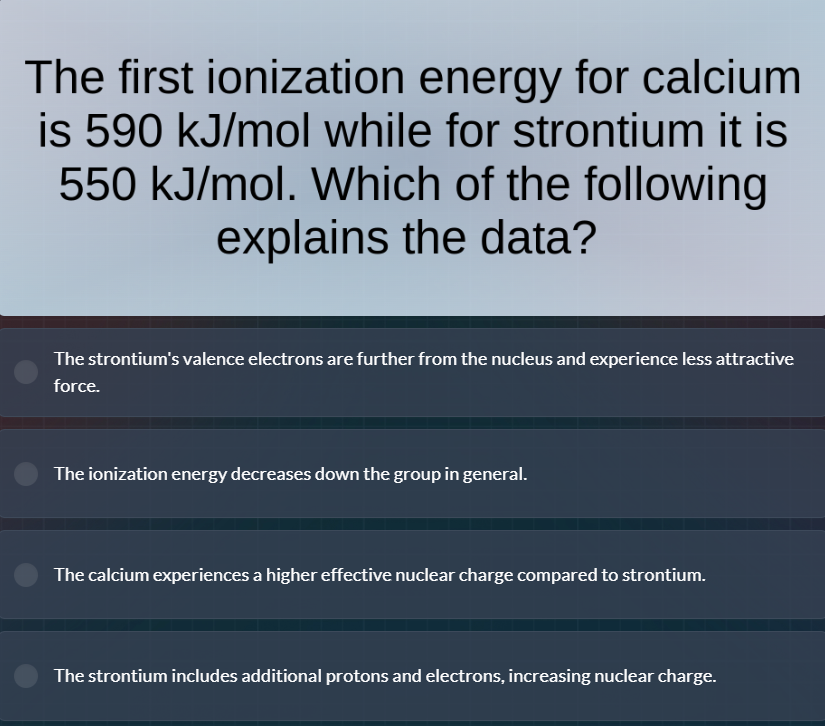
the first ionization energy for calcium is 590 kj/mol while for strontium it is 550 kj/mol. which of the following explains the data?
the strontiums valence electrons are further from the nucleus and experience less attractive force.
the ionization energy decreases down the group in general.
the calcium experiences a higher effective nuclear charge compared to strontium.
the strontium includes additional protons and electrons, increasing nuclear charge.
Ionization energy depends on the attraction between the nucleus and valence electrons. Calcium (Ca) and strontium (Sr) are in Group 2 of the periodic table, with Sr below Ca. As you move down a group, atomic radius increases: Sr's valence electrons are in a higher energy level, farther from the nucleus. This greater distance reduces the attractive force from the nucleus, making it easier to remove an electron (lower ionization energy). While the general trend of decreasing ionization energy down a group is true, the first option provides the direct, causal explanation for the specific data given. The third option is incorrect because effective nuclear charge does not significantly increase down a group (shielding from inner electrons offsets added protons). The fourth option is incorrect because the increased nuclear charge is offset by shielding, so it does not reduce ionization energy.

Snap & solve any problem in the app
Get step-by-step solutions on Sovi AI
Photo-based solutions with guided steps
Explore more problems and detailed explanations
The strontium's valence electrons are further from the nucleus and experience less attractive force.