QUESTION IMAGE
Question
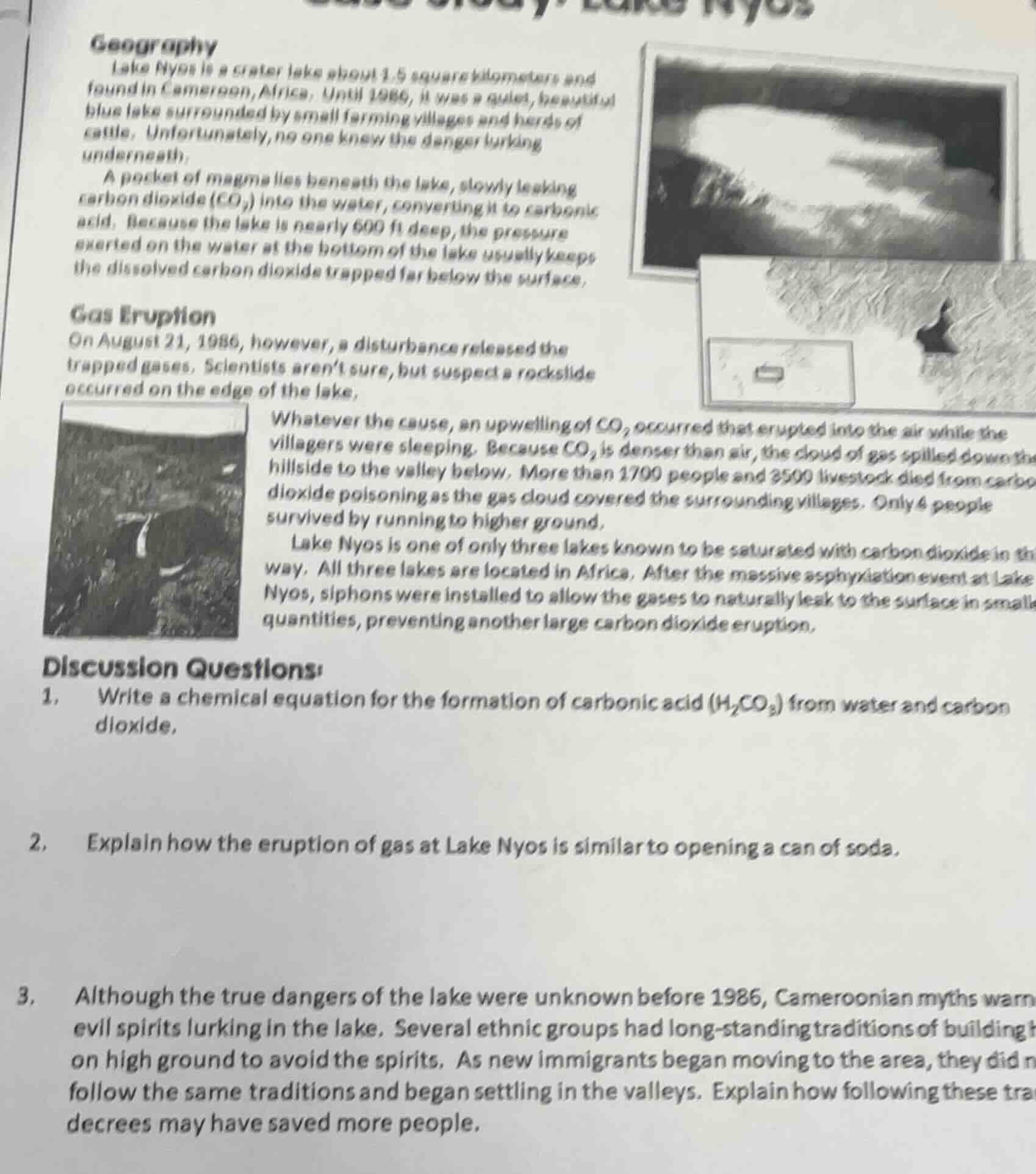
geographylake nyos is a crater lake about 1.5 square kilometers and found in cameroon, africa. until 1986, it was a quiet, beautiful blue lake surrounded by small farming villages and herds of cattle. unfortunately, no one knew the danger lurking underneath.a pocket of magma lies beneath the lake, slowly leaking carbon dioxide ($co_2$) into the water, converting it to carbonic acid. because the lake is nearly 600 ft deep, the pressure exerted on the water at the bottom of the lake usually keeps the dissolved carbon dioxide trapped far below the surface.gas eruptionon august 21, 1986, however, a disturbance released the trapped gases. scientists arent sure, but suspect a rockslide occurred on the edge of the lake.whatever the cause, an upwelling of $co_2$ occurred that erupted into the air while the villagers were sleeping. because $co_2$ is denser than air, the cloud of gas spilled down the hillside to the valley below. more than 1700 people and 3500 livestock died from carbon dioxide poisoning as the gas cloud covered the surrounding villages. only 4 people survived by running to higher ground.lake nyos is one of only three lakes known to be saturated with carbon dioxide in this way. all three lakes are located in africa. after the massive asphyxiation event at lake nyos, siphons were installed to allow the gases to naturally leak to the surface in small quantities, preventing another large carbon dioxide eruption.discussion questions:1. write a chemical equation for the formation of carbonic acid ($h_2co_3$) from water and carbon dioxide.2. explain how the eruption of gas at lake nyos is similar to opening a can of soda.3. although the true dangers of the lake were unknown before 1986, cameroonian myths warn evil spirits lurking in the lake. several ethnic groups had long-standing traditions of building on high ground to avoid the spirits. as new immigrants began moving to the area, they did not follow the same traditions and began settling in the valleys. explain how following these traditions may have saved more people.
Step1: Write reaction reactants & product
Reactants: $\text{CO}_2$ (carbon dioxide) and $\text{H}_2\text{O}$ (water); Product: $\text{H}_2\text{CO}_3$ (carbonic acid)
Step2: Balance the chemical equation
Count atoms on each side: 1 C, 2 H, 3 O on both sides, so the equation is balanced.
<Expression>$\text{CO}_2 + \text{H}_2\text{O}
ightleftharpoons \text{H}_2\text{CO}_3$</Expression>

Snap & solve any problem in the app
Get step-by-step solutions on Sovi AI
Photo-based solutions with guided steps
Explore more problems and detailed explanations
- $\text{CO}_2 + \text{H}_2\text{O}
ightleftharpoons \text{H}_2\text{CO}_3$
- Both rely on pressure to trap dissolved CO₂: Lake Nyos uses high water pressure at depth to hold CO₂ in the lake water; a sealed soda can uses internal gas pressure to keep CO₂ dissolved in the liquid. When the pressure is released (a disturbance at the lake, opening the can), the solubility of CO₂ drops sharply, causing the gas to rapidly escape/erupt from the liquid.
- The traditional practice of building on high ground aligned with the physical behavior of CO₂: since CO₂ is denser than air, it accumulates in low-lying valleys. If new immigrants had settled on high ground instead of valleys, they would have avoided the concentrated cloud of toxic CO₂ that flowed into the valley floor during the eruption, likely preventing most of the deaths.