QUESTION IMAGE
Question
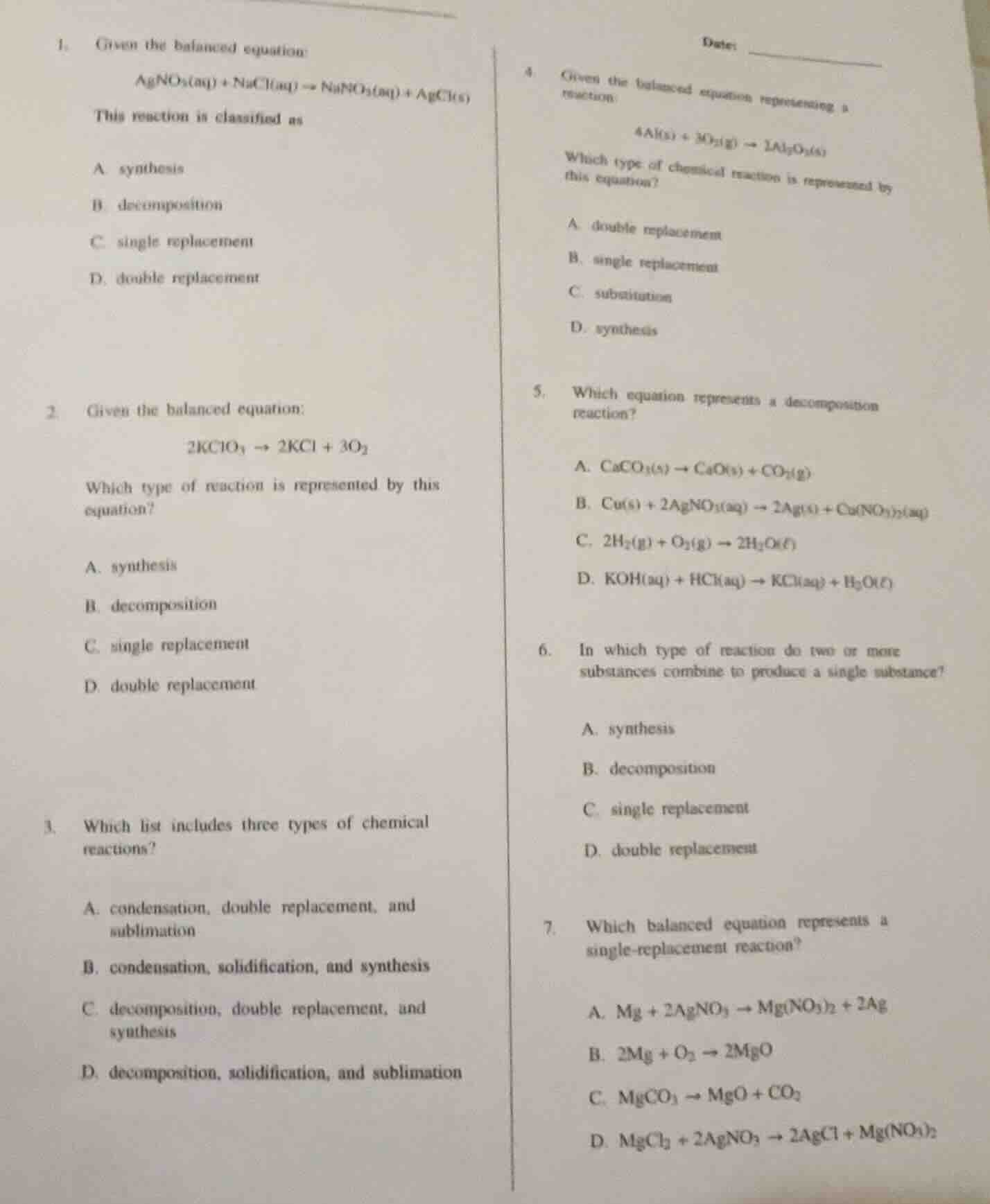
- given the balanced equation: \\(\ce{agno_{3}(aq) + nacl(aq) \
ightarrow nano_{3}(aq) + agcl(s)}\\) this reaction is classified as a. synthesis b. decomposition c. single replacement d. double replacement 2. given the balanced equation: \\(\ce{2kclo_{3} \
ightarrow 2kcl + 3o_{2}}\\) which type of reaction is represented by this equation? a. synthesis b. decomposition c. single replacement d. double replacement 3. which list includes three types of chemical reactions? a. condensation, double replacement, and sublimation b. condensation, solidification, and synthesis c. decomposition, double replacement, and synthesis d. decomposition, solidification, and sublimation 4. given the balanced equation representing a reaction: \\(\ce{4al(s) + 3o_{2}(g) \
ightarrow 2al_{2}o_{3}(s)}\\) which type of chemical reaction is represented by this equation? a. double replacement b. single replacement c. substitution d. synthesis 5. which equation represents a decomposition reaction? a. \\(\ce{caco_{3}(s) \
ightarrow cao(s) + co_{2}(g)}\\) b. \\(\ce{cu(s) + 2agno_{3}(aq) \
ightarrow 2ag(s) + cu(no_{3})_{2}(aq)}\\) c. \\(\ce{2h_{2}(g) + o_{2}(g) \
ightarrow 2h_{2}o(l)}\\) d. \\(\ce{koh(aq) + hcl(aq) \
ightarrow kcl(aq) + h_{2}o(l)}\\) 6. in which type of reaction do two or more substances combine to produce a single substance? a. synthesis b. decomposition c. single replacement d. double replacement 7. which balanced equation represents a single - replacement reaction? a. \\(\ce{mg + 2agno_{3} \
ightarrow mg(no_{3})_{2} + 2ag}\\) b. \\(\ce{2mg + o_{2} \
ightarrow 2mgo}\\) c. \\(\ce{mgco_{3} \
ightarrow mgo + co_{2}}\\) d. \\(\ce{mgcl_{2} + 2agno_{3} \
ightarrow 2agcl + mg(no_{3})_{2}}\\)
- In the reaction $\text{AgNO}_3(\text{aq}) + \text{NaCl}(\text{aq})
ightarrow \text{NaNO}_3(\text{aq}) + \text{AgCl}(\text{s})$, the cations ($\text{Ag}^+$ and $\text{Na}^+$) swap their anions, which is characteristic of a double replacement reaction.
- The reaction $2\text{KClO}_3
ightarrow 2\text{KCl} + 3\text{O}_2$ shows one compound breaking down into simpler substances, which is a decomposition reaction.
- Decomposition, double replacement, and synthesis are all standard categories of chemical reactions; the other options include phase changes (condensation, sublimation, solidification) which are not chemical reactions.
- The reaction $4\text{Al}(\text{s}) + 3\text{O}_2(\text{g})
ightarrow 2\text{Al}_2\text{O}_3(\text{s})$ combines two substances into a single compound, which is a synthesis reaction.
- The reaction $\text{CaCO}_3(\text{s})
ightarrow \text{CaO}(\text{s}) + \text{CO}_2(\text{g})$ has one compound breaking into simpler products, fitting decomposition.
- A synthesis reaction is defined as two or more substances combining to form one single product.
- The reaction $\text{Mg} + 2\text{AgNO}_3
ightarrow \text{Mg(NO}_3\text{)}_2 + 2\text{Ag}$ shows one element replacing another in a compound, which is a single-replacement reaction.

Snap & solve any problem in the app
Get step-by-step solutions on Sovi AI
Photo-based solutions with guided steps
Explore more problems and detailed explanations
- D. double replacement
- B. decomposition
- C. decomposition, double replacement, and synthesis
- D. synthesis
- A. $\text{CaCO}_3(\text{s})
ightarrow \text{CaO}(\text{s}) + \text{CO}_2(\text{g})$
- A. synthesis
- A. $\text{Mg} + 2\text{AgNO}_3
ightarrow \text{Mg(NO}_3\text{)}_2 + 2\text{Ag}$