QUESTION IMAGE
Question
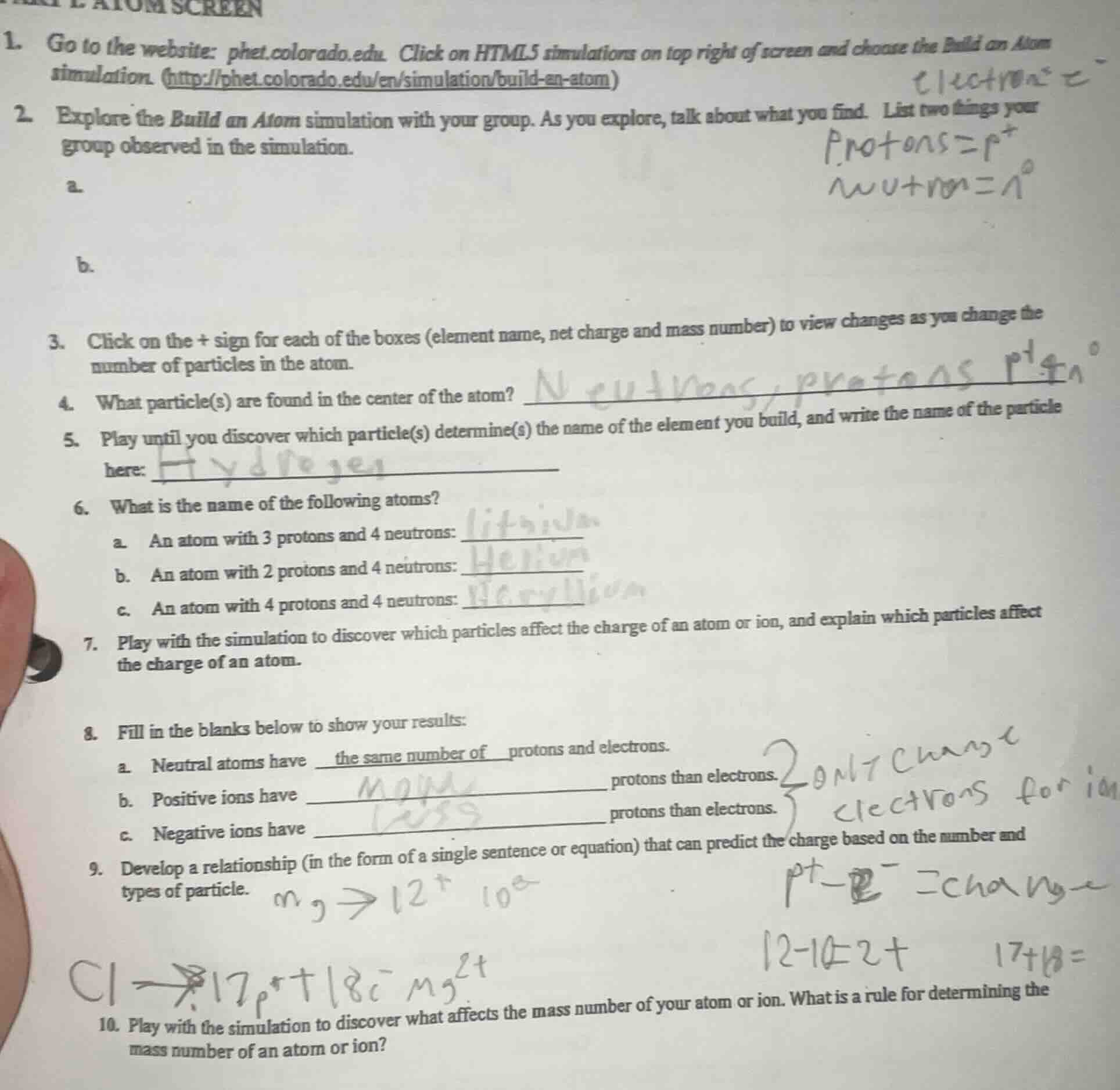
- go to the website: phet.colorado.edu. click on html5 simulations on top right of screen and choose the build an atom simulation. (http://phet.colorado.edu/en/simulation/build - an - atom)
- explore the build an atom simulation with your group. as you explore, talk about what you find. list two things your group observed in the simulation.
a.
b.
- click on the + sign for each of the boxes (element name, net charge and mass number) to view changes as you change the number of particles in the atom.
- what particle(s) are found in the center of the atom?
- play until you discover which particle(s) determine(s) the name of the element you build, and write the name of the particle here:
- what is the name of the following atoms?
a. an atom with 3 protons and 4 neutrons:
b. an atom with 2 protons and 4 neutrons:
c. an atom with 4 protons and 4 neutrons:
- play with the simulation to discover which particles affect the charge of an atom or ion, and explain which particles affect the charge of an atom.
- fill in the blanks below to show your results:
a. neutral atoms have ____ protons and electrons.
b. positive ions have ____ protons than electrons.
c. negative ions have ____ protons than electrons.
- develop a relationship (in the form of a single sentence or equation) that can predict the charge based on the number and types of particle.
- play with the simulation to discover what affects the mass number of your atom or ion. what is a rule for determining the mass number of an atom or ion?
Brief Explanations
- For question 2, observations are based on the simulation's core features: particles have distinct charges/locations, and changing particles alters atom properties.
- Question 4: The atomic nucleus contains protons and neutrons.
- Question 5: The number of protons (atomic number) uniquely defines an element's identity.
- Question 6: Element names are determined by proton count (atomic number) from the periodic table.
- Question 7: Electrons carry a negative charge; adding/removing them changes the atom's net charge, while protons/neutrons do not affect charge.
- Question 8: Charge depends on the balance of positive protons and negative electrons.
- Question 9: Net charge is calculated by subtracting electron count from proton count.
- Question 10: Mass number is the total of heavy particles (protons + neutrons) in the nucleus; electrons have negligible mass.

Snap & solve any problem in the app
Get step-by-step solutions on Sovi AI
Photo-based solutions with guided steps
Explore more problems and detailed explanations
2.
a. Protons have a positive charge, electrons negative.
b. Neutrons have no electrical charge.
- Protons and neutrons
- Protons
6.
a. Lithium
b. Helium
c. Beryllium
- Electrons affect the charge of an atom/ion. Adding electrons creates a negative charge, removing electrons creates a positive charge; protons and neutrons do not impact the net charge.
8.
a. the same number of
b. more
c. fewer
- Net Charge = (Number of Protons) - (Number of Electrons)
- The mass number is determined by the total number of protons and neutrons in the atom/ion (electrons have negligible mass, so they do not affect the mass number). The rule is: Mass Number = Number of Protons + Number of Neutrons