QUESTION IMAGE
Question
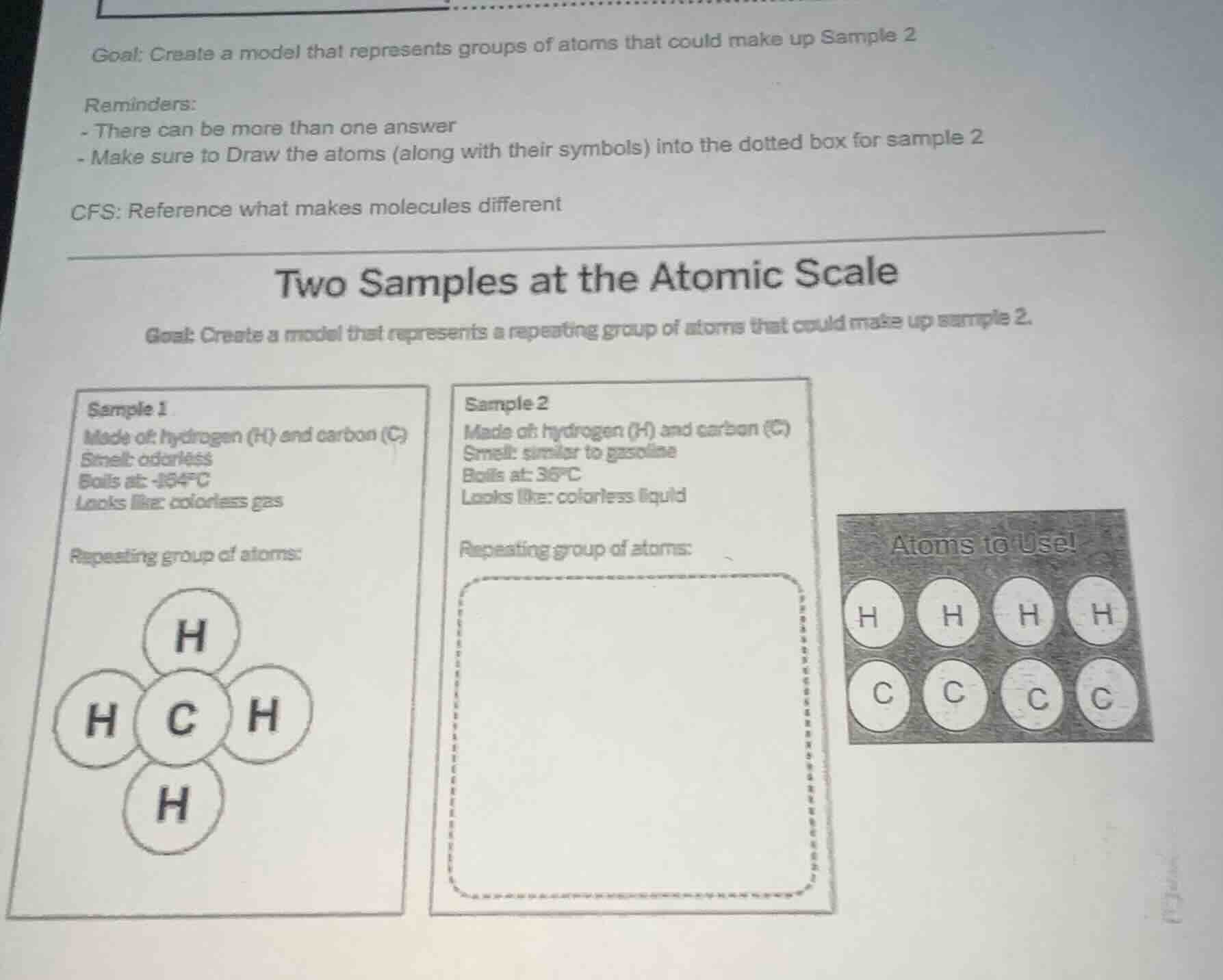
goal: create a model that represents groups of atoms that could make up sample 2
reminders:
- there can be more than one answer
- make sure to draw the atoms (along with their symbols) into the dotted box for sample 2
cfs: reference what makes molecules different
two samples at the atomic scale
goal: create a model that represents a repeating group of atoms that could make up sample 2.
sample 1
made of: hydrogen (h) and carbon (c)
smell: odorless
boils at: -164°c
looks like: colorless gas
repeating group of atoms:
diagram of a carbon atom bonded to four hydrogen atoms
sample 2
made of: hydrogen (h) and carbon (c)
smell: similar to gasoline
boils at: 36°c
looks like: colorless liquid
repeating group of atoms:
dotted box for drawing
atoms to use!
diagram of four h atoms and four c atoms
Sample 1 is methane ($CH_4$), a small hydrocarbon gas. Sample 2 is a larger hydrocarbon liquid (matches gasoline-like smell and boiling point). A valid repeating group uses the available C and H atoms to form a larger hydrocarbon, like ethane's repeating unit or a small alkane segment. We can use 2 C and 6 H, but since we have 4 H and 4 C available, a valid repeating group is two carbons bonded with four hydrogens attached (a segment of ethane/ethane-like structure, which is a liquid at higher temps than methane).

Snap & solve any problem in the app
Get step-by-step solutions on Sovi AI
Photo-based solutions with guided steps
Explore more problems and detailed explanations
A valid repeating group for Sample 2 is:
  H   H
  |   |
H-C-C-H
  |   |
  H   H
(This is ethane, $C_2H_6$, which is a colorless liquid/gas near room temp, matches the gasoline-like hydrocarbon property, and uses 2 of the available C atoms and all 4 available H atoms; alternatively, a larger group using more C atoms could also work, but this is a simple, correct model.)