QUESTION IMAGE
Question
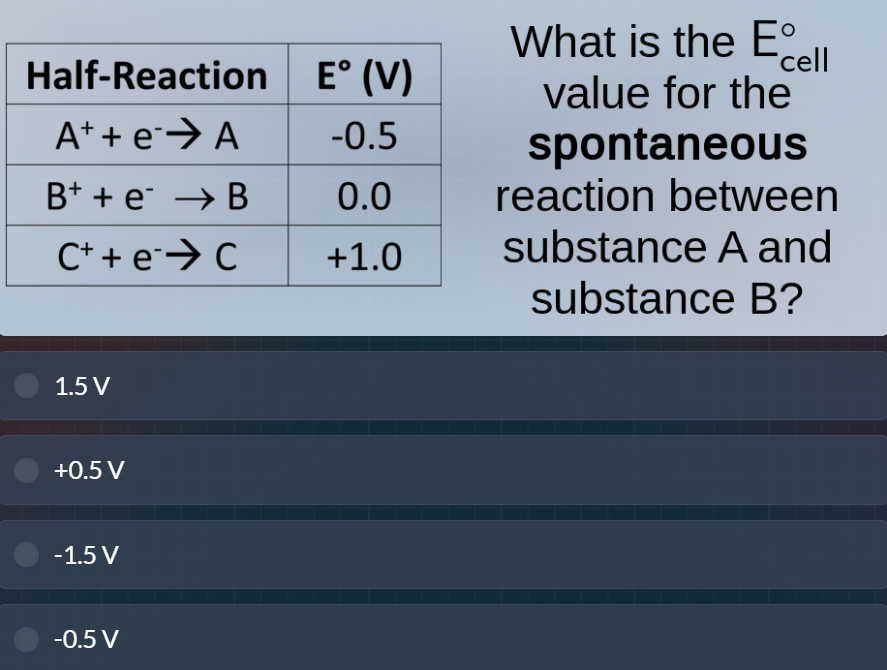
half-reaction | e° (v)
a⁺ + e⁻→ a | -0.5
b⁺ + e⁻ → b | 0.0
c⁺ + e⁻→ c | +1.0
what is the e°_cell value for the spontaneous reaction between substance a and substance b?
1.5 v
+0.5 v
-1.5 v
-0.5 v
Step1: Identify Oxidation and Reduction
For a spontaneous reaction, \( E^{\circ}_{\text{cell}}>0 \). We need to determine which species is oxidized (loses electrons) and which is reduced (gains electrons). The half - reactions are:
- \( \text{A}^++\text{e}^-
ightarrow\text{A} \), \( E^{\circ}_1 = - 0.5\space\text{V} \)
- \( \text{B}^++\text{e}^-
ightarrow\text{B} \), \( E^{\circ}_2=0.0\space\text{V} \)
A species with a more negative (or less positive) reduction potential will be oxidized (reverse the half - reaction). The reduction potential of A (\( E^{\circ}_1=- 0.5\space\text{V} \)) is more negative than that of B (\( E^{\circ}_2 = 0.0\space\text{V} \)). So, A is oxidized (reverse its half - reaction): \( \text{A}
ightarrow\text{A}^++\text{e}^- \), and the oxidation potential \( E^{\circ}_{\text{ox}}=-E^{\circ}_{\text{red}}=0.5\space\text{V} \) (since the reduction potential of A is \( E^{\circ}_{\text{red}}=- 0.5\space\text{V} \)). B is reduced: \( \text{B}^++\text{e}^-
ightarrow\text{B} \), \( E^{\circ}_{\text{red}} = 0.0\space\text{V} \)
Step2: Calculate \( E^{\circ}_{\text{cell}} \)
The formula for \( E^{\circ}_{\text{cell}} \) is \( E^{\circ}_{\text{cell}}=E^{\circ}_{\text{red (cathode)}}+E^{\circ}_{\text{ox (anode)}} \) (or \( E^{\circ}_{\text{cell}}=E^{\circ}_{\text{cathode}}-E^{\circ}_{\text{anode}} \) where \( E^{\circ}_{\text{cathode}} \) is the reduction potential of the cathode and \( E^{\circ}_{\text{anode}} \) is the reduction potential of the anode).
Using \( E^{\circ}_{\text{cell}}=E^{\circ}_{\text{cathode (reduction)}}-E^{\circ}_{\text{anode (reduction)}} \):
The cathode is where reduction occurs (B is reduced, so \( E^{\circ}_{\text{cathode}} = 0.0\space\text{V} \)), the anode is where oxidation occurs (A is oxidized, so the reduction potential of the anode \( E^{\circ}_{\text{anode}}=- 0.5\space\text{V} \))
\( E^{\circ}_{\text{cell}}=E^{\circ}_{\text{cathode}}-E^{\circ}_{\text{anode}}=0.0-(- 0.5)=0.5\space\text{V} \)

Snap & solve any problem in the app
Get step-by-step solutions on Sovi AI
Photo-based solutions with guided steps
Explore more problems and detailed explanations
+0.5 V