QUESTION IMAGE
Question
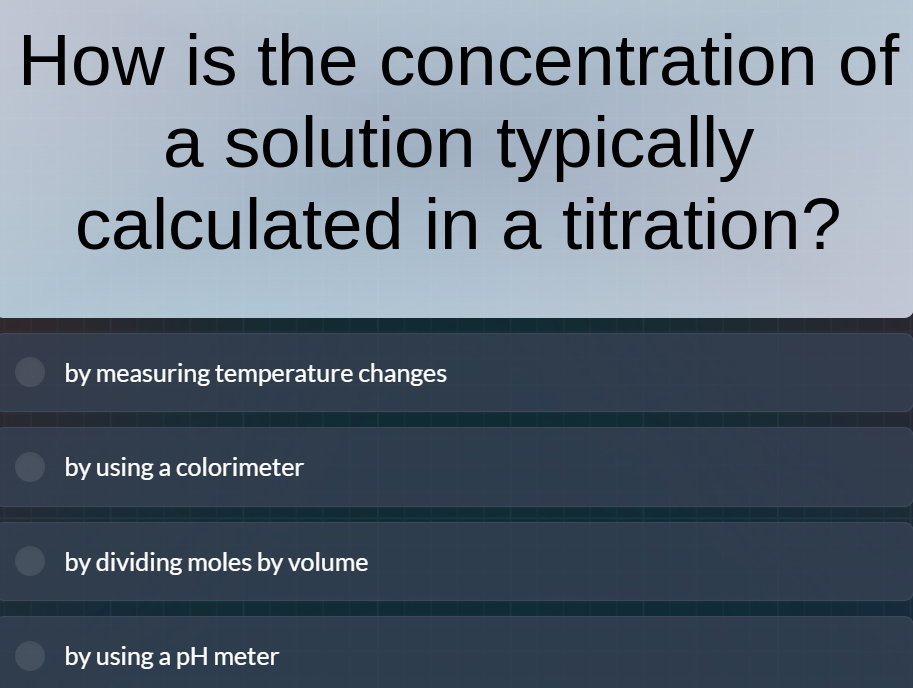
how is the concentration of a solution typically calculated in a titration? by measuring temperature changes by using a colorimeter by dividing moles by volume by using a ph meter
Brief Explanations
To determine the correct option, we analyze each choice:
- Measuring temperature changes is related to calorimetry (heat changes in reactions), not titration concentration calculation.
- A colorimeter is used to measure the concentration of a solution based on its absorbance of light (Beer - Lambert Law), not directly for titration - based concentration calculation.
- The formula for molarity (a common measure of concentration) is $M=\frac{n}{V}$, where $M$ is molarity (concentration), $n$ is the number of moles of solute, and $V$ is the volume of the solution in liters. In a titration, once the moles of the titrant (or analyte) are known (from the stoichiometry of the reaction and the volume and concentration of the titrant used), and the volume of the analyte solution is known, the concentration of the analyte can be calculated by dividing moles by volume.
- A pH meter is used to measure the pH of a solution, which can be related to the concentration of acidic or basic solutions in some cases, but it is not the direct way to calculate the concentration in a titration. It may be used to determine the equivalence point in an acid - base titration, but not to calculate the concentration directly.

Snap & solve any problem in the app
Get step-by-step solutions on Sovi AI
Photo-based solutions with guided steps
Explore more problems and detailed explanations
by dividing moles by volume