QUESTION IMAGE
Question
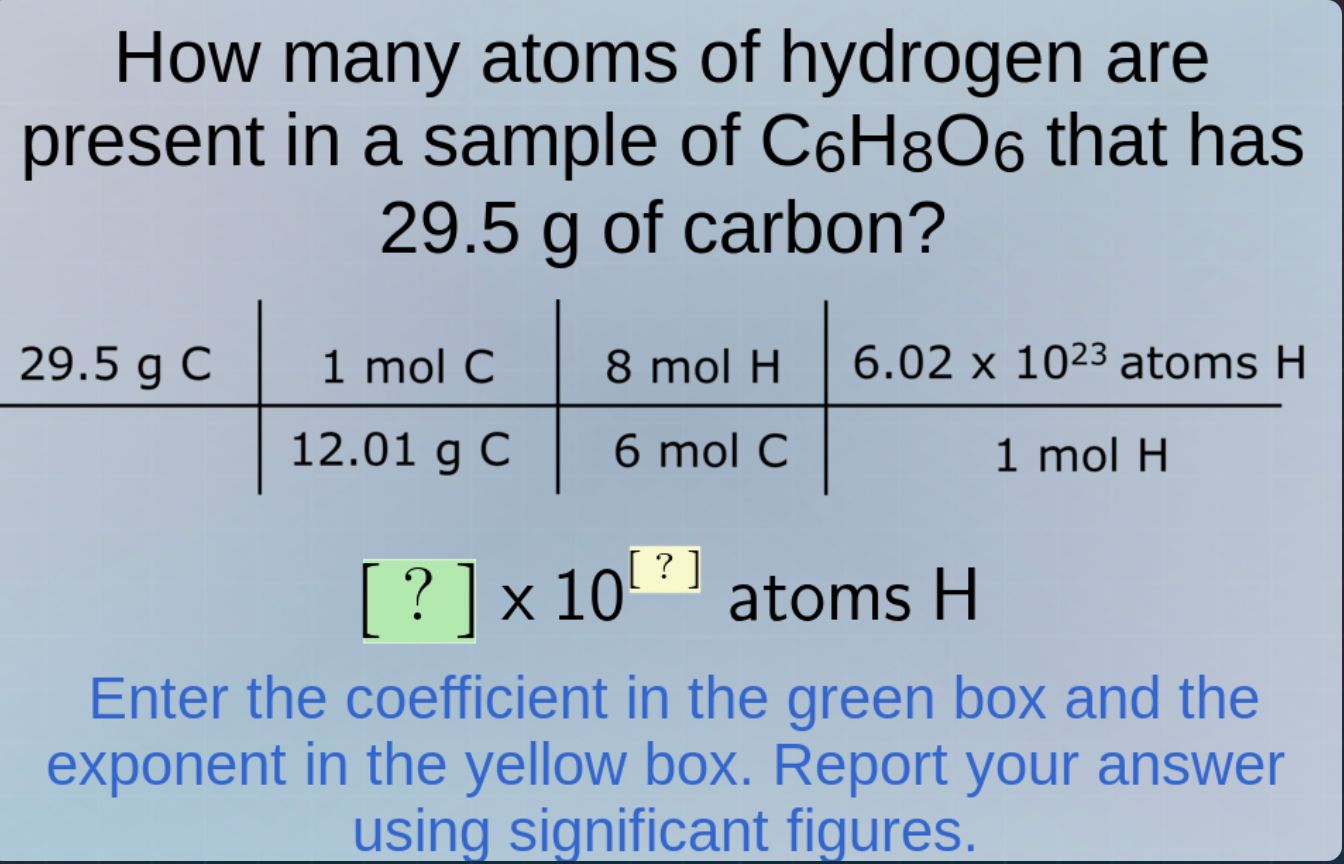
how many atoms of hydrogen are present in a sample of c₆h₈o₆ that has 29.5 g of carbon?
29.5 g c | 1 mol c | 8 mol h | 6.02 x 10²³ atoms h
| 12.01 g c | 6 mol c | 1 mol h |
? x 10^? atoms h
enter the coefficient in the green box and the exponent in the yellow box. report your answer using significant figures.
Step1: Calculate moles of C
First, convert grams of C to moles. The molar mass of C is 12.01 g/mol. So, moles of C = $\frac{29.5\ g}{12.01\ g/mol}$.
Step2: Relate moles of C to moles of H
In $\ce{C6H8O6}$, the mole ratio of H to C is $\frac{8\ mol\ H}{6\ mol\ C}$. Multiply moles of C by this ratio to get moles of H.
Step3: Convert moles of H to atoms of H
Use Avogadro's number ($6.02\times10^{23}$ atoms/mol) to convert moles of H to atoms. Multiply moles of H by $6.02\times10^{23}$ atoms/mol.
Putting it all together:
\[
\]
Wait, let's recalculate more accurately:
First, $\frac{29.5}{12.01} \approx 2.456\ mol\ C$
Then, $\frac{8}{6} \times 2.456\ mol\ C = \frac{4}{3} \times 2.456 \approx 3.275\ mol\ H$
Then, $3.275\ mol\ H \times 6.02\times10^{23}\ atoms/mol \approx 3.275\times6.02\times10^{23} \approx 19.7155\times10^{23} = 1.97\times10^{24}$ (adjusting significant figures: 29.5 has 3 sig figs, 12.01 has 4, 8 and 6 are exact, 6.02e23 has 3. So the result should have 3 sig figs.)
Wait, let's do the calculation step by step with the given conversion factors:
$29.5\ g\ C \times \frac{1\ mol\ C}{12.01\ g\ C} = \frac{29.5}{12.01} \approx 2.456\ mol\ C$
$2.456\ mol\ C \times \frac{8\ mol\ H}{6\ mol\ C} = 2.456\times\frac{8}{6} \approx 3.275\ mol\ H$
$3.275\ mol\ H \times 6.02\times10^{23}\ atoms\ H/mol\ H = 3.275\times6.02\times10^{23} \approx 19.7155\times10^{23} = 1.97\times10^{24}$ (when rounded to 3 significant figures, since 29.5 has 3, 12.01 has 4, but the least number of significant figures in the given data for multiplication/division is 3 from 29.5 and 6.02e23 (3 sig figs). Wait, 6.02e23 has 3, 29.5 has 3, 12.01 has 4, 8 and 6 are exact. So the result should have 3 sig figs.
Wait, let's check the calculation again:
$29.5 \div 12.01 = 2.456286$
$2.456286 \times 8 = 19.65029$
$19.65029 \div 6 = 3.275048$
$3.275048 \times 6.02e23 = 3.275048\times6.02\times10^{23}$
$3.275048\times6.02 = 19.71579$
So $19.71579\times10^{23} = 1.971579\times10^{24} \approx 1.97\times10^{24}$ (3 sig figs)
Wait, but maybe I made a mistake in sig figs. Let's see: 29.5 (3), 12.01 (4), 8 (exact), 6 (exact), 6.02e23 (3). So the limiting is 3 sig figs. So the coefficient is 1.97 and the exponent is 24? Wait, no, wait:
Wait, $19.71579\times10^{23} = 1.971579\times10^{24}$, so the coefficient is approximately 1.97 (3 sig figs) and the exponent is 24.
Wait, but let's do the calculation with more precision:
$29.5 \times 8 \times 6.02 \div (12.01 \times 6)$
$29.5\times8 = 236$
$236\times6.02 = 236\times6 + 236\times0.02 = 1416 + 4.72 = 1420.72$
$12.01\times6 = 72.06$
$1420.72 \div 72.06 \approx 19.715$
So $19.715\times10^{23} = 1.9715\times10^{24} \approx 1.97\times10^{24}$ (3 sig figs)
So the coefficient is 1.97 and the exponent is 24.
Wait, but let's check the original problem's conversion factors. The user provided:
29.5 g C (1 mol C / 12.01 g C) (8 mol H / 6 mol C) * (6.02 x 10^23 atoms H / 1 mol H)
So multiplying all the numbers:
29.5 1 8 6.02 x 10^23 / (12.01 6 * 1)
Calculate numerator: 29.5 8 6.02 = 29.5 * 48.16 = 1420.72
Denominator: 12.01 * 6 = 72.…

Snap & solve any problem in the app
Get step-by-step solutions on Sovi AI
Photo-based solutions with guided steps
Explore more problems and detailed explanations
Green box: 1.97, Yellow box: 24