QUESTION IMAGE
Question
how can the shaded area below be calculated? (select all that apply) show your work here
Step1: Analyze each circle's shaded fraction
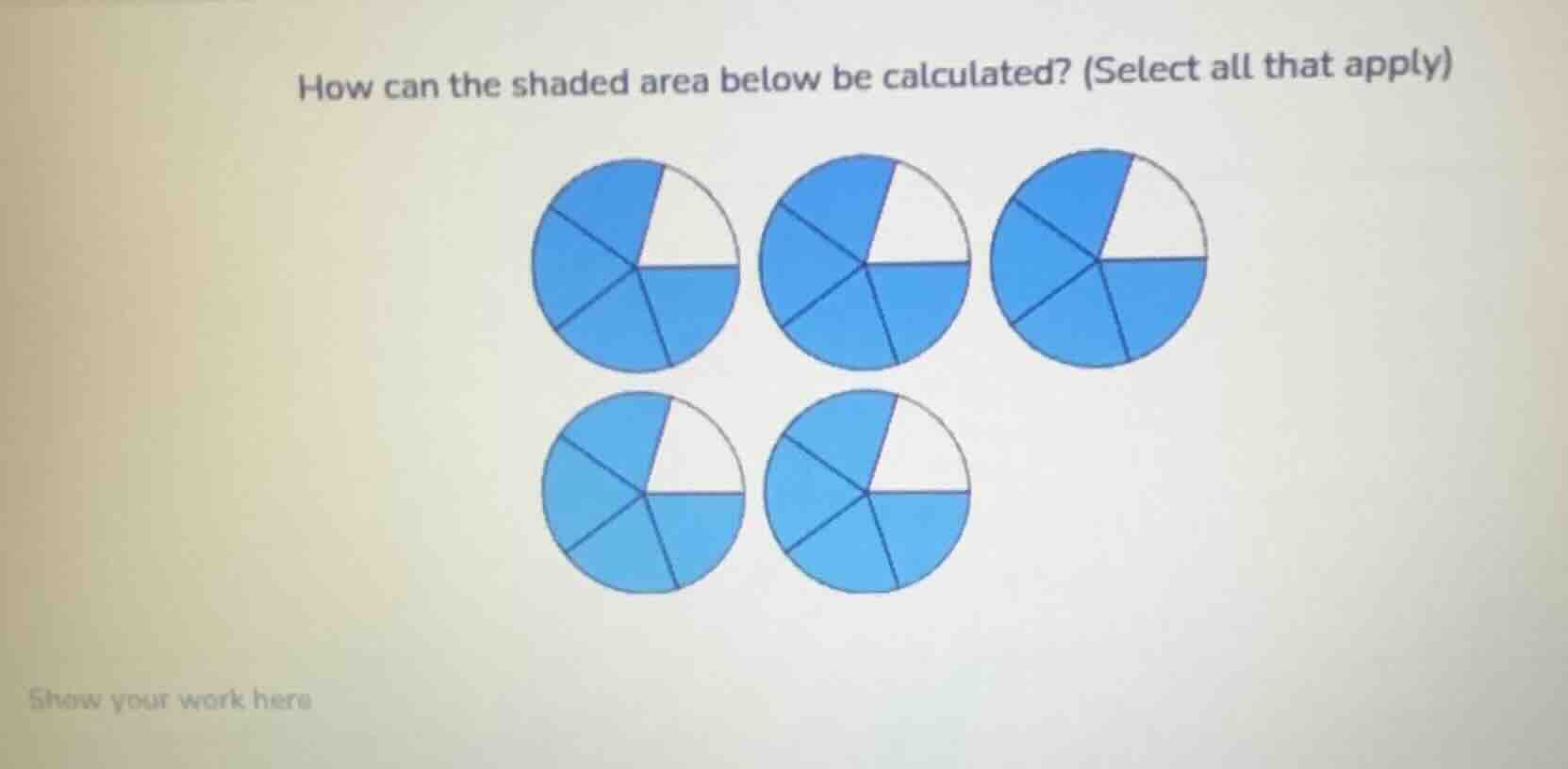
Each circle is divided into 6 equal parts, and the shaded parts in each circle: Let's see, the first three circles (top row) and the last two (bottom row). Wait, actually, looking at the sectors: each circle has a white sector of \( \frac{1}{6} \)? Wait no, wait the white part: let's count the shaded regions. Wait, maybe each circle has \( \frac{5}{6} \) shaded? Wait no, looking at the diagram: each circle has a white triangle - shaped sector? Wait, no, the circles are divided into 6 equal sectors? Wait, no, maybe 6 sectors? Wait, the first circle: shaded sectors: let's count. Wait, maybe each circle has \( \frac{5}{6} \) shaded? Wait, no, let's check the number of circles. There are 5 circles? Wait, top row: 3 circles, bottom row: 2 circles. Total 5 circles. Each circle: let's see the shaded area. Let's assume each circle is a unit circle (area \( A \) per circle). Wait, maybe each circle has \( \frac{5}{6} \) of its area shaded? Wait, no, looking at the diagram: each circle has a white sector that is \( \frac{1}{6} \)? Wait, no, maybe the white part is \( \frac{1}{6} \), so shaded is \( 1 - \frac{1}{6}=\frac{5}{6} \) per circle. Then total shaded area would be number of circles times shaded fraction per circle. Wait, number of circles: 5? Wait, top row: 3, bottom row: 2. So 5 circles. So total shaded area: \( 5\times\frac{5}{6}=\frac{25}{6} \)? Wait, no, maybe I miscounted. Wait, let's re - examine:
Wait, maybe each circle has 5 shaded sectors out of 6. So per circle, shaded fraction is \( \frac{5}{6} \). Number of circles: 5. So total shaded area: \( 5\times\frac{5}{6}=\frac{25}{6} \), or alternatively, sum the shaded fractions. Another way: if we consider each circle's shaded area as \( \frac{5}{6} \), then for 5 circles, it's \( 5\times\frac{5}{6} \), or we can think of it as \( 3\times\frac{5}{6}+2\times\frac{5}{6}=(3 + 2)\times\frac{5}{6}=5\times\frac{5}{6} \).
Alternatively, maybe the white sector is \( \frac{1}{6} \), so shaded is \( \frac{5}{6} \) per circle. So total shaded area: number of circles \( \times\frac{5}{6} \). Since there are 5 circles, total shaded area is \( 5\times\frac{5}{6}=\frac{25}{6} \), or \( 4\frac{1}{6} \).
Wait, maybe the problem is about calculating the total shaded area of 5 circles, each with \( \frac{5}{6} \) shaded. So the methods to calculate:
- Multiply the number of circles (5) by the shaded fraction per circle (\( \frac{5}{6} \)): \( 5\times\frac{5}{6} \).
- Sum the shaded fractions: \( \frac{5}{6}+\frac{5}{6}+\frac{5}{6}+\frac{5}{6}+\frac{5}{6}=5\times\frac{5}{6} \) (using repeated addition, which is multiplication).
So the ways to calculate the shaded area are:
- Multiply the number of circles (5) by the shaded fraction per circle (\( \frac{5}{6} \)): \( 5\times\frac{5}{6} \).
- Add the shaded fraction (\( \frac{5}{6} \)) five times: \( \frac{5}{6}+\frac{5}{6}+\frac{5}{6}+\frac{5}{6}+\frac{5}{6} \), which is equivalent to \( 5\times\frac{5}{6} \) by the definition of multiplication (repeated addition).

Snap & solve any problem in the app
Get step-by-step solutions on Sovi AI
Photo-based solutions with guided steps
Explore more problems and detailed explanations
If we assume each circle has a shaded fraction of \( \frac{5}{6} \) and there are 5 circles, the shaded area can be calculated as \( 5\times\frac{5}{6}=\frac{25}{6} \) (or \( 4\frac{1}{6} \)) by multiplying the number of circles by the shaded fraction per circle, or by adding \( \frac{5}{6} \) five times.