QUESTION IMAGE
Question
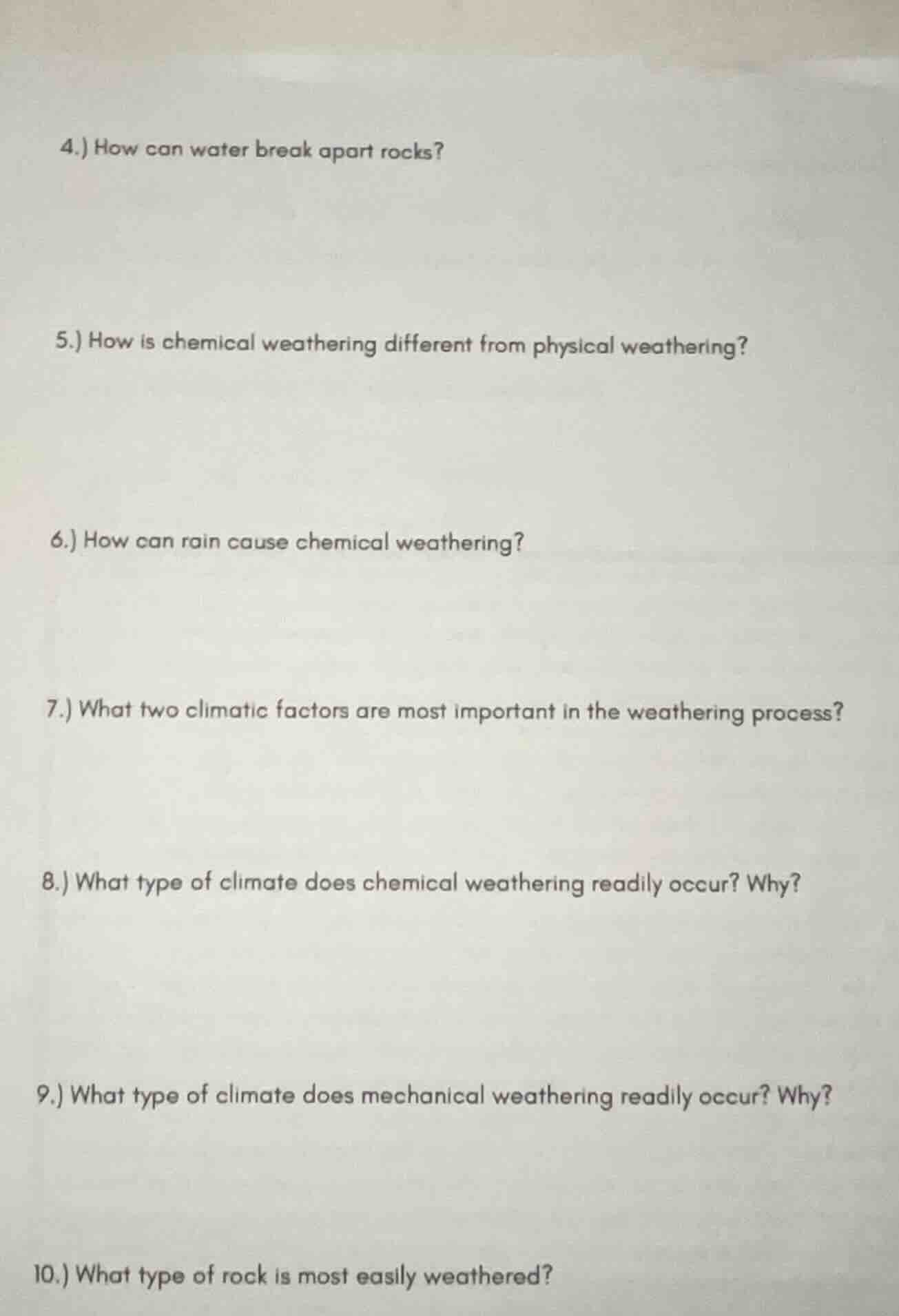
4.) how can water break apart rocks?
5.) how is chemical weathering different from physical weathering?
6.) how can rain cause chemical weathering?
7.) what two climatic factors are most important in the weathering process?
8.) what type of climate does chemical weathering readily occur? why?
9.) what type of climate does mechanical weathering readily occur? why?
10.) what type of rock is most easily weathered?
Question 4: How can water break apart rocks?
Water can break rocks through physical (mechanical) weathering processes. One way is freeze - thaw action: when water seeps into cracks in rocks and then freezes, water expands as it freezes (about 9% increase in volume). This expansion exerts pressure on the rock cracks, widening them. Repeated freezing and thawing cycles can cause the rock to break apart. Another way is abrasion: moving water (like in rivers) carries sediment and rocks. These particles collide with other rocks, wearing them down and breaking them into smaller pieces. Also, in chemical weathering, water can react with minerals in rocks. For example, water can dissolve soluble minerals (like halite) in rocks, weakening the rock structure and making it more prone to breaking.
- Physical Weathering: It involves the breakdown of rocks into smaller pieces without changing the chemical composition of the rock. Processes include freeze - thaw (water freezing in cracks), abrasion (rock - rock or sediment - rock collisions), exfoliation (due to pressure release), and plant root growth (roots grow into cracks and expand them). The resulting fragments have the same chemical makeup as the original rock.
- Chemical Weathering: It changes the chemical composition of the rock. It involves reactions between rock minerals and substances like water, oxygen, carbon dioxide, and acids. For example, oxidation (iron - rich minerals react with oxygen to form rust - like compounds), hydrolysis (water reacts with minerals to form new minerals), and dissolution (minerals dissolve in water). New substances are formed, and the rock's chemical identity is altered.
Rainwater is not pure. It can absorb carbon dioxide from the atmosphere to form carbonic acid ($\ce{H_{2}O + CO_{2}\xlongequal{}H_{2}CO_{3}}$). This weak acid can react with carbonate - rich rocks (like limestone, which is mainly $\ce{CaCO_{3}}$). The reaction $\ce{CaCO_{3}+H_{2}CO_{3}\xlongequal{}Ca(HCO_{3})_{2}}$ occurs, and calcium bicarbonate is soluble in water. So, the rock is dissolved. Also, rain can carry other acidic compounds (like sulfuric acid from acid rain, formed from sulfur dioxide in the atmosphere). These acids react with minerals in rocks, breaking them down chemically. For example, sulfuric acid can react with feldspar minerals in rocks, altering their chemical structure.

Snap & solve any problem in the app
Get step-by-step solutions on Sovi AI
Photo-based solutions with guided steps
Explore more problems and detailed explanations
Water breaks rocks via freeze - thaw (physical: water in cracks freezes, expands, and widens cracks; repeated cycles break rocks), abrasion (physical: moving water - carried particles collide with rocks, wearing them down), and chemical weathering (e.g., dissolving soluble minerals, weakening rock structure).