QUESTION IMAGE
Question
hypothesize
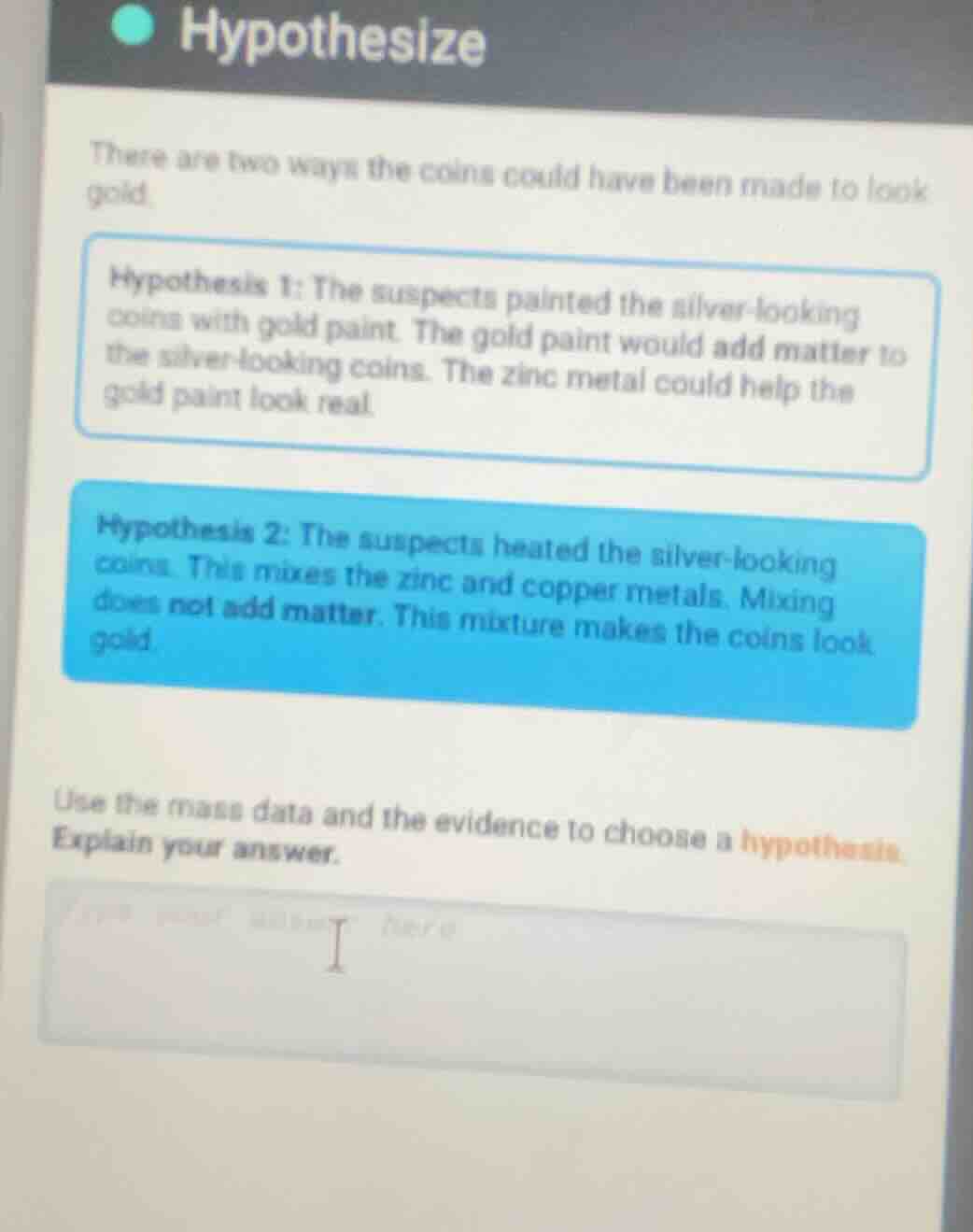
there are two ways the coins could have been made to look gold.
hypothesis 1: the suspects painted the silver - looking coins with gold paint. the gold paint would add matter to the silver - looking coins. the zinc metal could help the gold paint look real.
hypothesis 2: the suspects heated the silver - looking coins. this mixes the zinc and copper metals. mixing does not add matter. this mixture makes the coins look gold.
use the mass data and the evidence to choose a hypothesis.
explain your answer.
To determine the correct hypothesis, we analyze the mass change (or lack thereof). Hypothesis 1 involves adding gold paint (adding matter, so mass would increase). Hypothesis 2 involves heating (mixing metals, no matter added, so mass stays same as original silver - looking coins). If the mass of the "gold - looking" coins is equal to the original silver - looking coins, Hypothesis 2 is supported because heating (mixing zinc and copper) doesn't add matter. If mass increased, Hypothesis 1 (painting with gold paint, which adds matter) would be supported. Assuming typical data where mass doesn't change (since heating doesn't add matter), Hypothesis 2 is more likely as mixing metals via heating (like in a galvanic or alloy - like process with zinc and copper) creates a gold - like appearance without adding mass, while painting would add mass from the paint.

Snap & solve any problem in the app
Get step-by-step solutions on Sovi AI
Photo-based solutions with guided steps
Explore more problems and detailed explanations
Hypothesis 2 (The suspects heated the silver - looking coins. This mixes the zinc and copper metals. Mixing does not add matter. This mixture makes the coins look gold.) is the more likely hypothesis (assuming mass of the coins did not increase, as heating does not add matter while painting would add matter from the gold paint).