QUESTION IMAGE
Question
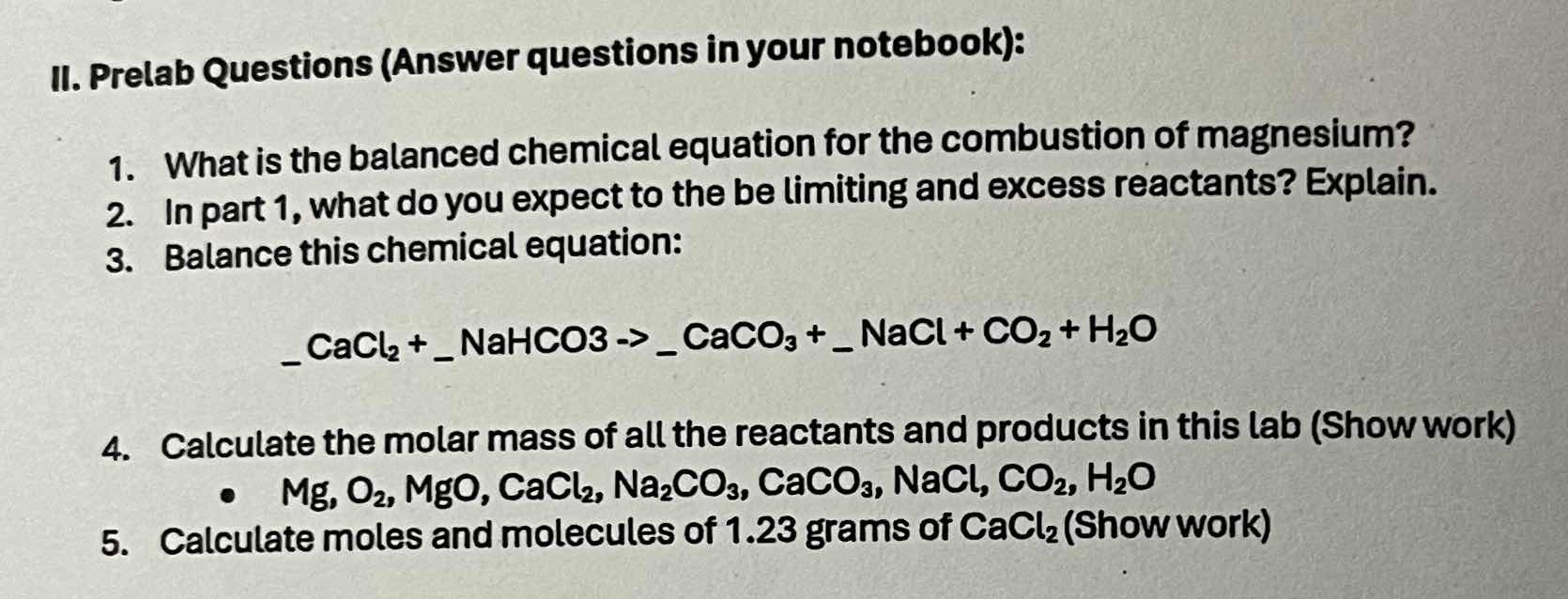
ii. prelab questions (answer questions in your notebook):
- what is the balanced chemical equation for the combustion of magnesium?
- in part 1, what do you expect to the be limiting and excess reactants? explain.
- balance this chemical equation:
_cacl₂ + _nahco3 -> _caco₃ + _nacl + co₂ + h₂o
- calculate the molar mass of all the reactants and products in this lab (show work)
- mg, o₂, mgo, cacl₂, na₂co₃, caco₃, nacl, co₂, h₂o
- calculate moles and molecules of 1.23 grams of cacl₂ (show work)
Step1: Balance Mg combustion equation
Magnesium reacts with oxygen to form magnesium oxide. Balance atoms:
Step2: Identify limiting/excess reactants
Combustion of Mg uses atmospheric $\text{O}_2$ (unlimited supply). Mg is the limiting reactant, $\text{O}_2$ is excess because $\text{O}_2$ is abundant in air, so Mg will be fully consumed first.
Step3: Balance given chemical equation
Match atom counts for each element:
- Balance Ca: 1 on left, so 1 for $\text{CaCO}_3$
- Balance Cl: 2 in $\text{CaCl}_2$, so 2 for $\text{NaCl}$
- Balance Na: 2 in $\text{NaCl}$, so 2 for $\text{NaHCO}_3$
- Verify C, H, O: 2 C from 2 $\text{NaHCO}_3$ matches 1 $\text{CaCO}_3$ + 1 $\text{CO}_2$; 2 H matches 1 $\text{H}_2\text{O}$; 6 O matches 3+2+1 O.
Step4: Calculate molar masses
Use atomic masses: Mg=24.305 g/mol, O=16.00 g/mol, Ca=40.08 g/mol, Cl=35.45 g/mol, Na=22.99 g/mol, C=12.01 g/mol, H=1.008 g/mol
- $\text{Mg}$: $24.305$ g/mol
- $\text{O}_2$: $2\times16.00 = 32.00$ g/mol
- $\text{MgO}$: $24.305 + 16.00 = 40.305$ g/mol
- $\text{CaCl}_2$: $40.08 + 2\times35.45 = 110.98$ g/mol
- $\text{Na}_2\text{CO}_3$: $2\times22.99 + 12.01 + 3\times16.00 = 105.99$ g/mol
- $\text{CaCO}_3$: $40.08 + 12.01 + 3\times16.00 = 100.09$ g/mol
- $\text{NaCl}$: $22.99 + 35.45 = 58.44$ g/mol
- $\text{CO}_2$: $12.01 + 2\times16.00 = 44.01$ g/mol
- $\text{H}_2\text{O}$: $2\times1.008 + 16.00 = 18.016$ g/mol
Step5: Calculate moles of $\text{CaCl}_2$
Moles = mass / molar mass
$$\text{Moles of } \text{CaCl}_2 = \frac{1.23\ \text{g}}{110.98\ \text{g/mol}} \approx 0.0111\ \text{mol}$$
Step6: Calculate molecules of $\text{CaCl}_2$
Molecules = moles $\times$ Avogadro's number ($6.022\times10^{23}$ mol$^{-1}$)
$$\text{Molecules} = 0.0111\ \text{mol} \times 6.022\times10^{23}\ \text{mol}^{-1} \approx 6.68\times10^{21}$$

Snap & solve any problem in the app
Get step-by-step solutions on Sovi AI
Photo-based solutions with guided steps
Explore more problems and detailed explanations
- $2\text{Mg} + \text{O}_2
ightarrow 2\text{MgO}$
- Limiting reactant: $\text{Mg}$; Excess reactant: $\text{O}_2$. Explanation: Atmospheric oxygen is infinitely abundant compared to the finite amount of magnesium used, so magnesium will be fully consumed first.
- $\text{CaCl}_2 + 2\text{NaHCO}_3
ightarrow \text{CaCO}_3 + 2\text{NaCl} + \text{CO}_2 + \text{H}_2\text{O}$
- Molar masses:
- $\text{Mg}$: 24.305 g/mol
- $\text{O}_2$: 32.00 g/mol
- $\text{MgO}$: 40.305 g/mol
- $\text{CaCl}_2$: 110.98 g/mol
- $\text{Na}_2\text{CO}_3$: 105.99 g/mol
- $\text{CaCO}_3$: 100.09 g/mol
- $\text{NaCl}$: 58.44 g/mol
- $\text{CO}_2$: 44.01 g/mol
- $\text{H}_2\text{O}$: 18.016 g/mol
- Moles of $\text{CaCl}_2$: $\approx 0.0111$ mol; Molecules of $\text{CaCl}_2$: $\approx 6.68\times10^{21}$