QUESTION IMAGE
Question
independent work
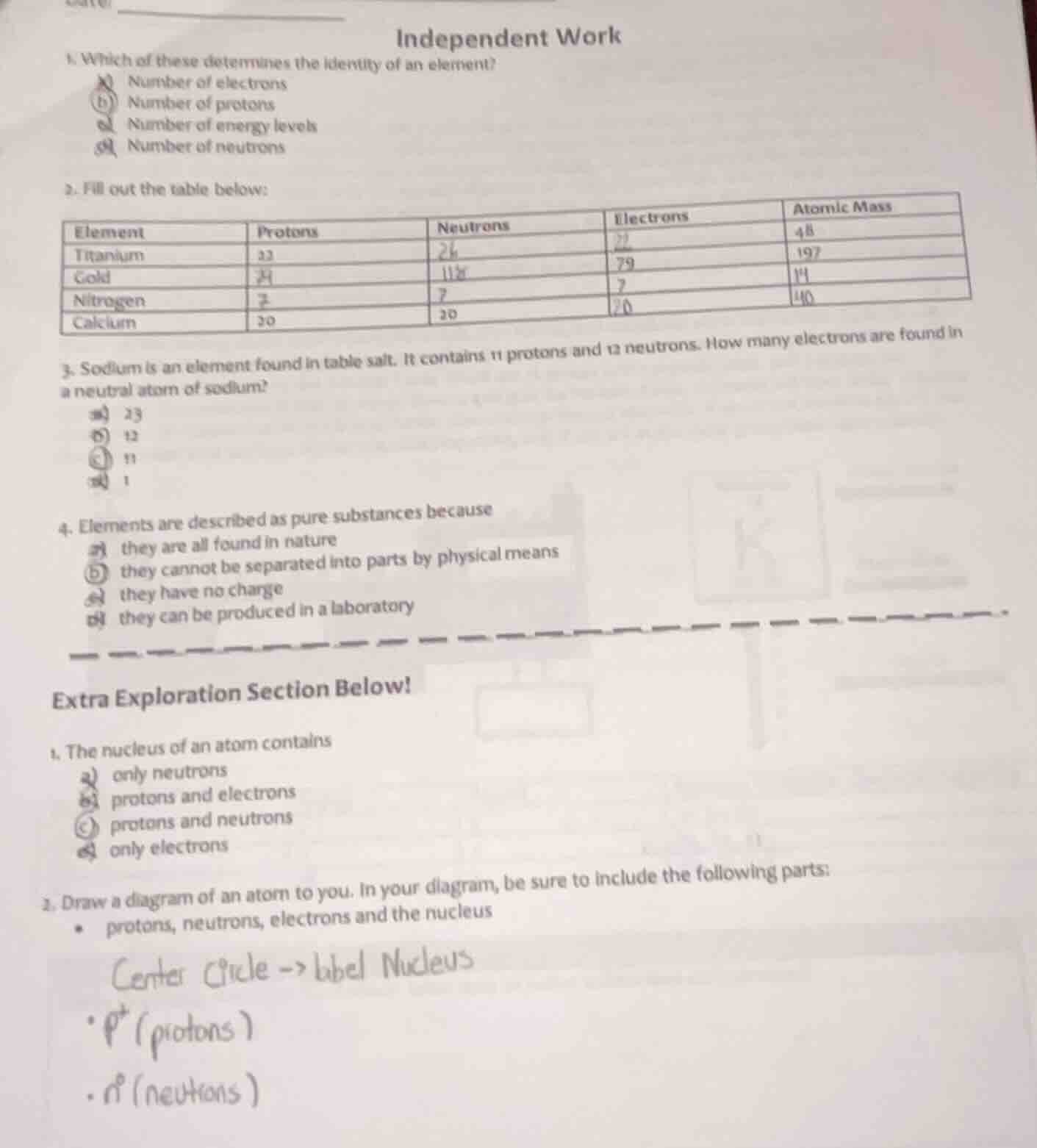
- which of these determines the identity of an element?
a) number of electrons
b) number of protons
c) number of energy levels
d) number of neutrons
- fill out the table below:
| element | protons | neutrons | electrons | atomic mass |
|---|---|---|---|---|
| gold | 79 | 197 | ||
| nitrogen | 14 | |||
| calcium | 20 | 20 |
- sodium is an element found in table salt. it contains 11 protons and 12 neutrons. how many electrons are found in a neutral atom of sodium?
a) 23
b) 12
c) 11
d) 1
- elements are described as pure substances because
a) they are all found in nature
b) they cannot be separated into parts by physical means
c) they have no charge
d) they can be produced in a laboratory
extra exploration section below!
- the nucleus of an atom contains
a) only neutrons
b) protons and electrons
c) protons and neutrons
d) only electrons
- draw a diagram of an atom to you. in your diagram, be sure to include the following parts:
- protons, neutrons, electrons and the nucleus
center circle -> label nucleus
- ( p^+ ) (protons)
- ( n^0 ) (neutrons)
Question 1
The identity of an element is determined by the number of protons (atomic number). Electrons can change in ions, energy levels vary, and neutrons change isotopes, but protons define the element.
Step1: Recall neutral atom electron-proton relation
In a neutral atom, number of electrons = number of protons.
Step2: Apply to sodium
Sodium has 11 protons, so electrons = 11.
Pure substances (elements/compounds) can’t be separated into simpler substances by physical means. Elements are pure as they have only one type of atom, and physical methods can’t split them. Other options are incorrect (e.g., not all elements are natural, charge isn’t related, production in lab doesn’t define purity).

Snap & solve any problem in the app
Get step-by-step solutions on Sovi AI
Photo-based solutions with guided steps
Explore more problems and detailed explanations
b. Number of protons
Question 2
To fill the table, we use:
- Electrons in neutral atom = Protons.
- Atomic Mass = Protons + Neutrons.
Titanium:
Neutrons = Atomic Mass - Protons = \( 48 - 22 = 26 \).
Electrons = Protons = \( 22 \).
Gold:
Protons = Electrons (neutral) = \( 79 \).
Neutrons = Atomic Mass - Protons = \( 197 - 79 = 118 \).
Nitrogen:
Protons (atomic number of N) = \( 7 \).
Neutrons = Atomic Mass - Protons = \( 14 - 7 = 7 \).
Electrons = Protons = \( 7 \).
Calcium:
Electrons = Protons = \( 20 \).
Atomic Mass = Protons + Neutrons = \( 20 + 20 = 40 \).
| Element | Protons | Neutrons | Electrons | Atomic Mass |
|---|---|---|---|---|
| Gold | 79 | 118 | 79 | 197 |
| Nitrogen | 7 | 7 | 7 | 14 |
| Calcium | 20 | 20 | 20 | 40 |