QUESTION IMAGE
Question
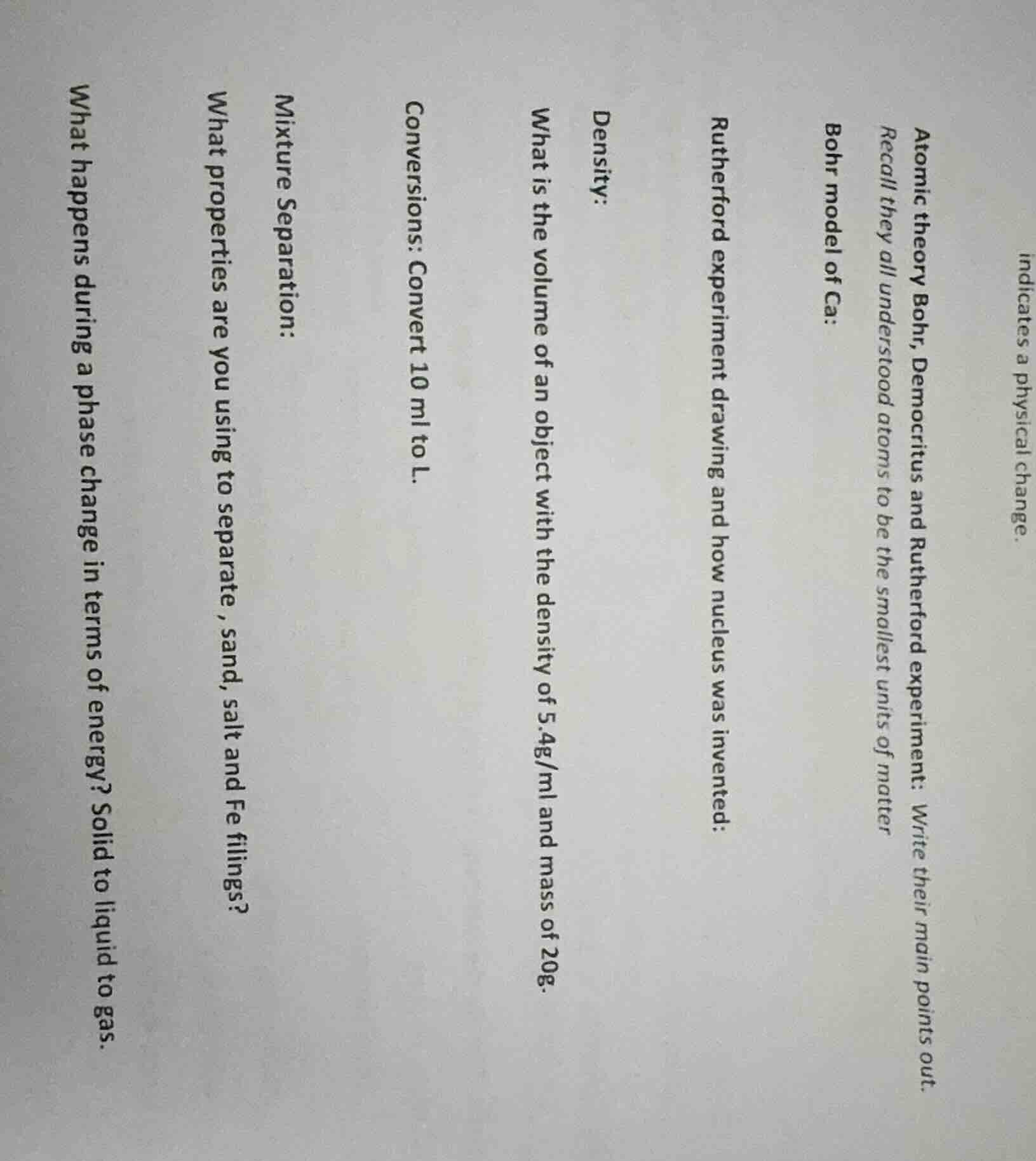
indicates a physical change.
atomic theory bohr, democritus and rutherford experiment: write their main points out.
recall they all understood atoms to be the smallest units of matter
bohr model of ca:
rutherford experiment drawing and how nucleus was invented:
density:
what is the volume of an object with the density of 5.4g/ml and mass of 20g.
conversions: convert 10 ml to l.
mixture separation:
what properties are you using to separate, sand, salt and fe filings?
what happens during a phase change in terms of energy? solid to liquid to gas.
- Atomic theory summaries:
- Democritus: Proposed matter is made of indivisible, indestructible tiny particles called atoms; different substances have different atom shapes/sizes.
- Bohr: Electrons orbit the nucleus in fixed, circular energy levels; electrons absorb/release energy to jump between levels.
- Rutherford experiment: Fired alpha particles at gold foil; most passed through, some deflected. This led to the discovery of the dense, positively charged atomic nucleus, as deflections showed concentrated positive mass at the atom's center.
- Bohr model of Ca: Calcium has an atomic number of 20. Its Bohr model has 4 energy levels: 2 electrons in the first level, 8 in the second, 8 in the third, and 2 in the outermost (fourth) level.
- Density calculation: Use the density formula rearranged to solve for volume.
- Unit conversion: Use the conversion factor 1 L = 1000 mL.
- Mixture separation properties: Use magnetism for iron filings, solubility for salt, and particle size for sand.
- Phase change energy: Energy is absorbed/released to break/form intermolecular forces without changing chemical identity.

Snap & solve any problem in the app
Get step-by-step solutions on Sovi AI
Photo-based solutions with guided steps
Explore more problems and detailed explanations
- Atomic theory main points:
- Democritus: Matter is made of indivisible, indestructible atoms; different atoms have different shapes and sizes.
- Bohr: Electrons occupy fixed, discrete circular energy levels (shells) around the nucleus; electrons absorb or emit energy when moving between levels.
- Rutherford experiment:
- Drawing: A source of alpha particles directed at a thin gold foil, surrounded by a fluorescent screen to detect deflected particles.
- Nucleus discovery: Most alpha particles passed straight through the foil, showing atoms are mostly empty space. A small fraction of particles were deflected at large angles, indicating a dense, positively charged central region (the nucleus) that repels the positively charged alpha particles.
- Bohr model of Ca: A central nucleus with 20 protons and 20 neutrons, surrounded by 4 electron shells: 2 electrons in the 1st shell, 8 in the 2nd, 8 in the 3rd, and 2 in the 4th (outer) shell.
- Density problem:
Step1: Rearrange density formula for volume
$\text{Volume} = \frac{\text{Mass}}{\text{Density}}$
Step2: Substitute given values
$\text{Volume} = \frac{20\ \text{g}}{5.4\ \text{g/ml}} \approx 3.70\ \text{ml}$