QUESTION IMAGE
Question
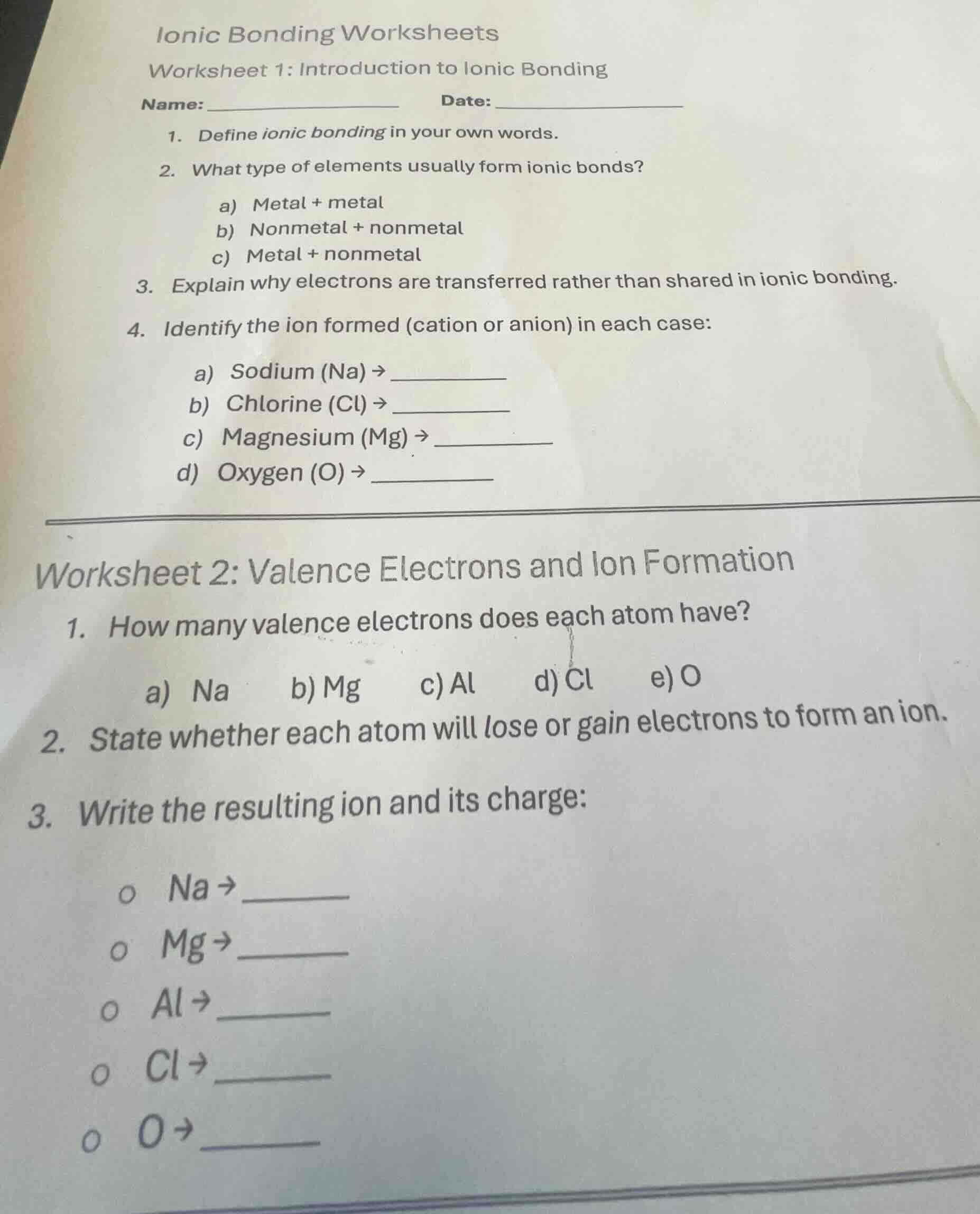
ionic bonding worksheets
worksheet 1: introduction to ionic bonding
name: _____________ date: _____________
- define ionic bonding in your own words.
- what type of elements usually form ionic bonds?
a) metal + metal
b) nonmetal + nonmetal
c) metal + nonmetal
- explain why electrons are transferred rather than shared in ionic bonding.
- identify the ion formed (cation or anion) in each case:
a) sodium (na) → _______
b) chlorine (cl) → _______
c) magnesium (mg) → _______
d) oxygen (o) → _______
worksheet 2: valence electrons and ion formation
- how many valence electrons does each atom have?
a) na b) mg c) al d) cl e) o
- state whether each atom will lose or gain electrons to form an ion.
- write the resulting ion and its charge:
- na → _______
- mg → _______
- al → _______
- cl → _______
- o → _______
Worksheet 1: Introduction to Ionic Bonding
- Defined based on electron transfer between atoms to form charged ions that attract.
- Ionic bonds form between elements with large differences in electronegativity, which are metals and nonmetals.
- Metals have low electronegativity (lose electrons easily), nonmetals have high electronegativity (gain electrons easily); the large difference means electrons are fully transferred instead of shared.
- Metals form positively charged cations; nonmetals form negatively charged anions.
Worksheet 2: Valence Electrons and Ion Formation
- Valence electrons correspond to the group number (for main group elements: Group 1=1, Group 2=2, Group 13=3, Group 17=7, Group 16=6).
- Metals lose valence electrons to reach a full outer shell; nonmetals gain valence electrons to reach a full outer shell.
- Ions are named by keeping the metal name for cations, changing nonmetal endings to "-ide", with charge based on electrons lost/gained.

Snap & solve any problem in the app
Get step-by-step solutions on Sovi AI
Photo-based solutions with guided steps
Explore more problems and detailed explanations
Worksheet 1: Introduction to Ionic Bonding
- Ionic bonding is a chemical bond formed when electrons are transferred from a metal atom to a nonmetal atom, creating positively charged cations and negatively charged anions that are attracted to each other.
- c) Metal + nonmetal
- Metals have very low electronegativity (they hold their valence electrons very weakly) and nonmetals have very high electronegativity (they strongly attract electrons). The large difference in electronegativity means the nonmetal pulls electrons completely away from the metal, rather than sharing them.
- a) Cation
b) Anion
c) Cation
d) Anion
Worksheet 2: Valence Electrons and Ion Formation
- a) 1
b) 2
c) 3
d) 7
e) 6
- a) Na: Lose electrons
b) Mg: Lose electrons
c) Al: Lose electrons
d) Cl: Gain electrons
e) O: Gain electrons
- $\text{Na}
ightarrow \text{Na}^+$
$\text{Mg}
ightarrow \text{Mg}^{2+}$
$\text{Al}
ightarrow \text{Al}^{3+}$
$\text{Cl}
ightarrow \text{Cl}^-$
$\text{O}
ightarrow \text{O}^{2-}$