QUESTION IMAGE
Question
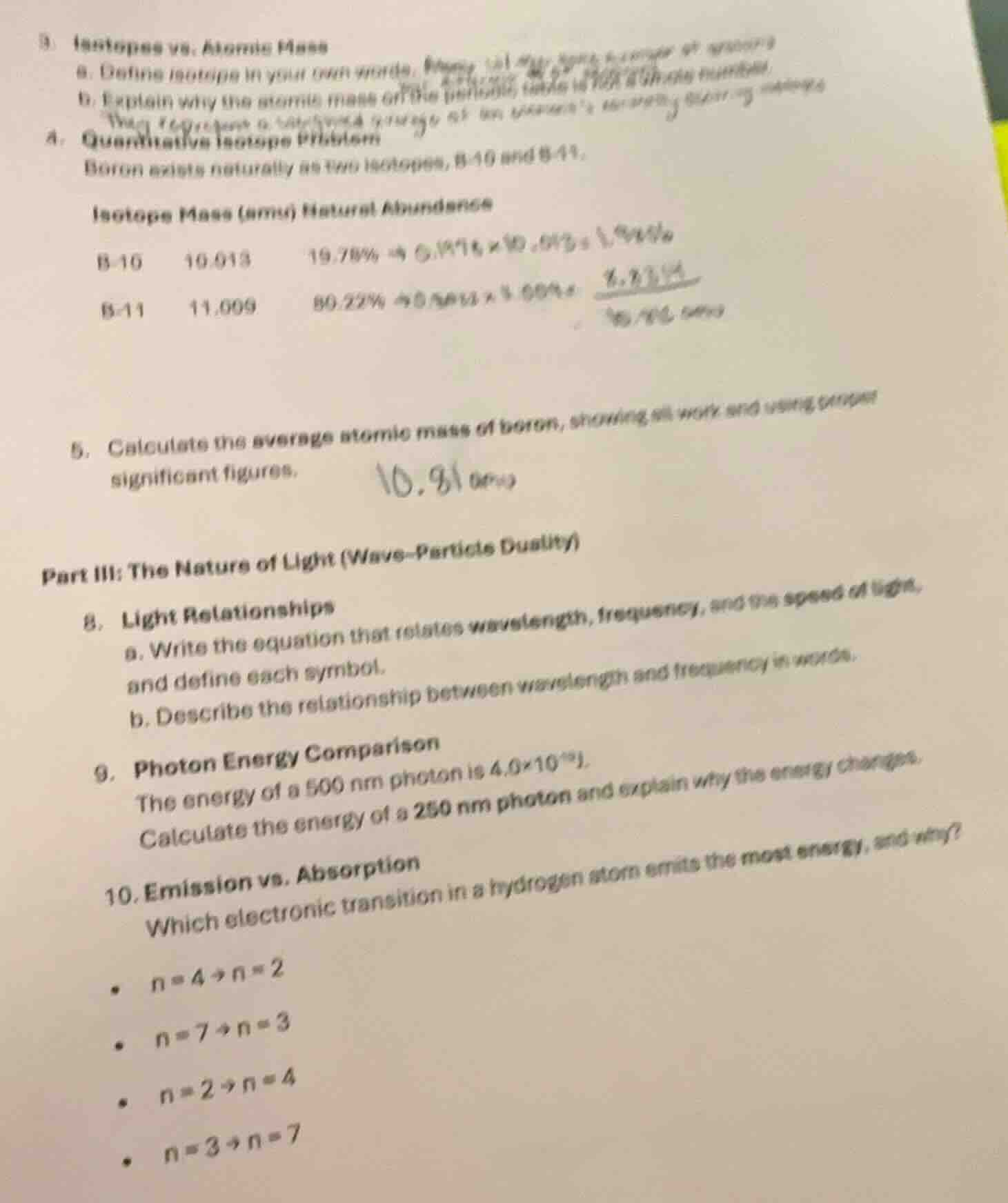
- isotopes vs. atomic mass
a. define isotope in your own words.
b. explain why the atomic mass of the periodic table is not a whole number.
a. quantitative isotope problem
boron exists naturally as two isotopes, b - 10 and b - 11.
isotope mass (amu) natural abundance
b - 10 10.013 19.78%
b - 11 11.009 80.22%
- calculate the average atomic mass of boron, showing all work and using correct significant figures.
part iii: the nature of light (wave - particle duality)
- light relationships
a. write the equation that relates wavelength, frequency, and the speed of light, and define each symbol.
b. describe the relationship between wavelength and frequency in words.
- photon energy comparison
the energy of a 500 nm photon is 4.0×10⁻¹⁹ j.
calculate the energy of a 250 nm photon and explain why the energy changes.
- emission vs. absorption
which electronic transition in a hydrogen atom emits the most energy, and why?
- n = 4 → n = 2
- n = 7 → n = 3
- n = 2 → n = 4
- n = 3 → n = 7
Question 3
a. An isotope is an atom of the same element (same proton count) with a different number of neutrons, so it has a different mass number.
b. The atomic mass on the periodic table is a weighted average of the masses of all an element's naturally occurring isotopes, accounting for their relative abundances, so it is not a whole number.
Step1: Convert % to decimals
$19.78\% = 0.1978$, $80.22\% = 0.8022$
Step2: Calculate isotope contributions
$\text{Contribution of B-10} = 0.1978 \times 10.013 = 1.9805714$
$\text{Contribution of B-11} = 0.8022 \times 11.009 = 8.8314198$
Step3: Sum contributions for average
$\text{Average atomic mass} = 1.9805714 + 8.8314198$
a. The core equation relates the three properties of light, with each symbol representing a specific measurable quantity.
b. Wavelength and frequency have an inverse relationship dictated by the constant speed of light.

Snap & solve any problem in the app
Get step-by-step solutions on Sovi AI
Photo-based solutions with guided steps
Explore more problems and detailed explanations
a. Isotopes are atoms of the same element with the same number of protons but different numbers of neutrons (different mass numbers).
b. Atomic mass is a weighted average of an element's naturally occurring isotopes' masses, so it is not a whole number.
---