QUESTION IMAGE
Question
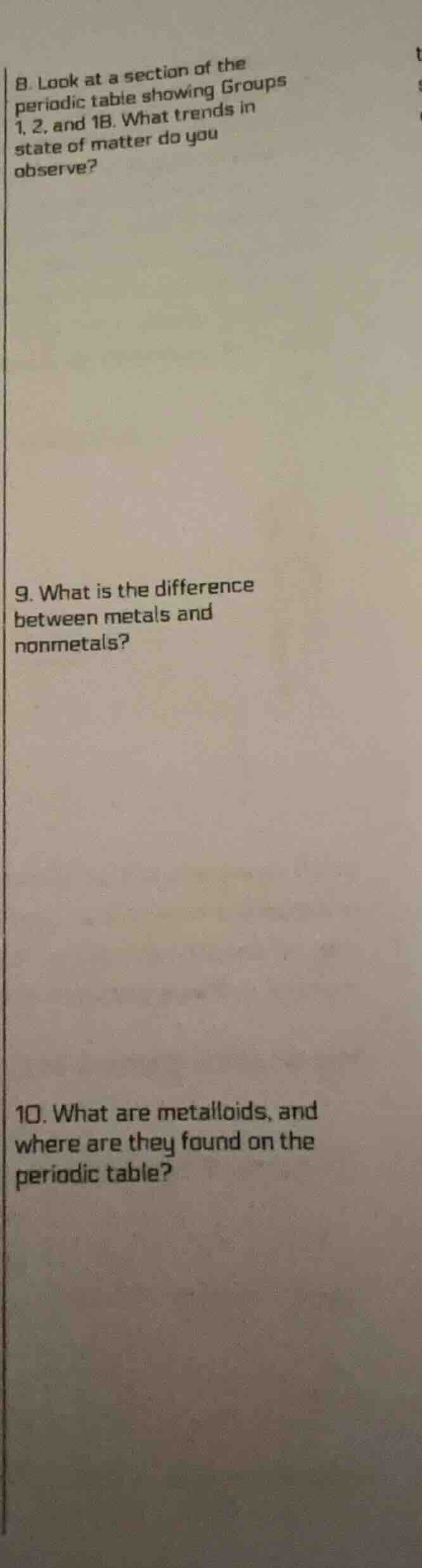
- look at a section of the periodic table showing groups 1, 2, and 18. what trends in state of matter do you observe?
- what is the difference between metals and nonmetals?
- what are metalloids, and where are they found on the periodic table?
For Question 8:
Groups 1 and 2 (alkali and alkaline earth metals) contain only solid elements at standard temperature and pressure (STP). Group 18 (noble gases) contains only gaseous elements at STP. The trend is that the leftmost groups (1,2) are solids, while the rightmost group (18) is gaseous.
For Question 9:
Metals are typically shiny, malleable, ductile, good conductors of heat and electricity, and tend to lose electrons in chemical reactions. Nonmetals are generally dull, brittle, poor conductors, and tend to gain or share electrons in reactions.
For Question 10:
Metalloids are elements that have properties intermediate between metals and nonmetals. They are found along the diagonal "staircase" line on the periodic table, separating metals from nonmetals (boron, silicon, germanium, arsenic, antimony, tellurium, polonium).

Snap & solve any problem in the app
Get step-by-step solutions on Sovi AI
Photo-based solutions with guided steps
Explore more problems and detailed explanations
- At standard conditions, all elements in Groups 1 and 2 are solids, while all elements in Group 18 are gases; the trend is a shift from solid (left) to gas (right) across these groups.
- Metals are shiny, malleable, ductile, good conductors, and lose electrons in reactions; nonmetals are dull, brittle, poor conductors, and gain/share electrons in reactions.
- Metalloids are elements with properties between metals and nonmetals; they lie along the diagonal "staircase" line that divides metals and nonmetals on the periodic table.