QUESTION IMAGE
Question
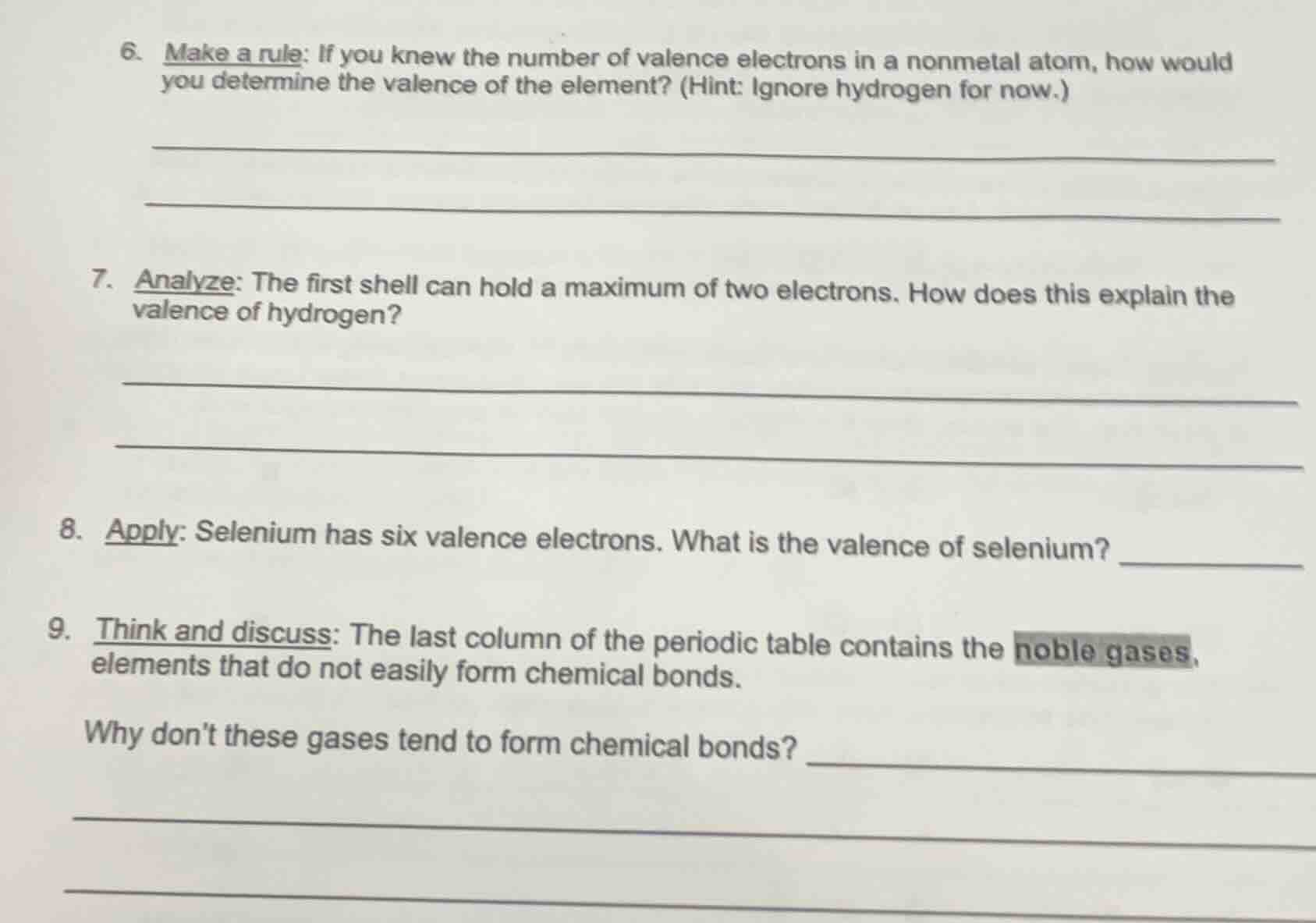
- make a rule: if you knew the number of valence electrons in a nonmetal atom, how would you determine the valence of the element? (hint: ignore hydrogen for now.)
- analyze: the first shell can hold a maximum of two electrons. how does this explain the valence of hydrogen?
- apply: selenium has six valence electrons. what is the valence of selenium?
- think and discuss: the last column of the periodic table contains the noble gases, elements that do not easily form chemical bonds.
why dont these gases tend to form chemical bonds?
Brief Explanations
- Nonmetals tend to gain electrons to reach a full valence shell (8 electrons, the octet rule). Subtract the number of valence electrons from 8 to get the valence, which equals the electrons the atom needs to gain for a full shell.
- Hydrogen's single shell holds max 2 electrons. Hydrogen has 1 valence electron, so it gains 1 electron to fill the shell, giving it a valence of 1.
- Use the rule from question 6: subtract selenium's 6 valence electrons from 8.
- Noble gases have a full valence shell (8 electrons, or 2 for helium). A full shell gives them stability, so they do not need to gain/lose electrons to form bonds.

Snap & solve any problem in the app
Get step-by-step solutions on Sovi AI
Photo-based solutions with guided steps
Explore more problems and detailed explanations
- For nonmetals (excluding H), valence = $8 - \text{number of valence electrons}$ (the number of electrons needed to fill the 8-electron valence shell).
- Hydrogen has 1 valence electron; its only shell holds a max of 2, so it gains 1 electron to fill the shell, giving it a valence of 1.
- 2
- Noble gases have a full, stable valence electron shell (8 electrons, or 2 for helium), so they do not need to gain, lose, or share electrons to form chemical bonds.