QUESTION IMAGE
Question
module 5
periodicity
you should be able to
- use the periodic table to locate elements, identify groups and their properties
- describe the trends in the periodic table – atomic radius, electronegativity, ionization energy, electron affinity, and ionic radius
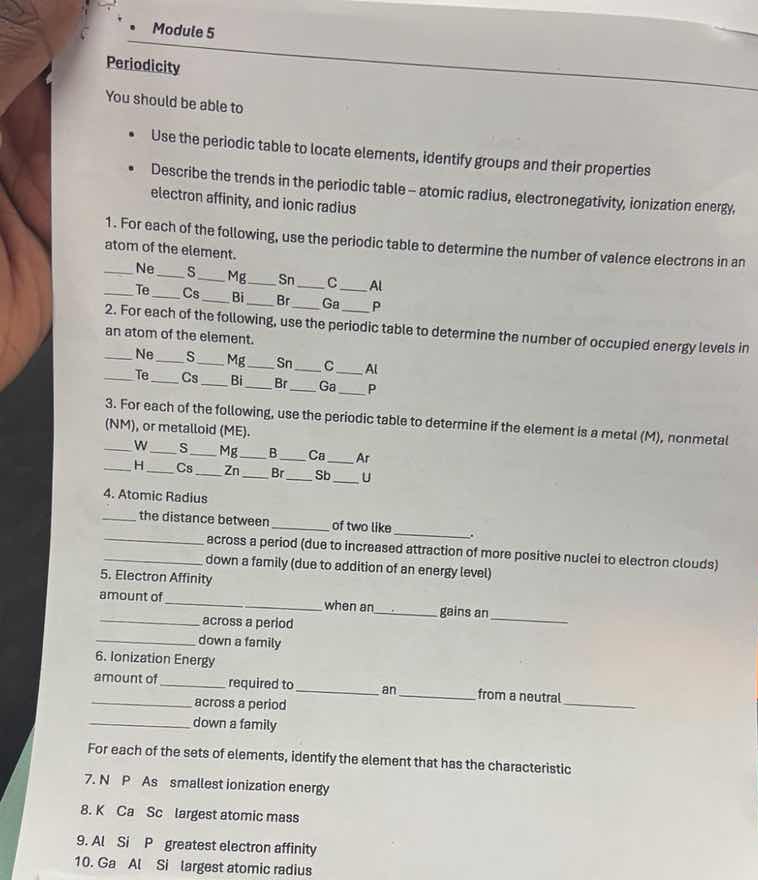
- for each of the following, use the periodic table to determine the number of valence electrons in an atom of the element.
_ ne _ s _ mg _ sn _ c _ al
_ te _ cs _ bi _ br _ ga _ p
- for each of the following, use the periodic table to determine the number of occupied energy levels in an atom of the element.
_ ne _ s _ mg _ sn _ c _ al
_ te _ cs _ bi _ br _ ga _ p
- for each of the following, use the periodic table to determine if the element is a metal (m), nonmetal (nm), or metalloid (me).
_ w _ s _ mg _ b _ ca _ ar
_ h _ cs _ zn _ br _ sb _ u
- atomic radius
_ the distance between _ of two like ___.
___ across a period (due to increased attraction of more positive nuclei to electron clouds)
___ down a family (due to addition of an energy level)
- electron affinity
amount of _ when an _ gains an ___
___ across a period
___ down a family
- ionization energy
amount of _ required to _ an _ from a neutral _
___ across a period
___ down a family
for each of the sets of elements, identify the element that has the characteristic
- n p as smallest ionization energy
- k ca sc largest atomic mass
- al si p greatest electron affinity
- ga al si largest atomic radius
Step1: Find valence electrons (Group #)
Valence electrons = main group number (for main group elements; transition metals: group 3-12, valence e⁻ vary, but Sn (14) has 4, Bi (15) has 5)
- Ne (18): 8; S (16): 6; Mg (2): 2; Sn (14): 4; C (14): 4; Al (13): 3
- Te (16): 6; Cs (1): 1; Bi (15): 5; Br (17): 7; Ga (13): 3; P (15): 5
Step2: Count occupied energy levels (Period #)
Occupied levels = period number of the element
- Ne (2): 2; S (3): 3; Mg (3): 3; Sn (5): 5; C (2): 2; Al (3): 3
- Te (5): 5; Cs (6): 6; Bi (6): 6; Br (4): 4; Ga (4): 4; P (3): 3
Step3: Classify metal/nonmetal/metalloid
Use periodic table regions: metals (left/center), nonmetals (right), metalloids (staircase)
- W (M); S (NM); Mg (M); B (ME); Ca (M); Ar (NM)
- H (NM); Cs (M); Zn (M); Br (NM); Sb (ME); U (M)
Step4: Define/describe atomic radius
Fill in key terms and trends:
- the distance between the nuclei of two like atoms
- Decreases across a period (due to increased attraction of more positive nuclei to electron clouds)
- Increases down a family (due to addition of an energy level)
Step5: Define/describe electron affinity
Fill in key terms and trends:
- amount of energy released/absorbed when an atom gains an electron
- Increases (becomes more negative) across a period
- Decreases (becomes less negative) down a family
Step6: Define/describe ionization energy
Fill in key terms and trends:
- amount of energy required to remove an electron from a neutral atom
- Increases across a period
- Decreases down a family
Step7: Find smallest ionization energy
Ionization energy decreases down a group: N, P, As (Group 15) → As is lowest
Step8: Find largest atomic mass
Atomic mass increases across a period: K, Ca, Sc (Period 4) → Sc is largest
Step9: Find greatest electron affinity
Electron affinity increases across a period (Group 13-15 to 17): Al, Si, P → Si (P has stable half-filled p-subshell, lower affinity)
Step10: Find largest atomic radius
Atomic radius increases down a group, decreases across period: Ga (4), Al (3), Si (3) → Ga is largest

Snap & solve any problem in the app
Get step-by-step solutions on Sovi AI
Photo-based solutions with guided steps
Explore more problems and detailed explanations
- Ne: 8; S: 6; Mg: 2; Sn: 4; C: 4; Al: 3; Te: 6; Cs: 1; Bi: 5; Br: 7; Ga: 3; P: 5
- Ne: 2; S: 3; Mg: 3; Sn: 5; C: 2; Al: 3; Te: 5; Cs: 6; Bi: 6; Br: 4; Ga: 4; P: 3
- W: M; S: NM; Mg: M; B: ME; Ca: M; Ar: NM; H: NM; Cs: M; Zn: M; Br: NM; Sb: ME; U: M
- the distance between the nuclei of two like atoms; Decreases across a period; Increases down a family
- amount of energy released/absorbed when an atom gains an electron; Increases (more negative) across a period; Decreases (less negative) down a family
- amount of energy required to remove an electron from a neutral atom; Increases across a period; Decreases down a family
- As
- Sc
- Si
- Ga