QUESTION IMAGE
Question
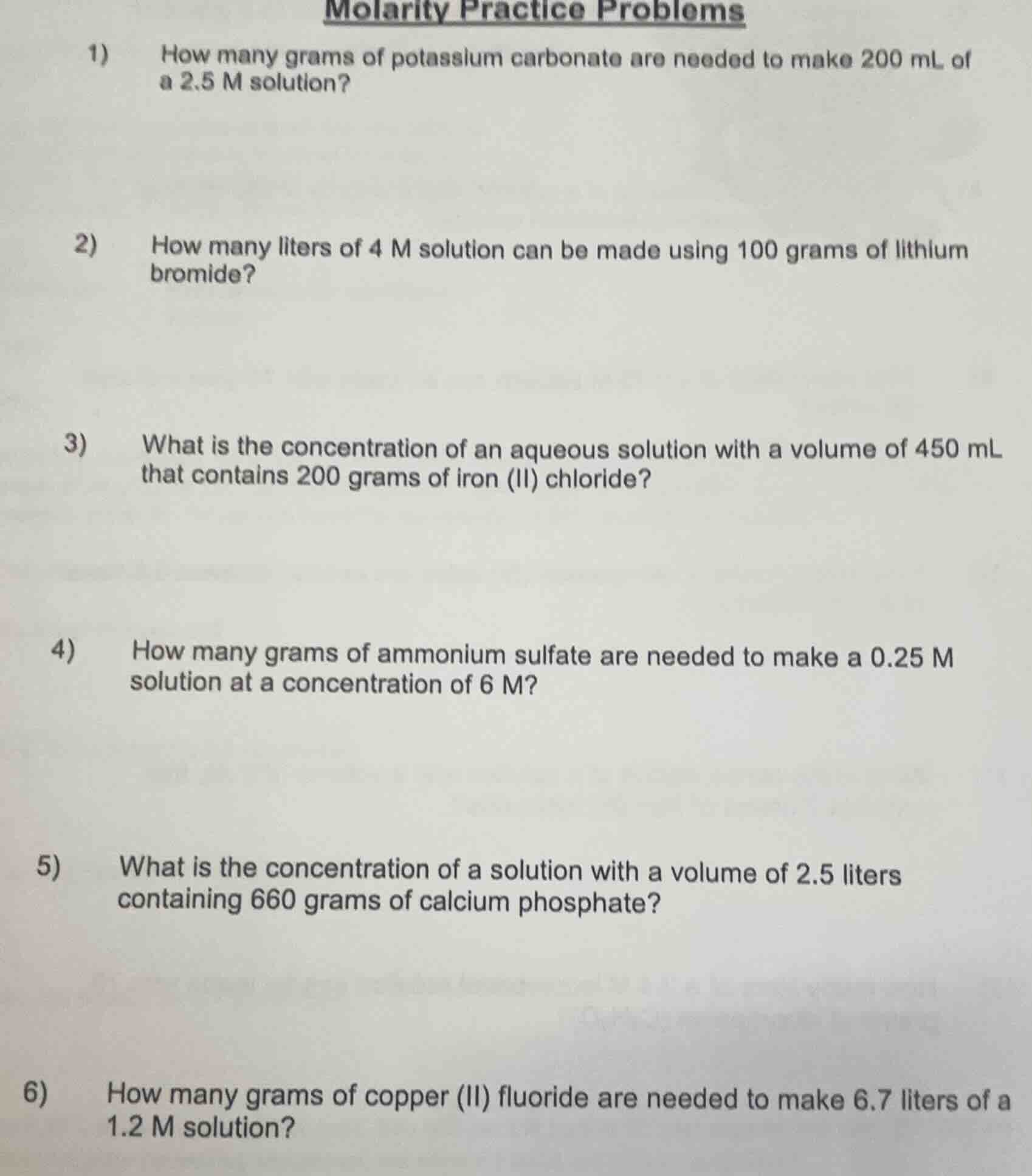
molarity practice problems
- how many grams of potassium carbonate are needed to make 200 ml of a 2.5 m solution?
- how many liters of 4 m solution can be made using 100 grams of lithium bromide?
- what is the concentration of an aqueous solution with a volume of 450 ml that contains 200 grams of iron (ii) chloride?
- how many grams of ammonium sulfate are needed to make a 0.25 m solution at a concentration of 6 m?
- what is the concentration of a solution with a volume of 2.5 liters containing 660 grams of calcium phosphate?
- how many grams of copper (ii) fluoride are needed to make 6.7 liters of a 1.2 m solution?
Problem 1
Step1: Convert volume to liters
$200\ \text{mL} = 0.2\ \text{L}$
Step2: Calculate moles of solute
Molarity formula: $n = M \times V$
$n = 2.5\ \text{mol/L} \times 0.2\ \text{L} = 0.5\ \text{mol}$
Step3: Find molar mass of $\text{K}_2\text{CO}_3$
$\text{Molar mass} = (2\times39.1) + 12.0 + (3\times16.0) = 138.2\ \text{g/mol}$
Step4: Calculate mass of solute
$m = n \times \text{molar mass}$
$m = 0.5\ \text{mol} \times 138.2\ \text{g/mol} = 69.1\ \text{g}$
---
Problem 2
Step1: Find molar mass of $\text{LiBr}$
$\text{Molar mass} = 6.94 + 79.90 = 86.84\ \text{g/mol}$
Step2: Calculate moles of solute
$n = \frac{m}{\text{molar mass}}$
$n = \frac{100\ \text{g}}{86.84\ \text{g/mol}} \approx 1.1516\ \text{mol}$
Step3: Calculate volume of solution
$V = \frac{n}{M}$
$V = \frac{1.1516\ \text{mol}}{4\ \text{mol/L}} \approx 0.29\ \text{L}$
---
Problem 3
Step1: Convert volume to liters
$450\ \text{mL} = 0.45\ \text{L}$
Step2: Find molar mass of $\text{FeCl}_2$
$\text{Molar mass} = 55.85 + (2\times35.45) = 126.75\ \text{g/mol}$
Step3: Calculate moles of solute
$n = \frac{200\ \text{g}}{126.75\ \text{g/mol}} \approx 1.578\ \text{mol}$
Step4: Calculate molarity
$M = \frac{n}{V}$
$M = \frac{1.578\ \text{mol}}{0.45\ \text{L}} \approx 3.51\ \text{M}$
---
Problem 4 (corrected: make 0.25 L of 6 M solution)
Step1: Calculate moles of solute
$n = M \times V$
$n = 6\ \text{mol/L} \times 0.25\ \text{L} = 1.5\ \text{mol}$
Step2: Find molar mass of $(\text{NH}_4)_2\text{SO}_4$
$\text{Molar mass} = (2\times(14.0+4\times1.0)) + 32.1 + (4\times16.0) = 132.1\ \text{g/mol}$
Step3: Calculate mass of solute
$m = n \times \text{molar mass}$
$m = 1.5\ \text{mol} \times 132.1\ \text{g/mol} = 198.15\ \text{g}$
---
Problem 5
Step1: Find molar mass of $\text{Ca}_3(\text{PO}_4)_2$
$\text{Molar mass} = (3\times40.08) + (2\times(30.97+(4\times16.0))) = 310.18\ \text{g/mol}$
Step2: Calculate moles of solute
$n = \frac{660\ \text{g}}{310.18\ \text{g/mol}} \approx 2.128\ \text{mol}$
Step3: Calculate molarity
$M = \frac{n}{V}$
$M = \frac{2.128\ \text{mol}}{2.5\ \text{L}} \approx 0.85\ \text{M}$
---
Problem 6
Step1: Calculate moles of solute
$n = M \times V$
$n = 1.2\ \text{mol/L} \times 6.7\ \text{L} = 8.04\ \text{mol}$
Step2: Find molar mass of $\text{CuF}_2$
$\text{Molar mass} = 63.55 + (2\times19.00) = 101.55\ \text{g/mol}$
Step3: Calculate mass of solute
$m = n \times \text{molar mass}$
$m = 8.04\ \text{mol} \times 101.55\ \text{g/mol} \approx 816.46\ \text{g}$

Snap & solve any problem in the app
Get step-by-step solutions on Sovi AI
Photo-based solutions with guided steps
Explore more problems and detailed explanations
- $69.1\ \text{grams}$
- $0.29\ \text{liters}$
- $3.51\ \text{M}$
- $198.15\ \text{grams}$
- $0.85\ \text{M}$
- $816.5\ \text{grams}$ (rounded)