QUESTION IMAGE
Question
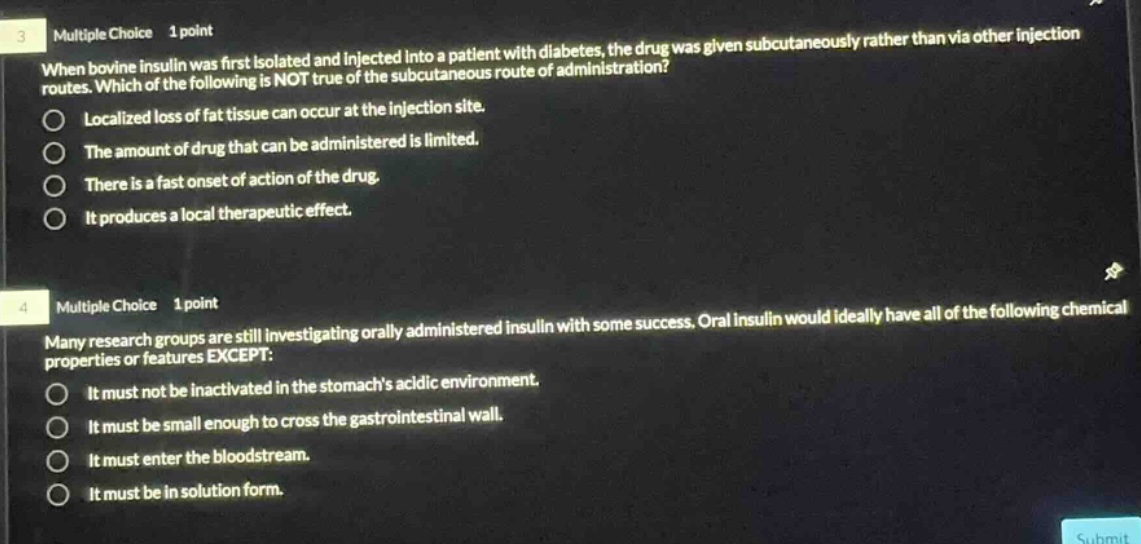
3 multiple choice 1 point when bovine insulin was first isolated and injected into a patient with diabetes, the drug was given subcutaneously rather than via other injection routes. which of the following is not true of the subcutaneous route of administration? localized loss of fat tissue can occur at the injection site. the amount of drug that can be administered is limited. there is a fast onset of action of the drug. it produces a local therapeutic effect. 4 multiple choice 1 point many research groups are still investigating orally administered insulin with some success. oral insulin would ideally have all of the following chemical properties or features except: it must not be inactivated in the stomachs acidic environment. it must be small enough to cross the gastrointestinal wall. it must enter the bloodstream. it must be in solution form.
Question 3
- For subcutaneous administration: Localized fat loss can occur (e.g., with some drugs over time), drug volume is limited (subcutaneous tissue has limited space), it can have local therapeutic effects (e.g., local anesthetics), but the onset is not fast (slower than intravenous, as drug is absorbed through tissue to blood). So "There is a fast onset of action of the drug" is not true.
- Oral insulin needs to survive stomach acid (so not inactivated), cross the GI wall (so small enough), enter the bloodstream (to act systemically), but it doesn't need to be in solution form (it can be in a formulation that dissolves in the GI tract or is absorbed as a solid - like some oral formulations). So "It must be in solution form" is the exception.

Snap & solve any problem in the app
Get step-by-step solutions on Sovi AI
Photo-based solutions with guided steps
Explore more problems and detailed explanations
C. There is a fast onset of action of the drug